Category
page 1UTC offsets

UTC+03:00
thumb|300px|UTC+03:00 – 2011: orange (DST Northern Hemisphere), yellow (year-round), light blue (sea areas)

UTC+01:00
UTC+01:00 is an identifier for a time offset from UTC of +01:00. In ISO 8601, the associated time would be written as 2019-02-07T23:28:34+01:00. It indicates a point of time meaning Greenwich Mean Time (GMT) plus one hour. It is synonym with Central European Time (CET).

UTC+02:00
UTC+02:00 is an identifier for a time offset from UTC of +02:00. In ISO 8601, the associated time would be written as 2020-11-08T23:41:45+02:00.

UTC+05:30
UTC+5:30 is an identifier for a time offset of 5 hours and 30 minutes ahead of Coordinated Universal Time. The Indian Standard Time, used in India, and the Sri Lanka Standard Time, followed in Sri Lanka, are based on the same. and Sri Lanka. It has the second-largest population among time zones, after UTC+08:00.
.png)
UTC+04:00
thumb|330px|UTC+04:00 – 2010: yellow (year-round), blue (DST Northern Hemisphere), light blue (sea areas)

UTC+07:00
UTC+07:00 is an identifier for a time offset from UTC of +07:00. In ISO 8601, the associated time would be written as . It is seven hours ahead of UTC, meaning that when the time in UTC is midnight (00:00), the time in areas using the time zone would be 07:00.

UTC+05:00
thumb|300px|UTC+05:00 2010: blue, yellow (year-round), light blue (sea areas)
thumb|Time zones of central Eurasia (numbers are hours ahead of [[UTC)]]

UTC+06:00
thumb|300px|UTC+06:00 – 2010: blue (December), orange (June), yellow (year-round), light blue (sea areas)

UTC±00:00
thumb|300px|UTC±00:00: black (January), orange (July), yellow (year-round), light blue (sea areas)

UTC−08:00
thumb|300px|UTC−08:00: blue (January), orange (July), yellow (year-round), light blue (sea areas)

UTC+08:00
300px|thumb|right|UTC+08:00 in 2024: yellow (observed year-round in all locations), light blue (sea areas)

UTC−05:00
thumb|300px|UTC−05:00: blue (January), orange (July), yellow (year-round), light blue (sea areas)

UTC−07:00
thumb|300px|UTC−07:00: blue (January), orange (July), yellow (year-round), light blue (sea areas)

UTC−03:00
UTC−03:00 is an identifier for a time offset from UTC of −03:00.

UTC+09:00
thumb|300px|UTC+09:00 in May 2018: blue (December), orange (June), yellow (year-round), light blue (sea areas)

UTC−06:00
thumb|300px|UTC−06:00: blue (January), orange (July), yellow (year-round), light blue (sea areas)
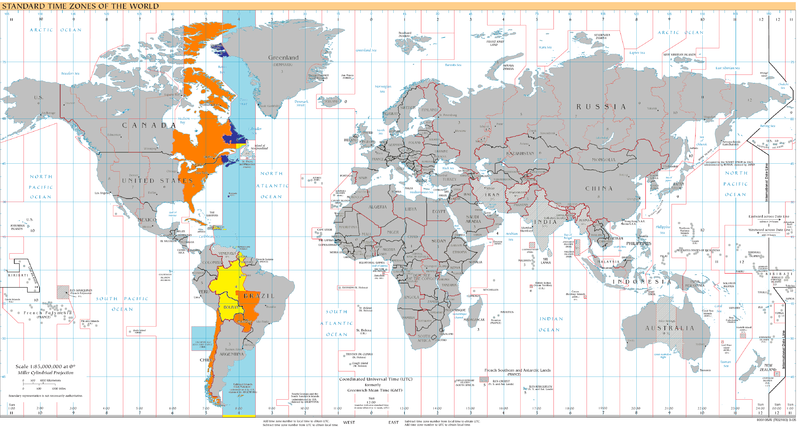
UTC−04:00
UTC−04:00 is an identifier for a time offset from UTC of −04:00.

UTC+10:00
thumb|300px|UTC+10:00: blue (December), orange (June), yellow (year-round), light blue (sea areas)

UTC+03:30
thumb|300px|GMT+03:30: blue (year-round)
UTC+03:30 is an identifier for a time offset from UTC of +03:30. In ISO 8601 the associated time would be written as . This time is used only in Iran, so it is also called Iran Standard Time.

UTC+11:00
thumb|300px|UTC+11:00: blue (December), orange (June), yellow (year-round), light blue (sea areas)

UTC−09:00
thumb|300px|UTC−09:00: blue (December), orange (June), yellow (year-round), light blue (sea areas)

UTC−11:00
thumb|300px|UTC−11:00: blue (December), orange (June), yellow (year-round), light blue (sea areas)
UTC−11:00 is an identifier for a time offset from UTC of −11:00. This time is used in Niue, American Samoa, Swains Island, and parts of the United States Minor Outlying Islands. This is the latest inhabited time zone, meaning this is the last inhabited time zone to celebrate the New Year, as the world's latest time zone (UTC-12:00) occurs only in strict nature reserves, such as Howland and Baker Island.

UTC−10:00
thumb|300px|UTC−10:00: blue (December), orange (June), yellow (year-round), light blue (sea areas)

UTC+06:30
300px|thumb|right|blue (December), orange (June), yellow (year-round), light blue (sea areas)

UTC+12:00
thumb|300px|UTC+12:00 in 2010: blue (December), orange (June), yellow (year-round), light blue (sea areas)

UTC+04:30
UTC+04:30 is an identifier for a time offset from UTC of +04:30.

UTC−02:00
thumb|300px|UTC−02:00: orange (July), yellow (year-round), light blue (sea areas)

UTC+14:00
UTC+14:00 is an identifier for a time offset from UTC of +14:00. This is the earliest time zone on Earth, meaning that areas in this zone are the first to see a new day, and therefore the first to enter a New Year. It is also referred to as the "latest time zone" on Earth, as clocks in it always show the 'latest' (i.e., most advanced) time of all time zones.

UTC−12:00
thumb|300px|UTC−12:00: blue (December), orange (June), yellow (year-round), light blue (sea areas)
UTC−12:00 is an identifier for a time offset from UTC of −12:00. It is the last to enter a New Year, and is sometimes referred to as the International Date Line West (IDLW) time zone.

UTC+05:45
thumb|300px|UTC+05:45: blue (December), orange (June), yellow (year-round), light blue (sea areas)
UTC+05:45 is an identifier for a time offset of 5 hours and 45 minutes ahead of Coordinated Universal Time. The Nepal Standard Time, used in Nepal is based on it. It is one of only three time zones with a 45-minute offset from UTC. Till 1986 Nepal followed UTC+05:30, same as Indian Standard Time and Sri Lanka Standard Time.

UTC+13:00
UTC+13:00 is an identifier for a time offset from UTC of +13:00. Because it does not contain any land in the Northern Hemisphere, this time zone is exclusive to the Southern Hemisphere.

UTC+09:30
thumb|300px|UTC+09:30: blue (December), orange (April), yellow (year-round), light blue (sea areas)

UTC−03:30
thumb|300px|UTC−03:30: blue (December), orange (June), yellow (year-round), light blue (sea areas)
UTC−03:30 is an identifier for a time offset from UTC of −03:30. It is used in the Canadian province of Newfoundland and Labrador as Newfoundland Time Zone.

UTC−01:00
thumb|300px|UTC−01:00: blue (December), orange (June), yellow (year-round), light blue (sea areas)
UTC+08:30
UTC+08:30 is an identifier for a time offset from UTC of +08:30.

UTC−09:30
thumb|300px|UTC−09:30: blue (December), orange (June), yellow (year-round), light blue (sea areas)
UTC−09:30 is an identifier for a time offset from UTC of −09:30. This time is used on the Marquesas Islands in French Polynesia.

UTC+12:45
thumb|300px|UTC+12:45: blue (December), orange (June), yellow (year-round), light blue (sea areas)

UTC+10:30
thumb|UTC+10:30: blue (January), orange (July), yellow (year-round), light blue (sea areas)

UTC+13:45
thumb|300px|UTC+13:45: blue (December), orange (June), yellow (year-round), light blue (sea areas)

UTC−04:30
UTC−04:30 is an identifier for a time offset from UTC of −04:30.
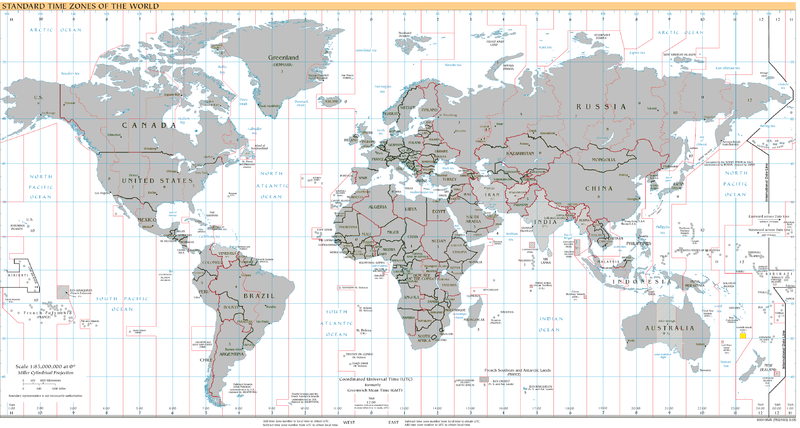
UTC+11:30
UTC+11:30 is an identifier for a time offset from UTC of +11:30. It is no longer in use as of 2015.

UTC−02:30
thumb|300px|UTC−02:30: blue (December), orange (June), yellow (year-round), light blue (sea areas)
UTC−02:30 is an identifier for a time offset from UTC of −02:30.

UTC+08:45
thumb|Sign on the Eyre highway indicating the start of the unofficial Australian Central Western Time Zone
UTC+08:45 is an identifier for a time offset from UTC of +08:45.
UTC+07:20
UTC+07:20 is an identifier for a time offset from UTC of +07:20.
UTC+04:51
UTC+04:51 is an identifier for a time offset from UTC of +04:51.
UTC+00:20
UTC+00:20 is an identifier for a time offset from UTC of +00:20.
UTC+07:30
UTC+07:30 is an identifier for a time offset from UTC of +07:30.
UTC+05:40
UTC+05:40 is an identifier for a time offset from UTC of +05:40. It is not currently used in any region in the world, but it was formerly used in Nepal.
UTC+00:30
UTC+00:30 is an identifier for a time offset from UTC of +00:30.
UTC−00:25:21
UTC−00:25:21 is an identifier for a time offset from UTC of −00:25:21, i.e. twenty-five minutes and twenty-one seconds behind Greenwich Mean Time. This time, known as Dublin Mean Time, is local mean time at Dunsink Observatory and was official time in Ireland between 1880 and 1916.
UTC−00:44
UTC−00:44 is an identifier for a time offset from UTC of −00:44.
UTC−08:30
UTC−08:30 is an identifier for a time offset from UTC of −08:30.
UTC−10:30
UTC−10:30 is an identifier for a time offset from UTC of −10:30.
UTC offset
difference in hours and minutes from UTC for a particular place and date
UTC+02:30
UTC+02:30 is an identifier for a time offset from UTC of +02:30. In ISO 8601 the associated time would be written as .
UTC+01:30
UTC+01:30 is an identifier for a time offset from UTC of +01:30.
UTC+01:24
UTC+01:24 is an identifier for a time offset from UTC of +01:24. In ISO 8601 the associated time would be written as .