Category
page 1Vaishnavism

Vishnu
Vishnu (; , , ), also known as Narayana and Hari, is one of the principal deities of Hinduism. He is the Supreme Being within Vaishnavism, one of the major traditions within contemporary Hinduism, and the god of preservation (sattva). Though not prominently represented in the Vedas Vishnu was possibly already a significant non-elite divine figure in early Vedic times. Vishnu rose to prominence in post-Vedic times, and was identified with various local traditions and deities, particularly the Bhāgavata-deities Vāsudeva-Krishna and Gopala-Krishna and the Pāñcarātra-deity Narayana, in the last ce

Krishna
Krishna (; Sanskrit: कृष्ण, ) is a major deity in Hinduism. He is worshipped as the eighth avatar of Vishnu and also as the Supreme God in his own right. He is the god of protection, compassion, tenderness, and love; and is widely revered among Hindu divinities. Krishna's birthday is celebrated every year by Hindus on Krishna Janmashtami according to the lunisolar Hindu calendar, which falls in late August or early September of the Gregorian calendar.

avatar
thumb|Hindu god Vishnu's ten major avatars (Balarama-Krishna version) [[Dasavatara shrine, 18th century ivory, National Museum, New Delhi]]
Vaishnavism
Vaishnavism (), also called Vishnuism, is one of the major Hindu religious traditions, that considers Vishnu as the supreme being leading all other Hindu deities, that is, Mahavishnu. It is one of the major Hindu denominations along with Shaivism, Shaktism, and Smartism. Its followers are called Vaishnavites or Vaishnavas (), and it includes sub-sects like Krishnaism and Ramaism, which consider Krishna and Rama as the supreme beings respectively.

Haridwar
Haridwar (; ; formerly Mayapuri) is a city and municipal corporation in the Haridwar district of Uttarakhand, India. With a population of 228,832 according to 2011 census, it is the second-largest city in the state and the largest in the district. Haridwar is located at the south western part of the state.

Madhvacharya
Madhvacharya (; ; 1199–1278 CE or 1238–1317 CE), also known as Purna Prajna () and Ānanda Tīrtha, was an Indian philosopher, theologian and the chief proponent of the Dvaita (dualism) school of Vedanta. Madhva called his philosophy Tattvavāda meaning "arguments from a realist viewpoint".
Madhvacharya was born at Pajaka near Udupi on the west coast of Karnataka state in 13th-century India. As a teenager, he became a Sanyasi (monk) joining Brahma-sampradaya guru Achyutapreksha, of the Ekadandi order. Madhva studied the classics of Hindu philosophy, and wrote commentaries on the Principal Upanish

Krishna Janmashtami
Annual commemoration in India on account of birth of the Hindu deity Lord Krishna

Hare Krishna
Vaishnava mantra
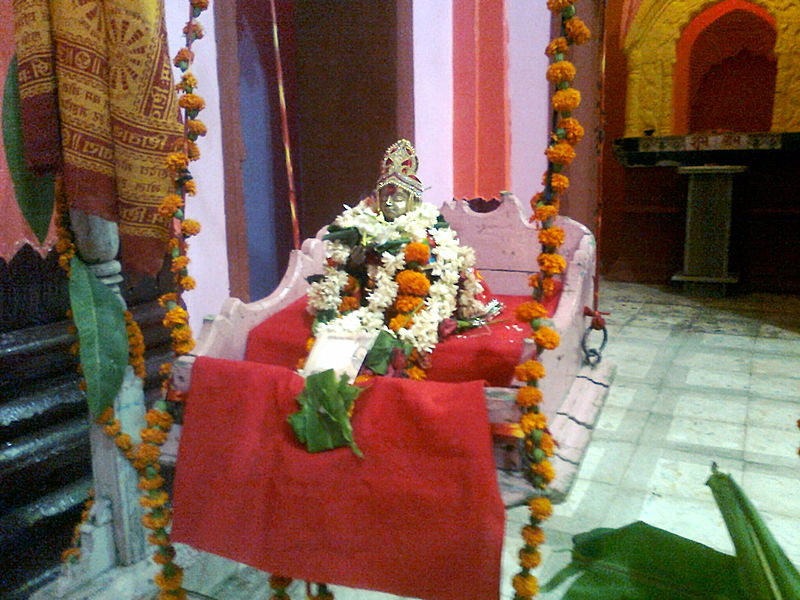
Rama Navami
spring festival that celebrates the birthday of the Hindu God Rama
Dashavatara
thumb|Hindu god [[Vishnu (centre) surrounded by his ten major avatars (Krishna-Buddha version). Anticlockwise from top left: Matsya; Kurma; Varaha; Narasimha; Vamana; Parashurama; Rama; Krishna; Buddha and Kalki]]

Śeṣa
Shesha (), also known by his epithets Sheshanaga () and Adishesha (), is a serpentine demigod (naga) and king of the serpents (Nagaraja), as well as a primordial being of creation in Hinduism. In the Puranas, Shesha is said to hold all the planets of the universe on his hoods and to constantly sing the glories of Vishnu from all his mouths. He is sometimes referred to as Ananta () or Ananta Shesha ().

Gita Govinda
poem by Jayadeva
Haridwar district
district of Uttarakhand, India

shaligram
thumb|upright=1.25|These ammonite fossils serve as a non-anthropomorphic symbol of Vishnu.

shankha
thumb|Carved conches or Vamavarta shankhas, , Pala Empire|Pala period, India: The leftmost one is carved with the image of [[Lakshmi and Vishnu, and has silver additions.]]
thumb|A shankha, 19th century
thumb|A Shankha (conch shell) with Vishnu emblem carved
Ranganathaswamy Temple, Srirangam
Hindu temple in Tamil Nadu, India

Vishishtadvaita
thumb|Ramanujacharya, who propounded the philosophy of Vishitadvaita Vedanta
Vishishtadvaita (IAST ''''; ) is a school of Hindu philosophy belonging to the Vedanta tradition. Vishishta Advaita means "non-duality with distinctions" and recognises Brahman (ब्रह्म) as the primordial quality while also acknowledging its existential multiplicity. This philosophy can be characterised as a form of qualified monism, or a qualified non-dualism. It upholds the belief that all diversity ultimately stems from a fundamental underlying unity.
Badrinath Temple
major Vishnu temple and pilgrimage site in Uttarakhand, India

Vaikuntha
thumb|300x300px|An illustration of Vaikuntha, presided over by Vishnu
Vaikuntha (), also called Vishnuloka (), is the abode of Vishnu, the supreme deity in the Vaishnava tradition of Hinduism, and his consort, Lakshmi, the supreme goddess of the sect.

Mayapur
Mayapur () is a pilgrimage town in the Nabadwip CD block in the Krishnanagar Sadar subdivision of the Nadia district, West Bengal, India. It is situated at the confluence of the Jalangi River and the Bhagirathi, a distributary of the Ganges. The area is considered spiritually significant by followers and devotees of Gaudiya Vaishnavism.
Nimbarkacharya
Nimbarka, also known as Nimbarkacharya, Nimbaditya or Niyamananda, was a Hindu philosopher, theologian and the chief proponent of the theology of Dvaitādvaita (dvaita–advaita) or dualistic–non-dualistic sometimes known as Svābhāvika bhedābheda. He played a major role in spreading the worship of the divine couple Radha and Krishna, and founded the Nimbarka Sampradaya.

Govinda
Govinda (, ), also rendered Govind, Gobinda, and Gobind, is an epithet of Vishnu and his avatars, such as Krishna. The name appears as the 187th and the 539th name of Vishnu in the Vishnu Sahasranama. The name is also popularly addressed to Krishna, referring to his youthful activity as a cowherd boy.

Goloka
thumb|Radha Krishna, queen and king of Goloka

Rasa lila
thumb|Krishna and [[Radha dancing the rasalila, a 19th-century painting, Rajasthan]]
The Raslila (), also rendered the Rasalila or the Ras dance, is part of a traditional story described in Hindu texts such as the Bhagavata Purana and Gita Govinda, where Krishna dances with Radha and the gopis of Braj. Rasalila has also been a popular theme for other India classical dances including Bharatanatyam, Odissi, Manipuri Raas Leela, Kuchipudi, and Kathak.

Krishnaism
Krishnaism is a term used in scholarly circles to describe large group of independent Hindu traditions—sampradayas related to Vaishnavism—that center on the devotion to Krishna as Svayam Bhagavan, Ishvara, Para Brahman, who is the source of all reality, not simply an avatar of Vishnu. This is its difference from such Vaishnavite groupings as Sri Vaishnavism, Sadh Vaishnavism, Ramaism, Radhaism, and Sitaism. There is also a personal Krishnaism, that is devotion to Krishna outside of any tradition and community, as in the case of the saint-poet Mirabai. Leading scholars do not define Krishnaism

Tattva
{| cellpadding=2 style="float:right" |
|
|}
Template:Vaishnavism
Wikimedia template
Anant Chaturdashi
Last day of Ganesh Chaturti in Nepal

Kaustubha
thumb|273x273px|Painting of Vishnu wearing the kaustubha, accompanied by Lakshmi|Sridevi, Bhudevi, and [[Niladevi]]
Radha Krishna
Divine couple in Hinduism
Tulsi Vivah
ceremonial marriage of the Tulsi plant (holy basil) to the Hindu god Vishnu or his Avatar Krishna

Radhastami
Radhashtami () is a Hindu festival commemorating the appearance anniversary of the goddess Radha, the chief consort of the god Krishna. It is celebrated in her birthplace, Barsana and the entire Braj region on the eighth day (ashtami) of the bright fortnight (Shukla Paksha) in the month of Bhadrapada in Anuradha Nakshatra at 12 noon in town of Barsana (Rawal), Uttar Pradesh, India. As per the Gregorian calendar, her birth date was believed to be 23 September 3221 BC - a Wednesday. Radhashtami falls fifteen days after Krishna Janmashtami.

Kaumodaki
thumb|Statue of Vishnu carrying the Kaumodaki in his lower left arm

Panchajanya
thumb|260x260px|Iconography of the Panchajanya on a temple wall
Panchajanya (, ) is the shankha (conch) of the Hindu preserver deity Vishnu, one of his four primary attributes. The Panchajanya symbolises the five elements, and is considered to produce the primeval sound of creation when blown.
Raghupati Raghava Raja Ram
Hindu devotional song

Jaya-Vijaya
In Hinduism, Jaya and Vijaya are the two dvarapalakas (gatekeepers) of Vaikuntha, the abode of the god Vishnu. Due to a curse by the four Kumaras, they were forced to undergo multiple births as mortals who would be subsequently killed by various avatars of Vishnu. They were incarnated as Hiranyakashipu and Hiranyaksha in the Satya Yuga, Ravana and Kumbhakarna in the Treta Yuga, and finally Shishupala and Dantavakra in the Dvapara Yuga.

Yogamāyā
Yogamaya (, ) is a Hindu goddess who serves as the personification of Vishnu's powers of illusion. In Vaishnava tradition, she is accorded the epithet Narayani—"the sister of Narayana"—and is regarded as the benevolent aspect of the goddess Durga.

Pancharatra
Pancharatra (IAST: Pāñcarātra) was a religious movement in Hinduism that originated in late 3rd-century BCE around the ideas of Narayana and the various avatar and forms of Vishnu as their central deities. The movement later merged with the Bhagavata tradition and contributed to the development of Vaishnavism. The Pancharatra movement created numerous literary treatises in Sanskrit called the Pancharatra Samhitas, and these have been influential Agamic texts within the theistic Vaishnava movements.
Bala Krishna
one of the early forms of worship in Krishnaism
Vaishnava jana to
Hindu bhajan
Sanatkumara
REDIRECT Four Kumaras#Sanatkumara
Achintya Bheda Abheda
school of Vedanta representing the philosophy of inconceivable one-ness and difference
Bhagavad-gītā As It Is
translation of Bhagavad Gita by Abhay Charan De
Satyatma Tirtha
Indian philosopher
Govardhan Puja
Hindu festival occurring on the first lunar day of the Shukla Paksha (bright fortnight) in the month of Kartik, the day after Diwali
Vivaha Panchami
Public holiday in Mithilanchal
Svayam Bhagavan
term refers to Lord Krishna

Chaturmas
Chaturmasya (; Pali: Catumāsa), also rendered Chāturmāsa, is a holy period of four months, beginning on Shayani Ekadashi (June-July) and ending on Prabodhini Ekadashi (October-November) in Hinduism. This period also coincides with the monsoon season in India.

Shuddhadvaita
x216px|thumb|right|Vallabhacharya, who propounded the philosophy of Shuddadvaita
Satyanarayan Puja
religious ritual worship of Vishnu
Pancha Tattva
five aspects of divinity within Gaudiya Vaishnavism
Achyutananda Dasa
Indian devotional Poet from Odisha
Narada Bhakti Sutra
sutra in Hinduism
Nārāyaṇīyam
The Narayaniyam () is a medieval-era Sanskrit text, comprising a summary study in poetic form of the Bhagavata Purana. It was composed by Melpathur Narayana Bhattathiri, a celebrated Sanskrit poet of Kerala. Even though the Narayaniyam is believed to be composed as early as 1585 CE, the earliest available manuscripts came only after more than 250 years. The Bhagavata Purana is a major Hindu scripture consisting of about 18,000 verses, mainly devoted to the worship of Krishna. The work contains detailed descriptions of Guruvayurappan, a regional form of Krishna, and the temple town of Guruvayur
Prabodhini Ekadashi
hindu observance

New Vrindaban
human settlement in Marshall County, West Virginia, United States of America
Om Namo Bhagavate Vasudevaya
Hindu mantra
Acyuta
thumb|Achyuta (Krishna) at Sri Priyakant ju temple, Vrindavan
Bhagavata
hindu concept
Urdhva Pundra
U-shaped forehead mark worn by followers of Vaishnavism as an indication of their devotion to Vishnu