Category
page 1Varangians

Rurik
Rurik (also spelled Rorik, Riurik or Ryurik; ; ; died 879) was a Varangian chieftain of the Rus' who, according to tradition, was invited to reign in Novgorod in the year 862. The Primary Chronicle states that Rurik was succeeded by his kinsman Oleg who was regent for his infant son Igor.

Oleg of Kiev
Prince of Rus de Kiev'

Olga of Kiev
princess of Kiev, Orthodox saint (c. 890–925)

Varangians
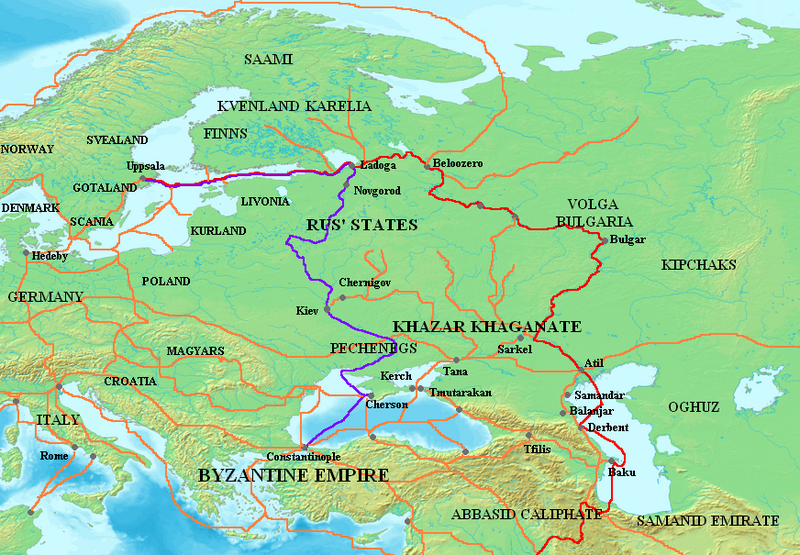
thumb|upright=1.5|Map showing the major Varangian trade routes: the Volga trade route (in red) and the Dnieper and Dniester routes (in purple). Other trade routes of the 8th–11th centuries shown in orange.

Igor of Kiev
prince of Kiev (877–945)

Staraya Ladoga
human settlement in Volkhovsky District, Leningrad Oblast, Russia
Rus' people
European ethnic group of Rucia
Trade route from the Varangians to the Greeks
medieval trade route between Scandinavia and the Byzantine Empire
Rus' Khaganate
hypothetical 8th–9th century polity in Eastern Europe

Garðaríki
thumb|350px|Towns of mentioned in Old Scandinavian sources, according to T. Jackson, E. Melnikova, K. Müllenhoff, V. Thomsen, and A. Bugge.
Volga trade route
trade route linking Varangians with Muslims
Eudokia Ingerina
Byzantine Empress consort (c. 840 – c. 882)
Rogvolod
Rogvolod (; ; 920978) was the first chronicled prince of Polotsk. He reigned until 978, when he and his two sons were killed by Vladimir the Great, then the prince of Novgorod, who took his daughter Rogneda as a wife.

Druzhina
thumb|right|Grand Prince of Kiev|Grand Prince [[Vladimir Monomakh of the Rurikid dynasty resting with his druzhina after a hunt, by Viktor Vasnetsov.]]

Roslagen
thumb|300px|Folklands in [[Svitjod (Uppland and Gästrikland)
Caspian expeditions of the Rus'
Caspian Sea expeditions carried out by the Rus between the 9th and 11th centuries
Ingvar the Far-Travelled
Viking chief who traveled to Persia
Berezan' Runestone
runestone discovered in 1905 in Berezan, Ukraine
Dnieper Rapids
rapids on the Dnieper River in Ukraine

Gnezdovo
thumb|Archaeological artefacts from Gnezdovo kurgans
thumb|Amphora with Cyrillic inscription
thumb|Byzantine coins and Scandinavian jewellery from Gnezdovo
Gnezdovo or Gnyozdovo () is an archeological site located near the village of Gnyozdovo in Smolensky District, Smolensk Oblast, Russia. The site contains extensive remains of a Slavic-Varangian settlement that flourished in the 10th century as a major trade station on the trade route from the Varangians to the Greeks.
Sveneld
Sveneld (also called Svenald or Sveinald; ; or ), is a semi-legendary 10th-century Varangian warlord in the service of Sviatoslav I and his family. Most of the information about Sveneld is scarce. He is described as a rich man and a voevoda ("troop commander") of Kievan Rus', but his relation to the reigning Rurikid princes, if it existed, has not been positively established.
Sineus and Truvor
brothers of Rurik, a Varangian chieftain of the Rus'

New England
reputed Byzantine colony on the Black Sea
Ingvar runestones
group of Norse runestones
Anti-Normanism
thumb|250px|Ethnic groups in Eastern Europe in the late 9th-century and early 10th-century. Green represents Slavic tribes, orange represents Baltic tribes, and yellow represents Finno-Ugric tribes.
Theodore the Varangian and his son Ioan
10th century martyrs
Alaborg
thumb|300px|Nicholas Roerich. Longships Built in the Land of the Slavs (1903)
Timerevo
Timerevo (, ) is an archaeological site near the village of Bolshoe Timeryovo, seven kilometers southwest of Yaroslavl, Russia, which yielded the largest deposits of early medieval Arabic coins in Northern Europe.
calling of the Varangians
historical legend about the origins of Rus
Šimon
Viking mentioned in the Patericon