Category
page 1Ventricular system
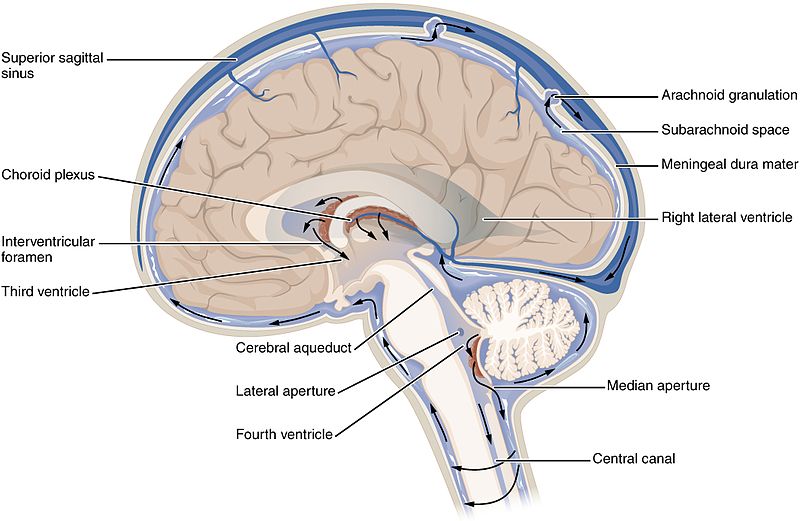
cerebrospinal fluid
clear colorless bodily fluid found in the brain and spine

hydrocephalus
Hydrocephalus is a condition in which cerebrospinal fluid (CSF) builds up within and/or around the brain, which can cause pressure to increase in the skull. Symptoms may vary according to age. Headaches and double vision are common. Elderly adults with normal pressure hydrocephalus (NPH) may have poor balance, difficulty controlling urination or mental impairment. In babies, there may be a rapid increase in head size. Other symptoms may include vomiting, sleepiness, seizures, and downward pointing of the eyes.
ventricular system
set of structures containing cerebrospinal fluid in the brain
intracranial pressure
pressure inside the skull and thus in the brain tissue and cerebrospinal fluid
choroid plexus
structure in the ventricles of the brain
cerebral aqueduct
conduit for CSF to the brain
normal pressure hydrocephalus
condition in which there is excess cerebrospinal fluid in the ventricles, and with normal or slightly elevated cerebrospinal fluid pressure
fourth ventricle
Part of the ventricular system
third ventricle
ventricle of the brain located between the two thalami
lateral ventricle
cavity in each of the hemispheres of the human brain
ependymoma
An ependymoma is a tumor that arises from the ependyma, a tissue of the central nervous system. Usually, in pediatric cases the location is intracranial, while in adults it is spinal. The common location of intracranial ependymomas is the floor of the fourth ventricle. Rarely, ependymomas can occur in the pelvic cavity.
ependyma
The ependyma is the thin neuroepithelial (simple columnar ciliated epithelium) lining of the ventricular system of the brain and the central canal of the spinal cord. The ependyma is one of the four types of neuroglia in the central nervous system (CNS). It is involved in the production of cerebrospinal fluid (CSF), and is shown to serve as a reservoir for neuroregeneration.
circumventricular organ
structures in the brain
cerebral shunt
surgical implant
interventricular foramina
It is part of diencephalon that makes connection between lateral and third ventricular
central canal of spinal cord
Cerebrospinal fluid-filled space around the spinal cord
septum pellucidum
thin membrane between the lateral ventricles of the brain
median aperture
which drains cerebrospinal fluid (CSF) from the fourth ventricle into the cisterna magna
Rhomboid fossa
depression in the human brain
lateral aperture
opening in each lateral extremity of the lateral recess of the fourth ventricle of the human brain
Obex
The obex (), also known as calamus scriptorius, is the point in the human brain at which the fourth ventricle narrows to become the central canal of the spinal cord. Cerebrospinal fluid can flow from the fourth ventricle into the obex. In anatomical studies, the obex has been found to occur approximately 10–12 mm above the level of the foramen magnum. In patients with low tonsillar position, the obex has been found at or below the plane of the foramen magnum.
colpocephaly
Colpocephaly is a cephalic disorder involving the disproportionate enlargement of the occipital horns of the lateral ventricles and is usually diagnosed early after birth due to seizures. It is a nonspecific finding and is associated with multiple neurological syndromes, including agenesis of the corpus callosum, Chiari malformation, lissencephaly, and microcephaly. Although the exact cause of colpocephaly is not known yet, it is commonly believed to occur as a result of neuronal migration disorders during early brain development, intrauterine disturbances, perinatal injuries, and other centra
subfornical organ
part of the brain
cavum septum pellucidum
slit-like space in the septum pellucidum
organum vasculosum of lamina terminalis