Category
page 1Vertebrate anatomy

vertebral column
bony structure found in vertebrates

skull
The skull, or cranium, is typically a bony enclosure around the brain of a vertebrate. In some fish and amphibians, the skull is of cartilage. The skull is at the head end of the vertebrate.

vertebra
Each vertebra (: vertebrae) is an irregular bone with a complex structure composed of bone and some hyaline cartilage, that make up the vertebral column or spine, of vertebrates. The proportions of the vertebrae differ according to their spinal segment and the particular species.

temple
side of the head behind the eyes
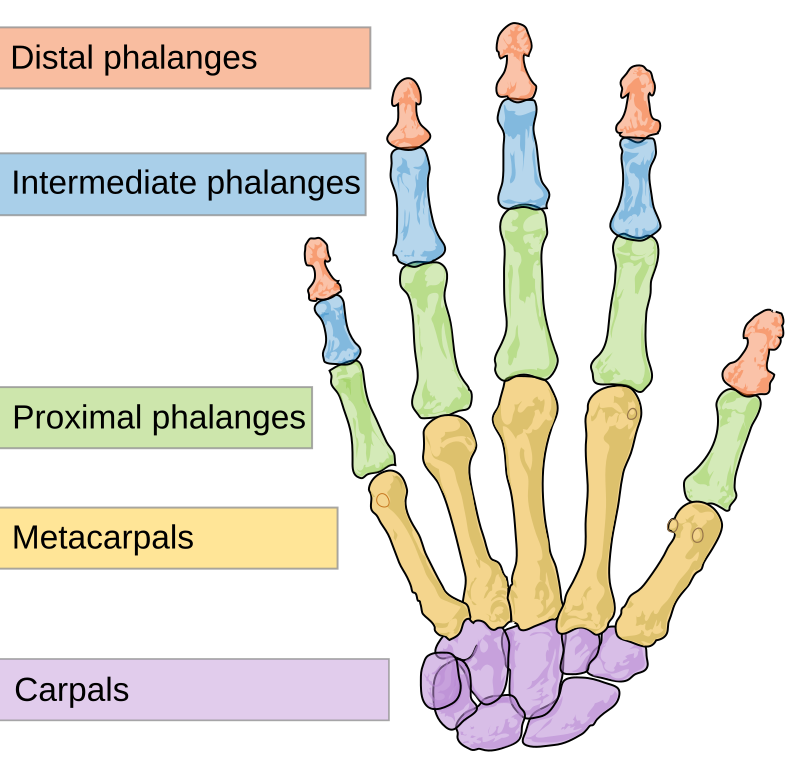
phalanx
digital bone in the hands and feet of most vertebrates

calcaneus
The calcaneus (; from the Latin calcaneus or calcaneum, meaning heel; : calcanei or calcanea) or heel bone is a bone of the tarsus of the foot which constitutes the heel. In some animals, it is the point of the hock.
Jacobson's organ
smell sense organ in the nasal septum of the nasal cavity just above the roof of the mouth
tapetum lucidum
layer of tissue in the eye of many vertebrates
nictitating membrane
transparent or translucent third eyelid in some animals

acromion
In human anatomy, the acromion (from Greek: akros, "highest", ōmos, "shoulder", : acromia) or summit of the shoulder is a bony process on the scapula (shoulder blade). Together with the coracoid process, it extends laterally over the shoulder joint. The acromion is a continuation of the scapular spine, and hooks over anteriorly. It articulates with the clavicle (collar bone) to form the acromioclavicular joint.

diastema
A diastema (: diastemata, from Greek , 'space') is a space or gap between two teeth. Many species of mammals have diastemata as a normal feature, most commonly between the incisors and molars. More colloquially, the condition may be referred to as gap teeth or tooth gap.
dorsal fin
fin on the dorsal of fish and cetaceans
pharyngeal arch
embryonic precursor structures in vertebrates

Osteoderm
thumb|right|Closeup of a Heloderma|helodermatid's skin, revealing the osteoderms
thumb|Armadillo skeleton, with shell made of osteoderms (displayed at the Museum of Osteology)
Osteoderms are bony deposits forming scales, plates, or other structures based in the dermis. Osteoderms are found in many groups of extant and extinct reptiles and amphibians, including lizards, crocodilians, frogs, temnospondyls (extinct amphibians), various groups of dinosaurs (most notably ankylosaurs and stegosaurians), phytosaurs, aetosaurs, placodonts, and hupehsuchians (marine reptiles with possible ichthyosaur a

Coracoid
thumb|Diagram of skeletal structure and musculature of a bird's wing
A coracoid is a paired bone which is part of the shoulder assembly in all vertebrates except therian mammals (marsupials and placentals). In therian mammals (including humans), a coracoid process is present as part of the scapula, but this is not homologous with the coracoid bone of most other vertebrates.
salt gland
organ for getting rid of salt
flesh
Flesh is any aggregation of soft tissues of an organism. Various multicellular organisms have soft tissues that may be called "flesh". In mammals, including humans, flesh encompasses muscles, fats and other loose connective tissues, but sometimes excludes non-muscular organs (liver, lung, spleen, kidney) and typically discarded parts (hard tendon, brain tissue, intestines, etc.). More generally, it may be considered the portions of the body that are soft and delicate. In a culinary context, consumable animal flesh is called meat, while processed visceral tissues are known as offal.
prehensile tail
tail of an animal that has adapted to be able to grasp or hold objects
spiracle
Inspirational organ of most cartilaginous fish
rete mirabile
complex of arteries and veins lying very close to each other, found in some vertebrates, mainly warm-blooded ones.

gastralium
thumb|250px|Crocodile|Crocodiles are among the few modern animals with gastralia
250px|thumb|Tyrannosaurus gastralia
Gastralia (: gastralium) are dermal bones found in the ventral body wall of modern crocodilians and tuatara, and many prehistoric tetrapods. They are found between the sternum and pelvis (collectively forming the gastral basket), and do not articulate with the vertebrae. In these reptiles, gastralia provide support for the abdomen and attachment sites for abdominal muscles.
thumb|Diagram of the dinosaur Torvosaurus, with the gastral basket labelled "20"
The possession of gastra

rachis
thumb|upright=1.1|The dark rachis of a wild turkey feather

dewclaw
thumb|right|Paw of a dog: A. Claw, B. Digital pads, C. Metacarpal pad, D. Dewclaw, E. Carpal pad
thumb|A dog's dewclaw does not make contact with the ground while the dog is standing. This older dog's dewclaw is rounded from use while running, but it has grown.thumb|Some active dogs' dewclaws make more frequent contact with the ground while running, so they wear down naturally, as do their other claws.
thumb|Double dewclaws on rear leg of dog

Dewlap
thumb|right|A mastiff with a dewlap, seen connecting from the neck to the lower jaw.
A dewlap is a longitudinal flap of skin or similar flesh that hangs beneath the lower jaw or neck of many vertebrates. More loosely, it can be various similar structures in the neck area, such as those caused by a double chin or the submandibular vocal sac of a frog. More generally, it can be any hanging mass of skin, such as a fold of loose skin on an elderly person's neck, or the wattle of a bird. Dewlaps can be considered as a caruncle, defined as "a small, fleshy excrescence that is a normal part of an ani

dactyly
alt=Human hand anatomy|thumb|Human hand anatomy (pentadactyl)
In biology, dactyly is the arrangement of digits (fingers and toes) on the hands, feet, or sometimes wings of a tetrapod animal. The term is derived from the Ancient Greek word δάκτυλος (dáktulos), meaning "finger."
chevron
bone in the tail of most reptiles and some mammals
wattle
fleshy caruncle hanging from various parts of the head or neck in several groups of birds and mammals

loin
The loins, or lumbus (: lumbi), are the sides between the lower ribs and pelvis, and the lower part of the back. The term is used to describe the anatomy of humans and quadrupeds, such as horses, pigs, or cattle. The anatomical reference also applies to particular cuts of meat, including tenderloin or sirloin steak.

forelimb
right|thumb|350px|Forelimbs in mammals have varying functions but are all homologous.
A forelimb or front limb is one of the paired articulated appendages (limbs) attached on the cranial (anterior) end of a terrestrial tetrapod vertebrate's torso. With reference to quadrupeds, the term foreleg or front leg is often used instead. In bipedal animals with an upright posture (e.g. humans and some other primates), the term upper limb is often used.
Harderian gland
Gland in the eye socket of tetrapods
Skeletal pneumaticity
presence of air spaces within bones
Arctometatarsal
thumb|Tyrannosaurus foot showing the compressed arctometatarsalian condition of the middle [[metatarsal, compared to that of Allosaurus]]
An arctometatarsalian organism is one in which the proximal part of the middle metatarsal is pinched between the surrounding metatarsals. The trait appears to be highly homoplastic, common in certain sorts of dinosaurs accustomed to running (among them the tyrannosauroids, ornithomimosaurs, and troodontids), to evenly transmit force to the metatarsals.
membranous bone
bony structure derived from intramembranous ossification
interclavicle
thumb|The rod-like interclavicle of Ophiacodon (a [[Permian synapsid) connected to a pair of rounded clavicles. Seen in ventral view (i.e. looking towards the chest from below)]]
An interclavicle is a bone which, in most tetrapods, is located between the clavicles. Therian mammals (marsupials and placentals) are the only tetrapods which never have an interclavicle, although some members of other groups also lack one. In therians, it is replaced by the sternum, which is similar in shape and function but forms via endochondral ossification (cartilage forming bone). The interclavicle, on the othe
Pes (anatomy)
scapulocoracoid
The scapulocoracoid is the unit of the pectoral girdle that contains the coracoid and scapula.
The coracoid itself is a beak-shaped bone that is commonly found in most vertebrates with a few exceptions.
The scapula is commonly known as the shoulder blade. The humerus is linked to the body via the scapula, and the clavicle is connected to the sternum via the scapula as well.
Skull roof
roofing bones of the skull
Endocranium
The endocranium in comparative anatomy is a part of the skull base in vertebrates and it represents the basal, inner part of the cranium. The term is also applied to the outer layer of the dura mater in human anatomy.
Haemal arch
anatomical feature of a vertebrate tail
Tomium
In anatomy, the tomium is the sharp cutting edge of the beak of a bird or the bill of a turtle. Sometimes the edge is serrated for tearing through flesh or vegetation.