Category
page 1Villanovan culture

Tuscany

Modena
Modena (, ; ; ; ; ) is a city and comune (municipality) on the south side of the Po Valley, in the Province of Modena, in the Emilia-Romagna region of northern Italy. It has 184,739 inhabitants as of 2025.

Volterra
Volterra (; Latin: Volaterrae) is a walled mountaintop town in the Tuscany region of Italy. Its history dates from before the 8th century BC and it has substantial structures from the Etruscan, Roman, and Medieval periods.

Tarquinia
Tarquinia (), formerly known as Corneto, is an ancient city in the Province of Viterbo, Lazio, central Italy. It is renowned for its extensive Etruscan necropoleis, which contain some of the most important painted tombs of the ancient world. In recognition of its cultural significance, Tarquinia was designated a UNESCO World Heritage Site as part of the Etruscan Necropolises of Cerveteri and Tarquinia.

Fermo
Fermo (; ancient: Firmum Picenum) is a town and comune of the Marche, Italy, in the Province of Fermo.

Q100041
Italian comune in Emilia-Romagna

Cerveteri
Cerveteri () is a comune (municipality) in the Metropolitan City of Rome Capital, in the Italian region of Lazio. Known by the ancient Romans as Caere, and previously by the Etruscans as Caisra or Cisra, and as Agylla (or ) by the Greeks, its modern name derives from Caere Vetus (more precisely its locative Caere Veterī) used in the 13th century to distinguish it from Caere Novum (the current town).
%2C%20Adria.jpg)
Adria
Adria is a town and comune in the province of Rovigo in the Veneto region of northern Italy, situated between the mouths of the rivers Adige and Po. The remains of the Etruscan city of Atria or Hatria are to be found below the modern city, three to four metres below the current level. Adria and Spina were the Etruscan ports and depots for Felsina (now Bologna). Adria may have received its name from the Adriatic Sea or from the river Adria that once passed nearby.

Sorano
Sorano is a town and comune in the province of Grosseto, in southern Tuscany, Italy. It is an ancient medieval hill town perched on a tuff outcrop overlooking the Lente River.
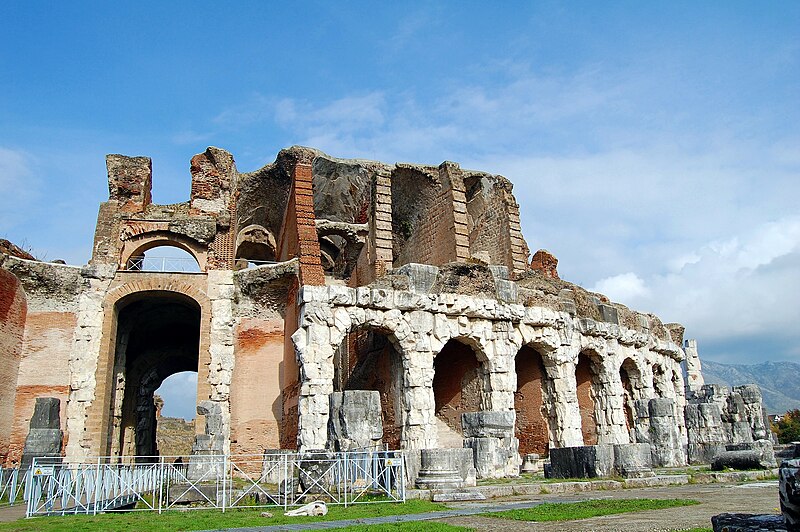
Santa Maria Capua Vetere
Italian comune

Eboli
Eboli (Ebolitano: ) is a town and comune of Campania, southern Italy, in the province of Salerno.

Casalecchio di Reno
Italian comune

Etruria
thumb|right|300px|Map showing Etruria and Etruscan colonies as of 750 BC and as expanded until 500 BC
Etruria ( ) was a region of Central Italy delimited by the rivers Arno and Tiber, an area that covered what is now most of Tuscany, northern Lazio, and north-western Umbria. It was inhabited by the Etruscans, an ancient civilization that flourished in the area from around the 8th century BC until they were assimilated into the Roman Republic in the 4th century BC.

San Lazzaro di Savena
Italian comune

Bentivoglio
Italian comune

Pontecagnano Faiano
Italian comune

Monterenzio
Monterenzio (Medial Mountain Bolognese: ) is a town and comune in the Metropolitan City of Bologna (Emilia-Romagna, Italy).

Castel Giorgio
town in the region Umbria, in Italy

Verucchio
Verucchio () is a comune in the province of Rimini, region of Emilia-Romagna, Italy. It has a population of about 9,300 and is from Rimini, on a spur overlooking the valley of the Marecchia river. It is one of I Borghi più belli d'Italia ("The most beautiful villages of Italy").
fibula
ancient pin or brooch for securing clothing
Metropolitan City of Bologna
Italian metropolitan city
Villanovan culture
archaeological culture in Italy

Vulci
Vulci or Volci (Etruscan: Velch or Velx, depending on the romanization used) was a rich Etruscan city in what is now northern Lazio, central Italy.

Populonia
Populonia or Populonia Alta (Etruscan: Pupluna, Pufluna or Fufluna, all pronounced Fufluna; Latin: Populonium, Populonia, or Populonii) today is a of the comune of Piombino (Tuscany, central Italy). As of 2009 its population was 17. It is one of I Borghi più belli d'Italia ("The most beautiful villages of Italy"). Populonia is especially noteworthy for its Etruscan remains, including one of the main necropolis in Italy, discovered by Isidoro Falchi.
Necropolis of Monterozzi
ancient necropolis in Tarquinia, Italy

Tyrrhenians
Tyrrhenians (Attic Greek: Turrhēnoi) or Tyrsenians (Ionic: Tursēnoi; Doric: Tursānoi) was the name used by the ancient Greeks to refer, in a generic sense, to non-Greek people, in particular pirates. While ancient sources have been interpreted in a variety of ways, the Greeks always called the Etruscans Tyrsenoi, although not all Tyrsenians were Etruscans. The term "Tyrrhenians" was sometimes used by ancient writers to refer to other ethnic groups in central-western Italy, such as the Latins. Dionysius of Halicarnassus stated that the Greeks once called Latins, Umbrians, Ausonians, and others

bucchero
thumb|right|Oinochoe in bucchero
Bucchero () is a class of ceramics produced in central Italy by the region's pre-Roman Etruscan population. This Italian word is derived from the Latin poculum, a drinking-vessel, perhaps through the Spanish búcaro, or the Portuguese púcaro.

Clusium
Clusium (, Klýsion, or , Kloúsion; Umbrian:Camars) was an ancient city in Italy, one of several found at the same site overlapping the current municipality of Chiusi (Tuscany). The Roman city remodeled an earlier Etruscan city, Clevsin, found in the territory of a prehistoric culture, possibly also Etruscan or proto-Etruscan. The site is located in northern central Italy on the west side of the Apennines.
Proto-Villanovan culture
Material culture
Giovanni Gozzadini
Italian historian and archaeologist (1810-1887)
Tarquinia National Museum
archaeological museum in Tarquinia, Italy
Padanian Etruria
northen Italy's area in ancient times inhabited by etruscans
Mamarce Oinochoe
etruscan clay jug by the potter Mamarce