Category
page 1Votive offering
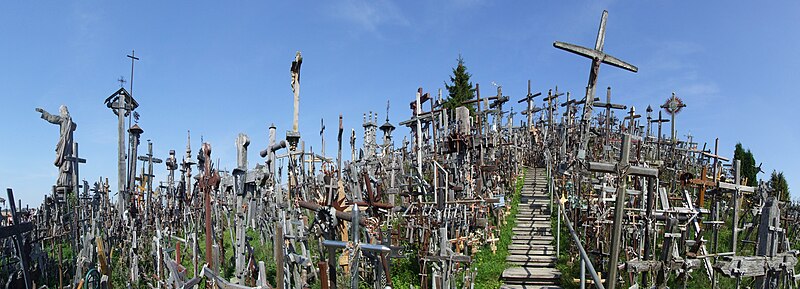
Hill of Crosses
pilgrimage site in northern Lithuania
votive offering
type of religious offering, obejct displayed or deposted in a sacred place
Gate of Dawn
city gate
Pyrgi Tablets
three golden plaques inscribed with a bilingual Phoenician–Etruscan dedicatory text ca. 500 B.C.
Siloam inscription
Hebrew inscription
Lithuanian cross crafting
Lithuanian folk art tradition
Hjortspring boat
large canoe type vessel dated to 350 found in Hjortspring Mose at Als, Denmark
Divine Mercy image
divine mercy image
Treasure of Guarrazar
archeological find composed of twenty-six votive crowns and gold crosses from a site in Guadamur, prov. of Toledo, Castilla-La Mancha, Spain
votive ship
model of a ship in a church building

ex-voto
thumb|votive paintings of Mexico|Mexican votive painting of 1911; the man survived an attack by a bull, attributed to the care of [[Our Lady of San Juan de los Lagos]]
thumb|La Rochelle [[slave ship Le saphir, ex-voto in the Saint Louis Cathedral in La Rochelle, 1741]]
Pitsa panels
archaic painted wooden tablets found in Pitsa cave, Corinthia (Greece)
Athenian Treasury
treasury in Delphi, Greece
Siphnian Treasury
treasury in Delphi, Greece
votive candle
type of votive offering in Christianity
First Fruits
religious offering of the first agricultural produce of the harvest

Godič
Godič (; ) is a village on the left bank of the Kamnik Bistrica River in the Municipality of Kamnik in the Upper Carniola region of Slovenia.
wish tree
tree used to make votive offerings
Nydam Mose
archaeological site at Øster Sottrup, Denmark
Cippi of Melqart
collective name for two bilingual Phoenician marble cippi, dated to the 2nd century BCE, that were unearthed in Malta under undocumented circumstances and were seminal in the deciphering of the Phoenician alphabet and language.
Thorsberg moor
Bog and iron age deposit site in north Germany
Jacopo Pesaro, Bishop of Paphos, being presented by Pope Alexander VI to Saint Peter
painting by Titian
votive crown
votive offering in Medieval Europe
Battersea Shield
Celtic archaeological discovery
Reitia
Reitia (Venetic: 𐌓𐌄:𐌉:𐌕𐌉:𐌀) was a goddess, one of the best known deities of the Adriatic Veneti of northeastern Italy.
Flag Fen
archaeological open-air museum in Peterborough, Cambridgeshire, England, UK
Llyn Fawr
reservoir in Rhondda Cynon Taf, Wales, UK
Veksø helmets
2 bronze helmets found near Veksø, Denmark
Llyn Cerrig Bach
lake in Anglesey, Wales, UK
Lod Mosaic
Roman mosaic found in Israel
Skotino cave
cave in Greece
Theban Treasury
building at Delphi in ancient times
Treasuries at Olympia
ruined building complex in ancient Olympia, Greece
Artaius
Artaius is a Celtic epithet applied to the Roman god Mercury during the Romano-Celtic period. It is known from a single inscription from Beaucroissant in the Isère:
monument of Prusias II
column
Rotunda of Xewkija
Roman Catholic church in Malta
Sanctuary of Montenero
cemetery in Livorno, Italy
Byblos figurines
statuettes found in ancient Phoenician temples
animal mummy
mummified animal
Thrones of Astarte
phoenician votive thrones
Illerup Ådal
ancient monument in Skanderborg Municipality (51311)
Senuna
frame|right|The silver Senuna statue recovered in 2002
Senuna was a Celtic goddess worshipped in Roman Britain. She was unknown until a cache of 26 votive offerings to her were discovered in 2002 in an undisclosed field at Ashwell End in Hertfordshire by metal detectorist Alan Meek. Her imagery shows evidence of syncretism between a pre-Roman goddess with the Roman Minerva (for a parallel, cf. Sulis Minerva, the Romano-British goddess worshipped at Bath).
Tsatsa
tibetan clay votive plaques
Biertan Donarium
4th-century Christian votive object found in Romania
Mother Catherine-Agnès Arnault and Sister Catherine de Sainte Suzanne de Champaigne
painting by Philippe de Champaigne
pendilia
thumb|120px|The Holy Crown of Hungary having pendilia.
thumb|120px|Votive crown of the Visigoth King [[Recceswinth († 672), part of the Treasure of Guarrazar.]]
Pendilia (singular pendilium; from Latin pendulus, hanging) or pendoulia (the Greek equivalent), are pendants or dangling ornaments hanging from a piece of metalwork such as a crown, votive crown, crux gemmata, or kamelaukion, and are a feature of Early Medieval goldsmith work. On crosses the pendilia may include the letters alpha and omega, and on votive offerings, which were often designed to be hung over altars and where pendilia ar
Temple of Minerva Medica
building in Rome, Italy
La Lechuga
XVIII century monstance