Category
page 1Web design

Cascading Style Sheets
Cascading Style Sheets (CSS) is a style sheet language used for specifying the presentation and styling of a document written in a markup language, such as HTML or XML (including XML dialects such as SVG, MathML, or XHTML). CSS is a cornerstone technology of the World Wide Web, alongside HTML and JavaScript.
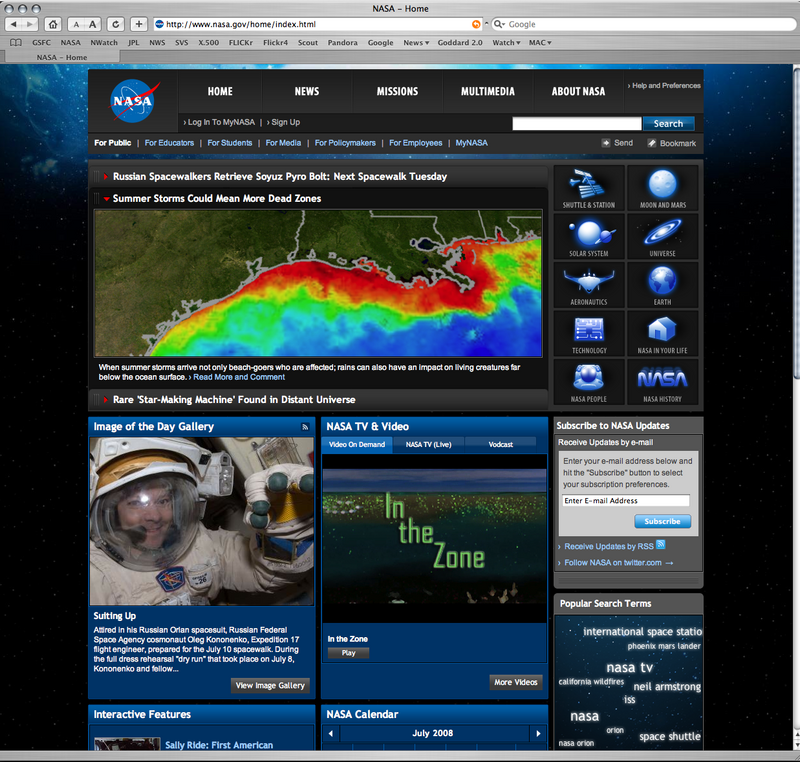
web page
single document composed of HTML that is directly viewable via web browsers and accessible via the World Wide Web

web design
creation and maintenance of websites

web color
color used in designing web pages

Bootstrap
web design front-end framework

home page
main page of a site
.png)
favicon
thumb|280px|Wikipedia's favicon, shown in [[Firefox]]
A favicon (; short for favorite icon), also known as a shortcut icon, website icon, tab icon, URL icon, or bookmark icon, is a file containing one or more small icons associated with a particular website or web page. A web designer can create such an icon and upload it to a website (or web page) by several means, and graphical web browsers will then make use of it. Browsers that provide favicon support typically display a page's favicon in the browser's address bar (sometimes in the history as well) and next to the page's name in a list of
dynamic web page
webpage server-dynamic
HTML editor
computer program for editing HTML site
responsive web design
approach to web design for making web pages render well on a variety of devices
W3Schools
W3Schools is a freemium educational website for learning coding online. Initially released in 1998, it derives its name from the World Wide Web but is not affiliated with the W3 Consortium. The domain name for website was registered on March 21, 2000.
web accessibility
property of webpages and web applications that measures how easily people in different circumstances (such as disability) can access information or use the tool
microformats
Microformats (μF) are predefined HTML markup (like HTML classes) created to serve as descriptive and consistent metadata about elements, designating them as representing a certain type of data (such as contact information, geographic coordinates, events, products, recipes, etc.). They allow software to process the information reliably by having set classes refer to a specific type of data rather than being arbitrary.
eye tracking
measuring the point of gaze or motion of an eye relative to the head
dark pattern
user interface designed for a user to make choices without being aware of them
Sitemaps
Sitemaps is a protocol in XML format meant for a webmaster to inform search engines about URLs on a website that are available for web crawling. It allows webmasters to include additional information about each URL: when it was last updated, how often it changes, and how important it is in relation to other URLs of the site. This allows search engines to crawl the site more efficiently and to find URLs that may be isolated from the rest of the site's content. The Sitemaps protocol is a URL inclusion protocol and complements robots.txt, a URL exclusion protocol.
user experience design
field of design focusing on the creation of user centered products and services

freeCodeCamp
freeCodeCamp (also referred to as Free Code Camp) is a non-profit educational organization that consists of an interactive learning web platform, an online community forum, chat rooms, online publications and local organizations that intend to make learning software development & computer programming accessible to anyone.
website wireframe
visual guide that represents the skeletal framework of a website
W3C Markup Validation Service
validator service by the World Wide Web Consortium
web typography
publishing considerations for the Web
Adobe Muse
Offline website builder developed by Adobe Systems
CSS framework
Web framework
website builder
a tool used to build a website
polyfill
code that implements a feature on web browsers that do not support the feature
CSS Flex Box Layout
CSS Flexible Box Layout, commonly known as Flexbox, is a CSS web layout model. It is in the W3C's candidate recommendation (CR) stage. The flex layout allows responsive elements within a container to be automatically arranged depending on viewport (device screen) size.
Modernizr
Modernizr is a JavaScript library that detects the features available in a user's browser. This lets web pages avoid unsupported features by informing the user their browser is not supported or loading a polyfill. Modernizr aims to provide feature detection in a consistent and easy to use manner that discourages the use of failure-prone browser sniffing.
findability
Findability is the ease with which information contained on a website can be found, both from outside the website (using search engines and the like) and by users already on the website. Although findability has relevance outside the World Wide Web, the term is usually used in that context. Most relevant websites do not come up in the top results because designers and engineers do not cater to the way ranking algorithms work currently. Its importance can be determined from the first law of e-commerce, which states "If the user can't find the product, the user can't buy the product." As of Dece

progressive enhancement
web design strategy in which core webpage content is set first, then more nuanced and technically rigorous layers of presentation and features are added on top as the browser/internet connection allow
Xara Photo & Graphic Designer
image editing program incorporating photo editing and vector illustration tools
above the fold
top section of the front page of a newspaper or website
Semantic HTML
HTML used to reinforce meaning of documents or webpages
infinite scrolling
approach to web design
web navigation
process of navigating a network of information resources in the World Wide Web, which is organized as hypertext or hypermedia

web template system
uses a template processor to combine web templates to form finished web pages; web publishing tool present in content management systems, web application frameworks, and HTML editors
navigation bar
user interface element for navigation
Interstitial webpage
webpage displayed before or after an expected content page
static site generator
software to generate static websites
Foundation
web design front-end framework
Slicing
image slicing for web design and interface design
web badge
small image used on websites measuring 80×15 pixels
click path
user behavior journey in virtual space
Three-click rule
unofficial web design rule
Scalable Inman Flash Replacement
obsolete dynamic web fonts implementation
Adobe Fonts
subscription service for fonts
tableless web design
web design method that avoids HTML tables for page layout control
printable version
alt=Printer Icon.|thumb|A printer icon.
Printer-friendly is a term used on the Internet to describe a version of a web page formatted for printing. Normally, web pages include information and navigation content that is only useful while browsing the website. Printer-friendly pages are designed to fit on an 8.5"x11" or A4 sheet (see paper sizes) and include only the content (plain text and images) of the page, along with source information. Inline hyperlinks become ordinary text, links on the margins may or may not be shown. Additionally link target URLs may be shown. Navigation tools such as o
Postback
In web development, a postback is the exchange of information between servers to report a user's action on a website, network, or app.
Web usability
usability of a website
CSS grid layout
CSS properties allowing to create complex responsive web design layouts
flash of unstyled content
phenomenon in web browsers
separation of presentation and content
concept in technology design