Category
page 1Wehrmacht

Wehrmacht
The Wehrmacht (, ) were the unified armed forces of Nazi Germany from 1935 to 1945. It consisted of the Heer (army), the Kriegsmarine (navy) and the Luftwaffe (air force). The designation "Wehrmacht" replaced the previously used term (Reich Defence) and was the manifestation of the Nazi regime's efforts to rearm Germany to a greater extent than the Treaty of Versailles permitted.
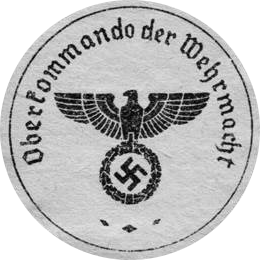
High Command of the Armed Forces
High Command of the Wehrmacht (armed forces) of Nazi Germany during World War II
Hunger Plan
mass starvation plan by Nazi Germany
Panzerlied
The "Panzerlied" ('Tank Song') is a German military march sung primarily by the Panzerwaffe—the tank force of Nazi Germany during World War II. It is one of the best-known songs of the Wehrmacht and was popularised by the 1965 film Battle of the Bulge. It was composed by Oberleutnant Kurt Wiehle in 1933.
National Committee for a Free Germany
German military and political organization operating in the Soviet Union during World War II
Legend of the clean Wehrmacht
post World War II myth

Balkenkreuz
thumb|right|upright=2.5|Various WWII styles of the Balkenkreuz; also see Luftwaffe for official specification versions
Hitler Oath
oath sworn by members of the Wehrmacht and German civil service from 1934
World War II German Army ranks and insignia
Wikimedia list article

Wehrmachtbericht
thumb|upright=1.1|Joseph Goebbels with Wehrmacht propaganda officers, 1941
thumb|upright=1.1|Image taken by Wehrmacht Propaganda Troops|Wehrmacht Propaganda Troops on 30 June 1944. Original caption reads: "Fight against terrorists in France. Communist terrorist groups are attempting to disrupt the German security measures. The Wehrmachtbericht reports daily on successes against the saboteurs. In the marketplace the first interrogations take place."
Wehrmachtbericht (, literally: "Armed forces report", usually translated as '''Wehrmacht communiqué or Wehrmacht report') was the daily Wehrmacht H

Reichssicherheitsdienst
The Reichssicherheitsdienst (RSD, lit. "Reich security service") was an SS security force of Nazi Germany. Originally bodyguards for Adolf Hitler, it later provided men for the protection of other high-ranking leaders of the Nazi regime. The group, although similar in name, was completely separate from the Sicherheitsdienst (SD), which was the formal intelligence service for the SS, the Nazi Party and later Nazi Germany.
war crimes of the Wehrmacht
crimes carried out by the German armed forces during World War II
Wehrmacht Propaganda Troops
branch of service of the Wehrmacht and the Waffen-SS of Nazi Germany producing and disseminating propaganda
Führerreserve
The '''''' (“Leaders Reserve” or "Reserve for Leaders") was set up in the German Armed Forces during World War II in 1939 as a pool of temporarily unoccupied high-ranking military officers awaiting new assignments. The various military branches and army groups each had their own pools that they could use as they saw fit. The officers were required to remain at their assigned stations and be available to their superiors but could not exercise any command function, which was in effect equivalent to a temporary retirement while retaining their previous active income. Especially in the second half

Feldjägerkorps
The Feldjägerkorps () ( field hunter corps) was a military provost organization in the German Wehrmacht during World War II. It was established on 27 November 1943 and consisted of three Feldjäger commands that reported directly to the Oberkommando der Wehrmacht, headed by chief of staff Generalfeldmarschall Wilhelm Keitel. It was recruited from veteran, battle-hardened troops and was senior to all other military police organizations. It operated approximately 12 miles behind the front lines, and its main function was to maintain order and discipline among the troops, hunting down deserters an
Comparative ranks of Nazi Germany
Wikimedia list article
Maybach I and II
architectural structure
World War II German uniform
Nazi military clothing
Wehrmacht waves of mobilization
In the German Wehrmacht before and during World War II, infantry divisions were raised as part of a designated Aufstellungswelle (deployment wave) or Welle (wave), sometimes translated as "draft". The Aufstellungswelle system was adopted by the Wehrmacht in late 1938. Peacetime units were the first wave, and 34 other waves followed until the 35th wave in April 1945. Several types of divisions were organized by Aufstellungswelle, including infantry, security, shadow and Volksgrenadier divisions.
Nationalsozialistischer Führungsoffizier
Officers of the German Wehrmacht
Transportkorps Speer
government agency
Army Personnel Office
German military agency
Wehrmachtsausstellung
exhibitions on the war crimes of the Wehrmacht
Deutsche Dienststelle
government office of Berlin
Wehrmacht and National Socialism
relationship between the NSDAP and the Wehrmacht
Die Wehrmacht
magazine
Wehrmachtbefehlshaber
The '''''' () was the German chief military position in countries occupied by the Wehrmacht which were headed by a civilian administration. The main responsibilities of this position were military security in the area and command of the defense in case of attack or invasion. The also had a judicial function, as he served as judge in German military courts. He had no control over Army units, but was responsible for the housing of troops. In the occupied territories of the Soviet Union, the Wehrmachtsbefehlshaber was also responsible for securing the occupied territories, protecting transport li