Category
page 1Welfare economics

social democracy
political ideology

Gini coefficient
measure of inequality in income or wealth distribution

mixed economy
economic system combining public and private production

welfare spending
means-oriented social benefit

poverty line
minimum income deemed adequate to live in a specific country or place

competition law
law that promotes or seeks to maintain market competition by regulating anti-competitive conduct by companies

externality
thumb|Air pollution from [[motor vehicles is an example of a negative externality. The costs of the air pollution for the rest of society is not compensated for by either the producers or users of motorized transport.]]
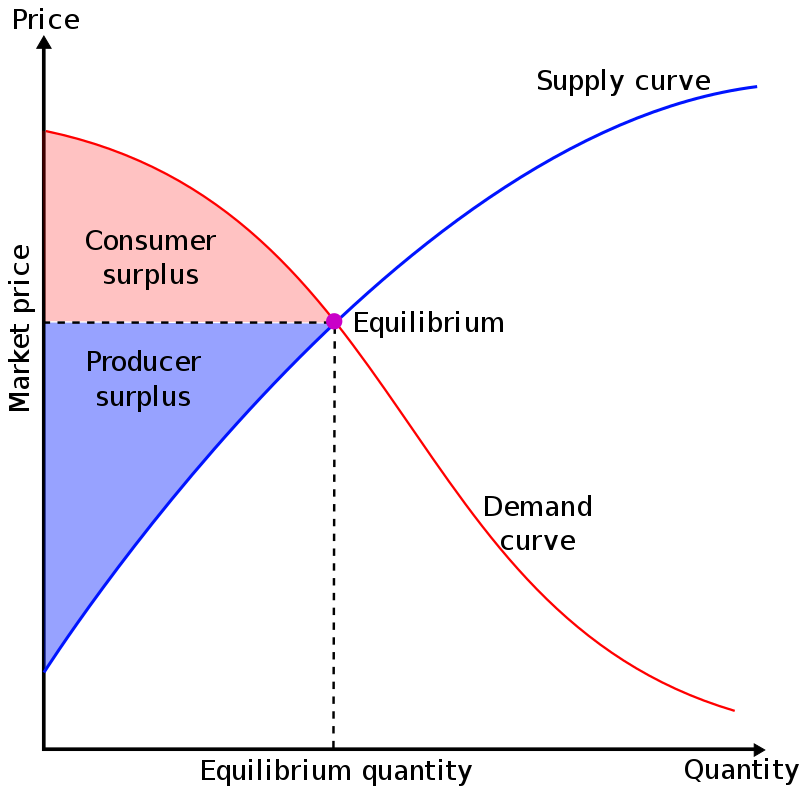
surplus
monetary benefit that accrues to parties to an economic transaction

marginal utility
change in satisfaction resulting from an increase or decrease in consumption of one unit of a good or service
Pareto efficiency
economic concept of a state in which no reallocation of resources can make everyone at least as well off
cost–benefit analysis
systematic approach to estimating the strengths and weaknesses of alternatives
welfare economics
use of economic techniques to evaluate well-being at the aggregate level
Lorenz curve
graphical representation of the distribution of income or of wealth
intergenerational equity
concept of fairness or justice between generations
general equilibrium theory
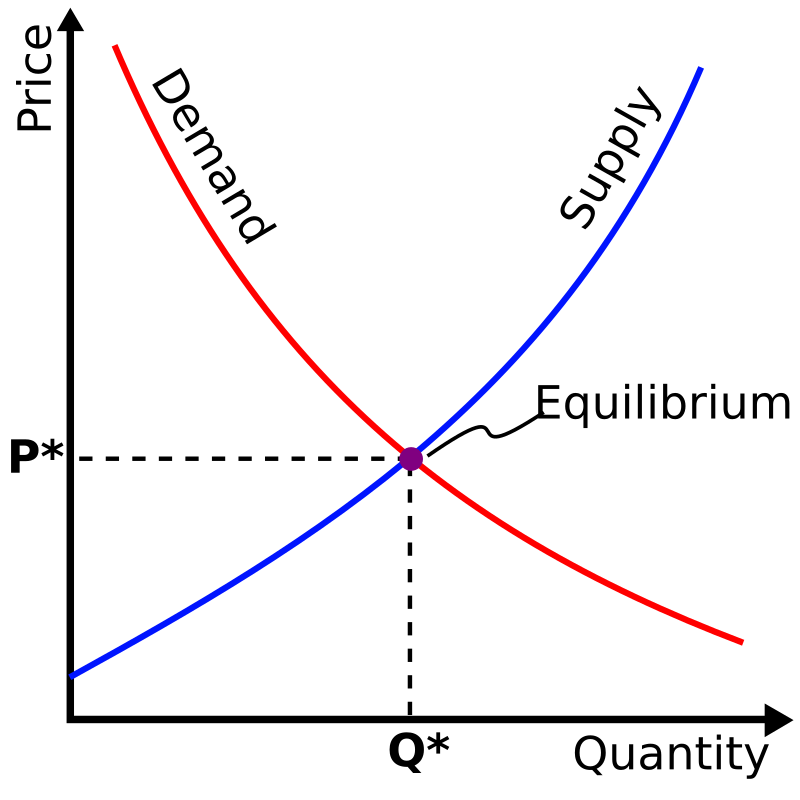
theory of equilibrium between supply and demand
deadweight loss
measure of lost economic efficiency
normative economics
part of economics that expresses value judgments about economic fairness
working poor
social class of working people whose incomes fall below a poverty line due to low-income jobs and low familial household income
Edgeworth box
model of an economic market
Human Poverty Index
index
Kaldor–Hicks efficiency
state leading to a Pareto-efficient outcome, concerning the compensation principle
structural adjustment
provision of loans by the International Monetary Fund and World Bank to countries that experienced economic crises
fundamental theorems of welfare economics
Complete, full information, perfectly competitive markets are Pareto efficient
triple bottom line
accounting framework
capability approach
economic theory
genuine progress indicator
metric that has been suggested to replace, or supplement, gross domestic product
happiness economics
quantitative and theoretical study of happiness, positive and negative affect, well-being, quality of life, life satisfaction and related concepts, typically combining economics with other fields such as psychology, health and sociology
Leapfrogging
Leapfrogging is a concept used in many domains of the economics and business fields, and was originally developed in the area of industrial organization and economic growth. The main idea behind the concept of leapfrogging is that small and incremental innovations usually lead a dominant firm to stay ahead, but sometimes, radical innovations will permit new firms to leapfrog the ancient and dominant firm. The phenomenon can occur to firms but also to leadership of countries or cities, where a developing country can skip stages of the path taken by industrial nations, enabling them to catch up
social welfare function
function that ranks states of society according to their desirability
fair division problem
problem of sharing resources
Robin Hood effect
economic occurence
welfarism
In ethics, welfarism is a theory that well-being, what is good for someone or what makes a life worth living, is the only thing that has intrinsic value. In its most general sense, it can be defined as descriptive theory about what has value but some philosophers also understand welfarism as a moral theory, that what one should do is ultimately determined by considerations of well-being. The right action, policy or rule is the one leading to the maximal amount of well-being. In this sense, it is often seen as a type of consequentialism, and can take the form of utilitarianism.

Theil index
index to measure economic inequality
Copenhagen Consensus
welfare economics project
social protection
prevention, management, and handling of situations that adversely affect people's well-being
life satisfaction
measure of well-being assessed in terms of mood, satisfaction with relationships, achieved goals, self-concepts, and self-perceived ability to cope with one's daily life
theory of the second best
branch of economics studying next-best alternatives
means test
eligibility criteria based on financial status
welfare chauvinism
policy advocating welfare benefits just for certain groups
workfare
thumb|right|Activists dressed as prisoners demonstrating against workfare in the United Kingdom (October 2011)
Workfare is a governmental plan under which welfare recipients are required to accept public-service jobs or to participate in job training. Many countries around the world have adopted workfare (sometimes implemented as "work-first" policies) to reduce poverty among able-bodied adults; however, their approaches to execution vary. The United States and United Kingdom are two countries utilizing workfare, albeit with different backgrounds.
Ghent system
type of socio-economic model
Contract curve
concept in microeconomics
Hoover index
Edgar Malone Hoover's inequality measure
value of life
economic value used to quantify the benefit of avoiding a fatality. It is also referred to as the cost of life, value of preventing a fatality (VPF), implied cost of averting a fatality (ICAF), and value of a statistical life (VSL)
International Social Security Association
Association of national welfare agencies
post-war consensus
period in British political history, 1945 to 1970s
Positional good
economic good whose value is determined by its distribution within a population
economic justice
subcategory of welfare economics
Equivalent variation
measure of how much more money a consumer would pay before a price increase to avert the price increase
wage share
economics concept
Uneconomic growth
economic growth that reflects or creates a decline in the quality of life
income inequality metrics
ways inequality is measured
Divide and choose
procedure for envy-free cake-cutting between two partners

Foundations of Economic Analysis
non-fiction work by Paul A. Samuelson

active labour market policies
government work relief programmes
Compensating variation
Economic concept
lump-sum taxation
taxation on a lump-sum basis
intergenerational struggle
Mincome
Mincome, the "Manitoba Basic Annual Income Experiment", was a Canadian guaranteed annual income (GAI) social experiment conducted in Manitoba in the 1970s. The project was funded jointly by the Manitoba provincial government and the Canadian federal government under Prime Minister Pierre Trudeau. It was launched with a news release on February 22, 1974, under the New Democratic Party Manitoba government of Edward Schreyer, and was closed down in 1979 under the Progressive Conservative Manitoba government of Sterling Lyon and the federal Progressive Conservative Party of Joe Clark. The purpose
compensation principle
law in welfare economics centered around prospective gainers helping losers