Category
page 1Wild men
.jpg)
Bigfoot
Bigfoot (), also commonly referred to as Sasquatch (, ; , ), is a large, hairy, mythical creature said to inhabit forests in North America, particularly in the Pacific Northwest. Bigfoot is featured in both American and Canadian folklore, and since the mid-20th century has become a cultural icon, permeating popular culture and becoming the subject of its own distinct subculture.

coat of arms of Denmark
national coat of arms of Denmark

Coat of arms of Greece
National emblem of the Hellenic Republic

Enkidu
thumb|Fighting scene between a beast and a man with horns, hooves and a tail, who has been compared to the Mesopotamian bull-man, suggestive of Indus–Mesopotamia relations. [[Mohenjo-daro (seal 1357), Indus Valley civilization.]]
%20Tomb%20of%20Orcus.jpg)
Orcus
Orcus was a god of the underworld, punisher of broken oaths in Etruscan and Roman mythology. As with Hades, the name of the god was also used for the underworld itself. Eventually, he was conflated with Dis Pater and Pluto.
.jpg)
caveperson
thumb|300px|Le Moustier [[Neanderthals (Charles R. Knight, 1920)]]
The caveman is a stock character representative of primitive humans in the Paleolithic. The popularization of the type dates to the early 20th century, when Neanderthals were influentially described as "simian" or "ape-like" by Marcellin Boule and Arthur Keith.
The Fool
zeroth Major Arcana tarot card, symbolising beggining and end, consciusness and impulsivity

Onuphrius
Onuphrius (also Onoufrios; ) lived as a hermit in the desert of Upper Egypt in the 4th or 5th centuries. He is venerated as Saint Onuphrius in both the Roman Catholic and Eastern Catholic churches, as Venerable Onuphrius in Eastern Orthodoxy, and as Saint Nofer the Anchorite in Oriental Orthodoxy.
wild man
mythical figure common in western European legend
Bal des Ardents
masquerade ball held on 28 January 1393 in Paris
coat of arms of Prussia
coat of arms
Vita Merlini
literary work by Geoffrey of Monmouth

Iron John
German fairy tale collected by the Brothers Grimm

Basajaun
thumb|upright|Artist's depiction of a basajaun and his female companion, a basandere.
In Basque mythology, ' (, "Lord of the forest", plural: , female ') is a huge, hairy hominid dwelling in the woods. They were thought to protect flocks of livestock and teach skills such as agriculture and ironworking to humans.
.jpg)
Drúedain
The Drúedain are a fictional race of Men, living in the Drúadan Forest, in the Middle-earth legendarium created by J. R. R. Tolkien. They were counted among the Edain who made their way into Beleriand in the First Age, and were friendly to the Elves. In The Lord of the Rings, they assist the Riders of Rohan to avoid ambush on the way to the Battle of the Pelennor Fields.
Aphrodisius
Aphrodisius () is a saint associated with the diocese of Béziers, in Languedoc, Southern France.

Iwein
Iwein is a Middle High German verse romance by the poet Hartmann von Aue, written around 1200. An Arthurian tale freely adapted from Chrétien de Troyes' Old French Yvain, the Knight of the Lion, it tells the story of Iwein (Yvain), a knight of King Arthur's Round Table. It was written after Hartmann's Erec, and is generally taken to be his last work.
Schrat
thumb|Schrat as Carnival costume.
The Schrat () or Schratt, also Schraz or Waldschrat (forest Schrat), is a rather diverse German and Slavic legendary creature with aspects of either a wood sprite, domestic sprite and/or a nightmare demon. In other languages it is further known as Skrat.
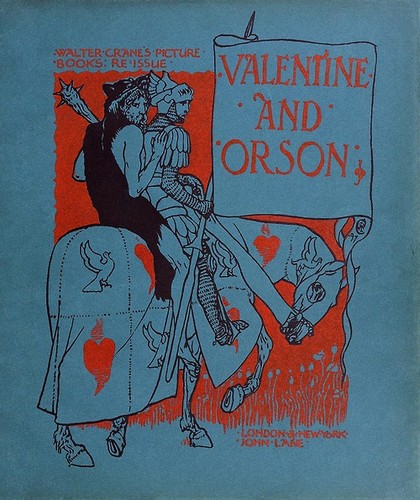
Valentine and Orson
medieval romance attached to the Carolingian circle
Lailoken
Lailoken (aka Merlyn Sylvester) was a semi-legendary madman and prophet who lived in the Caledonian Forest in the late 6th century. The Life of Saint Kentigern mentions "a certain foolish man, who was called Laleocen" living at or near the village of Peartnach (Partick) within the Kingdom of Strathclyde. Laleocen correctly prophesied the death of King Rhydderch Hael.
Jan-gant-i-tan
324x324px|thumb|right|Yan-gant-y-tan in the Dictionnaire Infernal, 1863.
Yan-gant-y-tan is the name of a demon from Brittany, France.Sirdar Ikbal Ali Shah. Occultism: Its Theory and Practice, p. 160 (1994)(4 July 1857). Superstitions and Traditions, Household Words