Category
page 1Winds

monsoon
thumb|upright=1.2|Advancing monsoon clouds and showers in Aralvaimozhy, near Nagercoil, [[Tamil Nadu, India]]
thumb|upright=1.2|Monsoon clouds arriving at Port Blair, Andaman, India

sirocco
thumb|upright=1.5|Sirocco wind
Sirocco ( ) or scirocco is a Mediterranean wind that comes from the Sahara and can reach hurricane speeds in North Africa and Southern Europe, especially during the summer season.

foehn wind
a warm, dry, downslope wind descending the lee side of the Alps as a result of synoptic-scale, cross-barrier flow over the mountain range

mistral
strong, cold, northwesterly wind that blows from the Rhone valley into the Gulf of Lion in the northern Mediterranean

harmattan
thumb|right|300px|Harmattan haze surrounding Abuja National Mosque in [[Abuja]]
bora
wind

khamsin
Khamsin, chamsin or hamsin ( , meaning "fifty"), more commonly known in Egypt, Israel and Palestine as khamaseen ( , ), is a dry, hot, sandy local wind affecting Egypt and the Levant; similar winds, blowing in other parts of North Africa, the Arabian Peninsula and the entire Mediterranean basin, have different local names, such as bad-i-sad-o-bist roz in Iran and Afghanistan, haboob in the Sudan, aajej in southern Morocco, ghibli in Tunis, harmattan in the western Maghreb, africo in Italy, sirocco (derived from the Arabic , "eastern") which blows in winter over much of the Middle East, and sim

Roaring Forties
strong westerly winds found in the Southern Hemisphere
Simoom
Simoom /Saimum( samūm; from the root s-m-m, "to poison") is a strong, hot, dry, dust-laden wind. The word is generally used to describe a local wind that blows in the Sahara, Jordan, Iraq, Syria, and the deserts of Arabian Peninsula. Its temperature may exceed and the relative humidity may fall below 10%.
%2C%20Clouds.jpg)
tramontane
Tramontane ( ) is a classical name for a northern wind. The exact form of the name and precise direction varies from country to country. The word came to English from Italian , which developed from Latin ( + ), "beyond/across the mountains", referring to the Alps in the North of Italy. The word has other non-wind-related senses: it can refer to anything that comes from, or anyone who lives on, the other side of mountains, or even more generally, anything seen as foreign, strange, or even barbarous.
Levant
wind
chinook wind
warm, dry wind in North America
Pampero
wind
Santa Ana winds
Strong down-slope winds that blow through the mountain passes in southern California

Libeccio
thumb|upright|Libeccio above Bastia
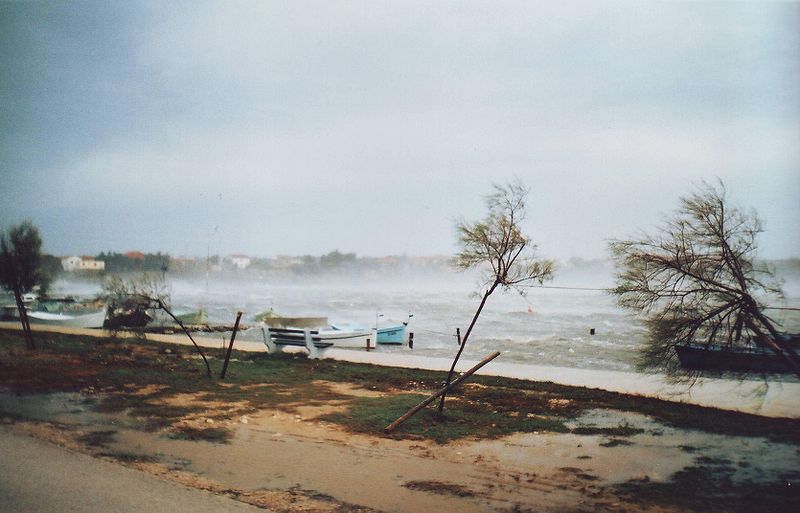
The libeccio (; Leveche ; ; ; ; ; ) is the south-westerly wind of the Western Mediterranean (which predominates in northern Corsica all year round); it frequently raises high seas and may give violent westerly squalls. In summer it is most persistent, but in winter it alternates with the Tramontane (north-east or north). The word libeccio is Italian, coming from Greek through Latin, and originally means "Libyan".
shamal
northwesterly wind blowing over Iraq and the Persian Gulf state
Gregale
The Gregale (, , , , , , , Graigos) is a Mediterranean wind that can occur during times when a low-pressure area moves through the area to the south of Malta and causes a strong, cool, northeasterly wind to affect the island. It also affects other islands of the Western Mediterranean. The Italian name "Grecale" could be translated as Greek wind, as the wind starts at the Ionian Island Zakynthos.
Ostro
Ostro (, , ), or Austro, is a southerly wind in the Mediterranean Sea, especially the Adriatic. Its name is Italian, derived from the Latin name Auster, which also meant a southerly wind. It is a warm and humid wind that often carries rain, but it is also sometimes identified with the Libeccio and Sirocco.
Etesian
The etesians ( or ; ; sometimes found in the Latin form etesiae), meltemia (; pl. of meltemi), or meltem (Turkish) are the strong, dry north winds of the Aegean Sea, which blow periodically from about mid-May to mid-September. The Etesian winds are a dominant weather influence in the Aegean Basin.
buran
type of wind or windstorm in Asia
Sukhovey
Sukhovey (, translates to dry wind) is a wind with high temperature and low relative humidity occurring in the steppes, the semi-deserts and the deserts of Kazakhstan and the Caspian region.
Zonda wind
foehn wind in Argentina
list of local winds
list article
Košava
wind

Bise
thumb|right|Bise on Lake Geneva
The Bise or bize (French: La Bise) is a cold, dry wind in Switzerland that blows through the Swiss Plateau from northeast to southwest. It typically arises when high-pressure systems over northern or eastern Europe create an air pressure difference that channels wind between the Jura mountains and the Alps. Occurring throughout the year, it brings dry weather in summer and often forms low stratus clouds in winter. The Bise has been associated with travel disruptions, agricultural damage, and weather-related physical symptoms, such as headaches.
polar easterlies
dry, cold prevailing winds from the high-pressure areas of the polar highs at the north and south poles towards low-pressure areas within the Westerlies at high latitudes
Loo
strong, hot and dry summer afternoon wind from the west which blows over the western Indo-Gangetic Plain region of North India and Pakistan
north wind
wind that originates in the north and blows south
Saharan air layer
hot, dry and sometimes dust-laden atmospheric layer
west wind
wind that originates in the west and blows east

Helm Wind
wind- and geology-driven weather complex in northern England
Cape Doctor
south-easterly wind in Western Cape, South Africa

monsoon of Indian subcontinent
Monsoon in Asian Countries
Khazri
Khazri () is the name of the cold north Caspian Sea wind that blows across the Absheron Peninsula throughout the year, particularly in Baku. Khazri is a gale-force coastal wind and one of the prevailing winds in the area. The speed of khazri can sometimes exceed 29 m/s. It damages some economic sectors. However, the wind provides cool temperatures during the summer. The Khazri wind is opposed to the Gilavar, the warm wind from the south, usually felt throughout the summertime.

Halny
thumb|right
Halny is a foehn wind that blows in southern Poland and in Slovakia in the Tatra Mountains of the Carpathians. The most turbulent halny blows in Podhale region of southern Poland, coming from the south, down the slopes of the Tatra Mountains; in Slovakia, on the other side of the mountains, it comes from the north.
Sudestada
Sudestada (Southeast blow) is the Argentine and Uruguayan name for a climatic phenomenon common to the Río de la Plata (an estuary formed by the combination of the Uruguay River and the Paraná River on the southeastern coastline of South America) and its surrounding region. The phenomenon consists of a sudden rotation of cold southern winds to the south-east. This change, while moderating the cold temperatures, loads the air masses with oceanic humidity, bringing heavy rain and rough seas in the coastal regions. The air circulation also increases the intensity of the winds. The Sudestada is mo
Cierzo
right|thumb|250px|Cierzo wind blowing in Zaragoza.
The cierzo is a strong, dry and usually cold wind that blows from the North or Northwest through the regions of Aragon, La Rioja and Navarra in the Ebro valley in Spain. It takes place when there is an anticyclone in the Bay of Biscay and a low-pressure area in the Mediterranean Sea. It is more common in autumn and winter, when larger pressure gradients take place, but a small pressure difference along the Ebro valley is sufficient to initiate it in any season.
south wind
wind that originates in the south and blows north
Gilavar
Gilavar is a name of the warm southern wind which blows across eastern Azerbaijan throughout the year, particularly in Baku and Shamakhi. Gilavar is one of the two main winds that dominate Baku, along with Khazri, the cold northern wind. The etymology of its name comes from the Tat language spoken in eastern Azerbaijan. In Tati, the word gilə means "grain/drop", and "var" means wind.
Piteraq
A piteraq is a cold katabatic wind which originates on the Greenlandic icecap and sweeps down the east coast. The word "piteraq" means "that which attacks you" in the local language. Piteraqs are most common in the autumn and winter. Wind speeds typically reach 50 to 80 m/s (180–288 km/h; 111–178 mph).
east wind
wind that originates in the east and blows west
Bayamo
Cuban wind
Minuano
Minuano is a cold southwesterly wind that blows in the southern Brazilian state of Rio Grande do Sul and in Uruguay. It has the same name of the indigenous Minuane people in the Portuguese language (in Spanish, the name of that people is Minuán, and the same wind is called pampero in Uruguay). It is widely mentioned in the Gaúcho folklore of the region. This wind originates from cold polar fronts that come from the southwest of South America during periods of high atmospheric pressure, usually following rains caused by the shock of the cold front with warmer stationary humid air. Sometimes it
Brickfielder
thumb|220px|The Brickfielder is the cause of dust storms in the east.
The Brickfielder is a hot and dry wind in Southern Australia that develops in the country's deserts in late spring and summer, which heavily raises temperatures in the southeast coast.
Tehuantepecer
thumb|upright=1.5|A graphicast issued by TAFB for a Tehuantepecer of January 11–12, 2011
Tehuantepecer, or Tehuano wind, is a violent mountain-gap wind that travels through the Chivela Pass in southern Mexico, across the Isthmus of Tehuantepec. It is most common between October and February, with a summer minimum in July. It originates from eastern Mexico and the Bay of Campeche as a post-frontal northerly wind, accelerated southward by cold air damming, that crosses the isthmus and blows through the gap between the Mexican and Guatemalan mountains. The term dates back to at least 1929. This w
Amihan
In the Philippines, amihan refers to the season dominated by the prevailing winds or trade winds, which are experienced in the country as a cool northeast wind or northeast monsoon.
Kali Andhi
Weather pattern occuring in the Indian Subcontinent
Fremantle Doctor
South westerly sea breeze in Fremantle, Western Australia
Marin
warm, moist wind in the Gulf of Lion of France
Berg wind
hot, dry foehn-type wind in South Africa
Nor'west arch
Weather pattern in New Zealand
Puelche
dry wind occurring the central Chile
East Asian Monsoon
monsoon in East Asia
Papagayo wind
meteorological phenomenon in Central America
Elephanta
wind
Norte
strong cold wind which blows from the northeast in Mexico along the Gulf of Mexico
Lodos
The lodos is the strong south-westerly wind which may predominate episodically in the Aegean Sea and Marmara Sea as well as the Mediterranean coast of Turkey all the year round; it frequently raises high seas and may give violent westerly squalls. The word lodos is Turkish, coming from Greek word "Notus", and originally means "southern wind".
==Description==
The predominant wind-driven surface current of the Aegean Sea is from northwest to southeast, but about twenty times a year the wind shifts southwards, pushing from the Mediterranean towards the Black Sea. If it continues long enough, the
classical compass winds
historical wind directions
leste
The Leste is a hot, dry, easterly wind of the Madeira and Canary Islands.
Cers
wind