Category
page 1Wireless communication systems

Wi-Fi
Wi-Fi () is a family of wireless network protocols based on the IEEE 802.11 family of standards, which are commonly used for local area networking of devices and Internet access, allowing nearby digital devices to exchange data by radio waves. These are the most widely used computer networks, used globally in home and small office networks to link devices and to provide Internet access with wireless routers and wireless access points in public places such as coffee shops, restaurants, hotels, libraries, and airports.

radar
Radar is a system that uses radio waves to determine the distance (ranging), direction (azimuth and elevation angles), and radial velocity of objects relative to the site. It is a radiodetermination method used to detect and track aircraft, ships, spacecraft, guided missiles, motor vehicles, weather formations and terrain. The term RADAR was coined in 1940 by the United States Navy as an acronym for "radio detection and ranging". The term radar has since entered English and other languages as an anacronym, a common noun, losing all capitalization.

Bluetooth
thumb|A Bluetooth earbud, an earphone and microphone that communicates with a cellphone using the Bluetooth protocol

4G
4G refers to the fourth generation of cellular network technology, introduced in the late 2000s and early 2010s. Compared to preceding third-generation (3G) technologies, 4G has been designed to support all-IP communications and broadband services, and eliminates circuit switching in voice telephony. It also has considerably higher data bandwidth compared to 3G, enabling a variety of data-intensive applications such as high-definition media streaming and the expansion of Internet of Things (IoT) applications.

3G
thumb|A USB modem for 3G plugged into a laptop.

5G
thumb|3GPP logo for 5G
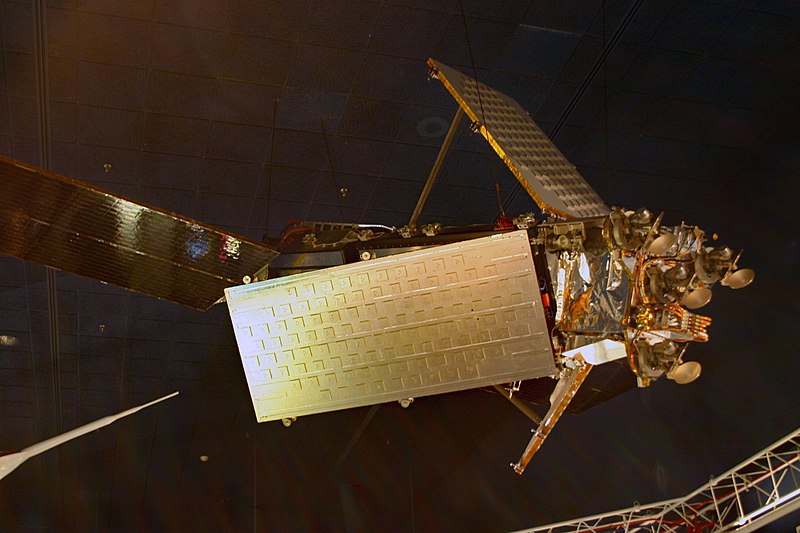
communications satellite
artificial satellite designed for telecommunications

cellular network
communication network where the last link is wireless

2G
2G refers to the second generation of cellular network technology, which were rolled out globally starting in the early 1990s. The main differentiator to previous mobile telephone systems, retrospectively dubbed 1G, is that the radio signals of 2G networks are digital rather than analog, for communication between mobile devices and base stations. In addition to voice telephony, 2G also made possible the use of data services.
1G
1G (first generation) refers to the analog mobile telecommunications standards introduced in the late 1970s. The term was later applied retroactively to distinguish these early cellular network systems from later digital generations.

6G
thumb|right|3GPP 6G logo
wireless telegraphy
method of communication

Zigbee
Zigbee is an IEEE 802.15.4-based specification for a suite of high-level communication protocols used to create personal area networks with small, low-power digital radios, such as for home automation, medical device data collection, and other low-power, low-bandwidth needs, designed for small-scale projects which need wireless connection. Hence, Zigbee is a standard for low-power, low-data-rate, close-proximity (i.e., personal area) wireless ad hoc networks.
Bluetooth Low Energy
wireless personal area network technology designed and marketed by the Bluetooth Special Interest Group aimed at novel applications
High Speed Packet Access
communications protocols

LoRa
LoRa (from "long range") is a physical proprietary radio communication technique based on spread spectrum modulation. It is used as the physical layer for LoRaWAN, a low-power, wide-area network (LPWAN) protocol that wirelessly connects battery-operated devices to the Internet. LoRa can be thought of as the radio signal technology (similar to Wi-Fi or cellular), while LoRaWAN is the protocol and network architecture that manages communication over that signal.
Z-Wave
Z-Wave is a wireless communications protocol used primarily for residential and commercial building automation. It is a mesh network using low-energy radio waves to communicate from device to device, allowing for wireless control of smart home devices, such as smart lights, security systems, thermostats, sensors, smart door locks, and garage door openers. Z-Wave Long Range (ZWLR) is a sub-GHz wireless communication protocol designed to extend smart home connectivity, offering a range of up to 1.5 miles. It enables direct hub-to-device communication, supports up to 4,000 nodes per network, and

Digital Enhanced Cordless Telecommunications
Digital Enhanced Cordless Telecommunications (DECT) is a cordless telephony standard maintained by ETSI. It originated in Europe, where it is the common standard, replacing earlier standards, such as CT1 and CT2. Since the DECT-2020 standard it also includes IoT communication.
Wi-Fi 7
IEEE standard for wireless networks

radiotelephone
thumb|Comparison of an amateur radio handheld transceiver, cell phone, and [[matchbox (the latter is not a phone)]]
Digital mobile radio
Transmission standard for voice and data in non-public radio networks
free-space optical communication
communication using light sent through free space

radioteletype
thumb|Radioteletype tuning indicator
thumb|Tuning indicator on cathode ray tube
Radioteletype (RTTY) is a telecommunications system consisting originally of two or more electromechanical teleprinters in different locations connected by radio rather than a wired link. Radioteletype evolved from earlier landline teleprinter operations that began in the mid-1800s. The US Navy Department successfully tested printing telegraphy between an airplane and ground radio station in 1922. Later that year, the Radio Corporation of America (RCA) successfully tested printing telegraphy via their Chatham, Mass
Mobile Telephone Service
early mobile telephone standard
digital private mobile radio
type of digital radio service
optical wireless communications
form of optical communication
WirelessHART
WirelessHART within telecommunications and computing, is a wireless sensor networking technology. It is based on the Highway Addressable Remote Transducer Protocol (HART). Developed as a multi-vendor, interoperable wireless standard, WirelessHART was defined for the requirements of process field device networks.
CT2
CT2 is a cordless telephony standard that was used in the early 1990s to provide short-range proto-mobile phone service in some countries in Europe and in Hong Kong. It is considered the precursor to the more successful DECT system. CT2 was also referred to by its marketing name, Telepoint.