Category
page 1Wood decomposition

Teredinidae
The shipworms, also called teredo worms or simply teredo (, via Latin ), are marine bivalve molluscs in the family Teredinidae, a group of saltwater clams with long and soft bodies. They are notorious for boring into (and commonly eventually destroying) wood that is immersed in seawater, including such structures as wooden piers, docks, and ships; they drill passages by means of a pair of very small shells ("valves") borne at one end, with which they rasp their way through. They are sometimes called "termites of the sea". Carl Linnaeus assigned the common name Teredo to the best-known genus of

xylophagy
350px|right|thumb|Worker termite
Xylophagy is a term used in ecology to describe the habits of an herbivorous animal whose diet consists primarily (often solely) of wood. The word derives from Greek ξυλοφάγος (xulophagos) "eating wood", from (') "wood" and (') "to eat". Animals feeding only on dead wood are called sapro-xylophagous or saproxylic.
wood-decay fungus
any species of fungus that digests moist wood, causing it to rot
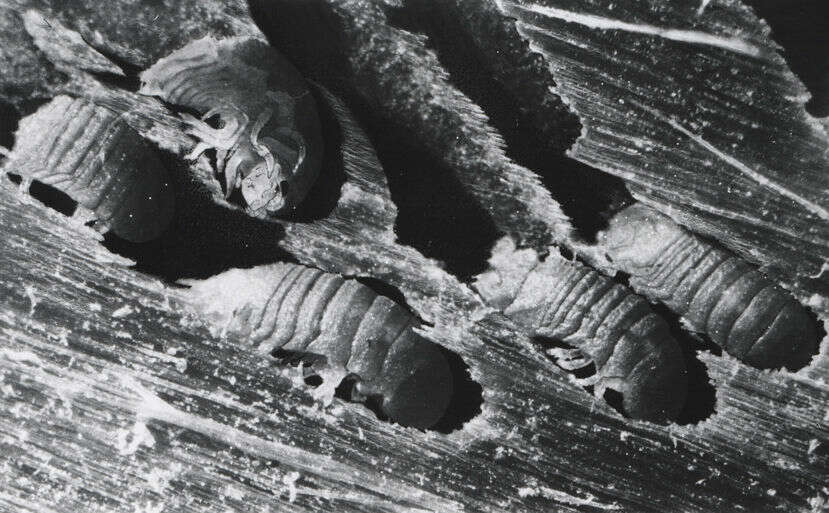
Gribble
A gribble () or gribble worm is any of about 56 species of marine isopod from the family Limnoriidae. They are mostly pale white and small ( long) crustaceans, although Limnoria stephenseni from subantarctic waters can reach .