Category
page 1Zoology

zoology
Zoology ( , ) is the scientific study of animals. Its studies include the structure, embryology, classification, habits, and distribution of all animals, both living and extinct, and how they interact with their ecosystems. Zoology is one of the primary branches of biology. The term is derived .

zoo
thumb|A sea lion and a zookeeper at the Welsh Mountain Zoo
A zoo (short for zoological garden; also called a zoological park, animal park, or menagerie) is a facility where animals are kept within enclosures for public exhibition and often bred for conservation purposes.

invertebrate
Invertebrates are animals that neither develop nor retain a vertebral column (commonly known as a spine or backbone), which evolved from the notochord. It is a paraphyletic grouping including all animals excluding the chordate subphylum Vertebrata, i.e. vertebrates. Well-known phyla of invertebrates include arthropods, molluscs, annelids, echinoderms, flatworms, cnidarians, and sponges.

twin
thumb|Identical twins can be difficult to visually distinguish especially when young, as demonstrated by brothers Billy and Bobby Mauch.
Twins are two offspring produced by the same pregnancy. Twins can be either monozygotic ('identical'), meaning that they develop from one zygote, which splits and forms two embryos, or dizygotic ('non-identical' or 'fraternal'), meaning that each twin develops from a separate egg and each egg is fertilized by its own sperm cell. Since identical twins develop from one zygote, they will share the same sex, while fraternal twins may or may not. In very rare cas

seashell
right|thumb|Seashells washed up on the beach in Valencia, Spain; nearly all are single valves of [[bivalve mollusks, mostly of Mactra corallina]]
right|thumb|Hand-picked molluscan seashells (bivalves and [[gastropods) from the beach at Clacton on Sea in England]]
thumb|A group of seashells, mostly bivalves in the family Pholadidae
thumb|226x226px|Mixed shells on a beach in Venezuela
thumb|Hermit crabs inhabiting marine gastropod shells that lived in the [[Persian Gulf]]
thumb|A group of beach-worn sea snail shells that vary in size, form and pattern combination.

parthenogenesis
thumb|280px|right|The asexual, all-female whiptail species Aspidoscelis neomexicanus (center), which reproduces via parthenogenesis, is shown flanked by two sexual species having males, A. inornatus (left) and A. tigris (right), which naturally hybridized to form A. neomexicanus.

cladistics
Cladistics ( ; from Ancient Greek 'branch') is an approach to biological classification in which organisms are categorized in groups ("clades") based on hypotheses of most recent common ancestry. The evidence for hypothesized relationships is typically shared derived characteristics (synapomorphies) that are not present in more distant groups and ancestors. However, from an empirical perspective, common ancestors are inferences based on a cladistic hypothesis of relationships of taxa whose character states can be observed. Theoretically, a last common ancestor and all its descendants constitut
.jpg)
carrion
thumb|A wedge-tailed eagle and carrion ([[roadkill kangaroo) in the Pilbara region of Western Australia.]]
thumb|Zoarcidae|Zoarcid fish feeding on the carrion of a mobulid ray.

antenna
appendages used for sensing in arthropods

cryptozoology
Cryptozoology is a pseudoscience and subculture that searches for and studies unknown, legendary, or extinct animals whose present existence is disputed or unsubstantiated, particularly those popular in folklore, such as Bigfoot, the Loch Ness Monster, Yeti, the chupacabra, the Jersey Devil, or the mokele-mbembe. Cryptozoologists refer to these entities as cryptids, a term coined by the subculture. Because it does not follow the scientific method, cryptozoology is considered a pseudoscience by mainstream science: it is a branch of neither zoology nor folklore studies. It was originally founded

offspring
right|thumb|A frog in frogspawn
In biology, offspring () are the young creation of living organisms, produced either by sexual or asexual reproduction. Collective offspring may be known as a brood or progeny. This can refer to a set of simultaneous offspring, such as the chicks hatched from one clutch of eggs, or to all offspring produced over time, as with the honeybee. Offspring can occur after mating, artificial insemination, or as a result of cloning.

photoperiodism
Photoperiod is the change of day length over the seasons. Earth's rotation around its axis produces 24-hour changes in light (daytime) and dark (night) cycles on Earth. The length of the light and dark in each phase varies across the seasons due to the axial tilt of Earth. The photoperiod defines the length of the light. For example, in summer the length of light could be 16 hours while the dark is 8 hours, whereas in winter the length of day could be 8 hours, while the dark is 16 hours. Importantly, the axial tilt of the Earth causes the opposing seasons in the Northern and Southern Hemispher
World Register of Marine Species
web-based database of marine species
.jpg)
megafauna
thumb|320px|The African bush elephant (foreground), Earth's largest extant land animal, and the [[Masai ostrich (background), one of Earth's largest extant birds]]
In zoology, megafauna (from Greek 'large' and Neo-Latin 'animal life') are large animals. The precise definition of the term varies widely, though a common threshold is approximately , this lower end being centered on humans, with other thresholds being more relative to the sizes of animals in an ecosystem, the spectrum of lower-end thresholds ranging from to , the latter largely restricted to megaherbivores. Large body size is gene
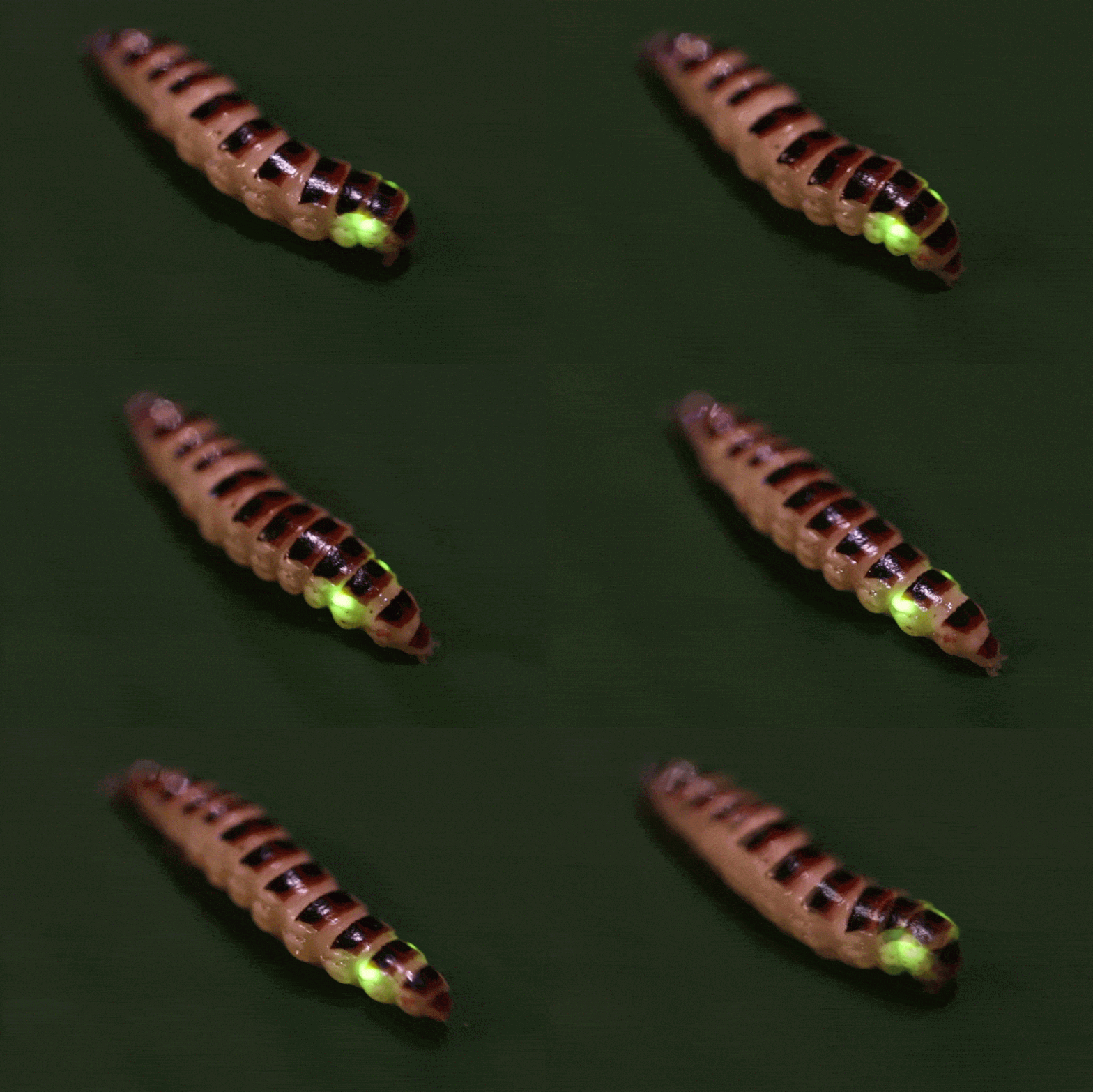
animal locomotion
self-propulsion by an animal

Portal:Animals
Wikipedia portal for content related to Animals

bestiary
thumb|Monocerus|Monoceros and [[Bear. Bodleian Library, MS. Ashmole 1511, The Ashmole Bestiary, Folio 21r, England (Peterborough?), Early 13th century.]]
right|thumb|upright|"The Leopard" from the 13th-century bestiary known as the "[[Rochester Bestiary"]]
thumb|upright|The Peridexion tree|Peridexion Tree
transitional fossil
fossilized remains of a life form that exhibits traits common to both an ancestral group and its derived descendant group

ecotype
Ecotypes, or ecospecies, are organisms which belong to the same species but possess different phenotypical features as a result of environmental factors such as elevation, climate and predation. Ecotypes can be seen in wide geographical distributions and may eventually lead to speciation.
alpha
individual in the community with the highest rank

zooarchaeology
thumb|Illustration of an Egyptian mummy of a dog

endoskeleton
thumb|upright=1.2|Endoskeleton of a swordfish

eggshell
thumb|upright=1.4|A broken wild bird eggshell

anthrozoology
thumb|Sled dog racing in Alaska
animal cognition
intelligence of non-human animals
Gloger's rule
ecogeographical rule for endotherms

anamniotes
The anamniotes are an informal group of vertebrates comprising all fish and amphibians, which lay their eggs in aquatic environments. They are distinguished from the amniotes (reptiles, birds and mammals), which can reproduce on dry land either by laying shelled eggs or by carrying fertilized eggs within the female. Older sources, particularly before the 20th century, may refer to anamniotes as "lower vertebrates" and amniotes as "higher vertebrates", based on the antiquated idea of the evolutionary great chain of being.
multiple birth
culmination of one multiple pregnancy, wherein the mother delivers two or more offspring; applicable to placental species
litter
animal offspring
metamerism
phenomenon of having a linear series of body segments fundamentally similar in structure
animal track
imprint left behind in soil, snow, or mud, or on some other ground surface, by an animal walking across it
animal colouration
general appearance of an animal resulting from the reflection or emission of light from its surfaces
sleep
sleep in non-human beings

gynogenesis
Gynogenesis, a form of parthenogenesis, is a system of asexual reproduction that requires the presence of sperm without the actual contribution of its DNA for completion. The paternal DNA dissolves or is destroyed before it can fuse with the egg. The egg cell of the organism is able to develop, unfertilized, into an adult using only maternal genetic material. Gynogenesis is often termed "sperm parasitism" in reference to the somewhat pointless role of male gametes. Gynogenetic species, "gynogens" for short, are unisexual, meaning they must mate with males from a closely related bisexual specie
.jpg)
heterodont
thumb|Tooth shape changes within the jaw (homodont to heterodont). Scanning electron microscope|SEMs of adult lower jaws. (A) Homodont unicuspid snake, [[Python molurus, (B) homodont gecko, Paroedura picta, (C) homodont tricuspid Monitor lizard, Varanus niloticus, (D) heterodont anole, Anolis allisoni. (D′) Tricuspid teeth of the posterior jaw at the back of the mouth. (D″) Unicuspid teeth of the anterior jaw at the front of the mouth. Scale bar = 1 mm (A–D) and 200 μm (D′,D″).]]
hearing range
range of frequencies that can be heard by humans or other animals
.jpg)
zoophyta
thumb|Tartar lamb illustration
thumb|Zoophytes in 1833 book.
A zoophyte (animal-plant) is an obsolete term for an organism thought to be intermediate between animals and plants, or an animal with plant-like attributes or appearance. In the 19th century they were reclassified as Radiata which included various taxa, a term superseded by Coelenterata referring more narrowly to the animal phyla Cnidaria (coral animals, true jellies, sea anemones, sea pens, and their allies), sponges, and Ctenophora (comb jellies).
terrestrial animal
animals living on land
display
set of ritualized behaviours that enable an animal to communicate to other animals about specific stimuli
sessility
property of organisms that do not possess a means of self-locomotion and are normally immobile

necrophage
thumb|250x250px|Carcass of a shrew surrounded by multiple necrophages, including a blow fly and [[burying beetle.]]
Necrophages (also known as carrion feeders) are animals that feed on decomposing dead animal biomass, such as the muscle and soft tissue of carcasses or corpses. The term derives from Greek , meaning 'dead', and , meaning 'to eat'. Many hundreds of necrophagous species have been identified including invertebrates in the insect, malacostracan and gastropod classes and vertebrates such as vultures, hyenas, quolls and wolves.

dactyly
alt=Human hand anatomy|thumb|Human hand anatomy (pentadactyl)
In biology, dactyly is the arrangement of digits (fingers and toes) on the hands, feet, or sometimes wings of a tetrapod animal. The term is derived from the Ancient Greek word δάκτυλος (dáktulos), meaning "finger."
swarm behaviour
collective behaviour of a large number of (usually) self-propelled entities of similar size

overpopulation
Overpopulation or overabundance is a state in which the population of a species is larger than the carrying capacity of its environment. This may be caused by increased birth rates, lowered mortality rates, reduced predation or large scale migration, leading to an overabundant species and other animals in the ecosystem competing for food, space, and resources. The animals in an overpopulated area may then be forced to migrate to areas not typically inhabited, or die off without access to necessary resources.
ethnozoology
Ethnozoology is a field of study that explores the complex relationships between humans and animals in their environment. This discipline encompasses the classification and naming of various animal species, as well as the cultural knowledge and use of both wild and domesticated animals. Ethnozoology is a subdiscipline of ethnobiology, which also includes ethnobotany, the study of human-plant relationships. However, unlike ethnobotany, ethnozoology focuses specifically on human-animal relationships and the knowledge that humans have acquired about the animals in their surroundings.
Census of Marine Life
biological census
mixed-species foraging flock
swarming behaviour of birds when foraging

microfauna
thumb|250px| Scanning electron microscope image of a [[soybean cyst nematode and its egg]]
Microfauna () are microscopic animals and organisms that exhibit animal-like qualities and have body sizes that are usually <0.1 mm. Microfauna are represented in the animal kingdom (e.g. nematodes, small arthropods) and some other heterotrophic, microscopic eukaryotes. A large amount of microfauna are soil microfauna which includes eukaryotic microbes, rotifers, and nematodes. These types of animal-like eukaryotic microbes and true animals are heterotrophic, largely feeding on bacteria. However, so

terrestrial locomotion
locomotion on land

automixis
thumb|280px|right|The effects of central fusion and terminal fusion on heterozygosity
infanticide
killing of young offspring by adult animals of the same species
animal science
science and business of producing domestic livestock species, including but not limited to beef cattle, dairy cattle, horses, poultry, sheep, and swine, and of nutrition, care, and welfare of companion animals
non-human
For the 2022 horror film, see Unhuman (film).
Non-human (also spelled nonhuman) is any entity displaying some, but not enough, human characteristics to be considered a human. The term has been used in a variety of contexts and may refer to objects that have been developed with human intelligence, such as robots or vehicles.
Argos System
system for collecting electronic environmental data
captive breeding
raising plants or animals in zoos or other controlled conditions
diphyodont
A diphyodont is any animal with two sets of teeth, initially the deciduous set and consecutively the permanent set. Most mammals are diphyodonts—as to chew their food they need a strong, durable and complete set of teeth.
animal nutrition science
science of nutrition for animals
Pitfall trap
trap for small animals
Species Survival Plan
The American Species Survival Plan was developed by the (American) Association of Zoos and Aquariums to help ensure the survival of selected species in zoos and aquariums.
defeminization
In developmental biology and zoology, defeminization is an aspect of the process of sexual differentiation by which a potential female-specific structure, function, or behavior is changed by one of the processes of male development.