
File:156_Xanthippe.png · Wikimedia Commons · See Wikimedia Commons
Picture of the Day · NASA
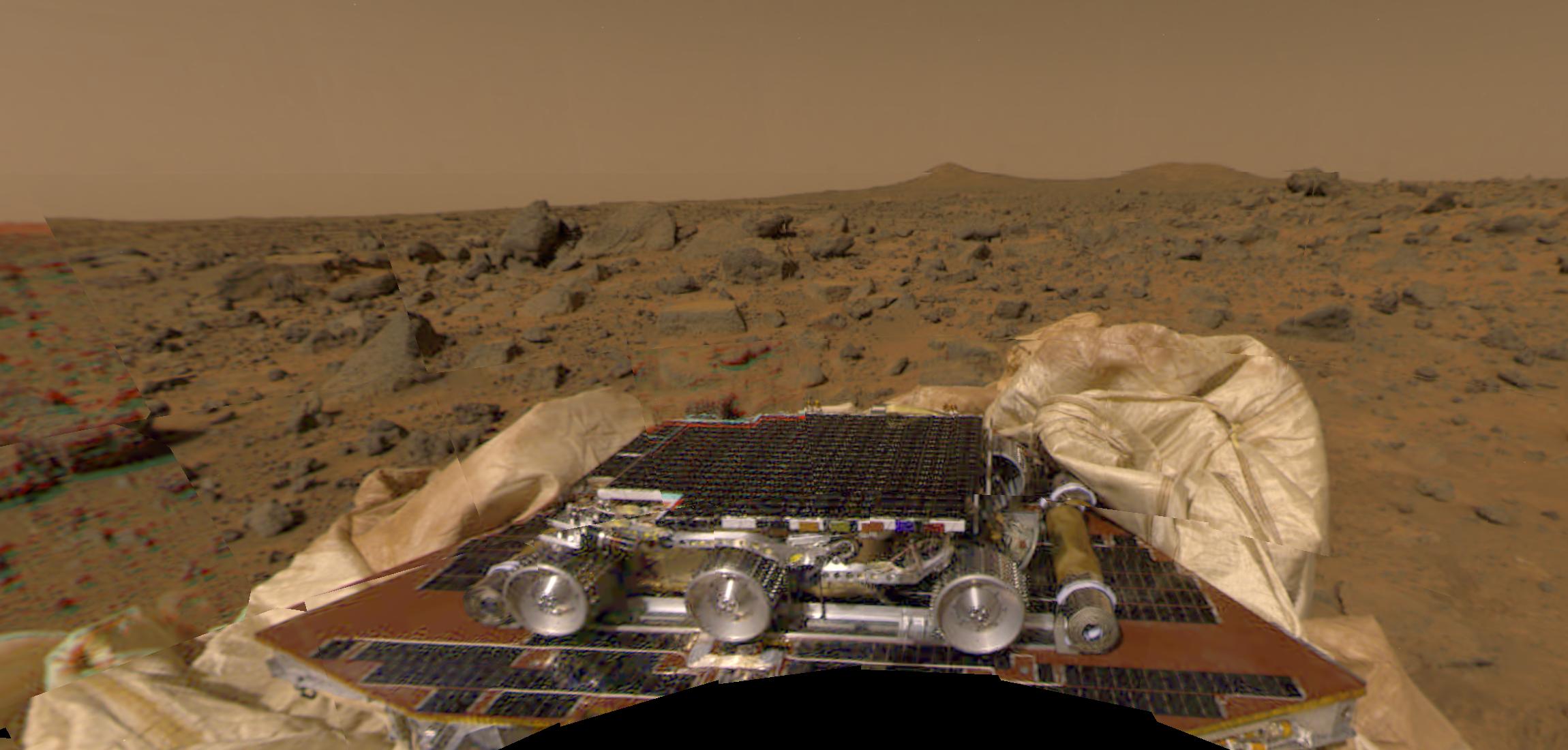
Pathfinder on Mars
2026-07-04
On July 4th, 1997, using its own array of fireworks, a parachute, and a cocoon of airbags, the Mars Pathfinder spacecraft bounced like a giant beach ball at least 15 times before it came to rest on the surface of Mars at 10:07 AM Pacific Daylight Time. After its then novel airbag-assisted landing sequence was completed, Pathfinder transmitted this color mosaic to mission operators on Earth. In the scene from another world, the Mars Sojourner robot rover is visible in the foreground, crouched on top of the unfolded Pathfinder. About the size of a large house cat, the six-wheeled, solar-powered Sojourner became the first successful Martian rover. Surrounding Pathfinder are deflated airbags and the rock-strewn terrain of the Ares Vallis floodplain. In the distance Martian hills appear against a dusty brownish sky. The Pathfinder lander was subsequently renamed the Carl Sagan Memorial Station.
via NASA APOD
Small body data
(156) Xanthippe
- Orbit class
- Main-belt
- Semi-major axis
- 2.733 AU
- Eccentricity
- 0.222
- Inclination
- 9.763 °
- Absolute magnitude
- 8.800 H
via Minor Planet Center
Key facts
- Discovered by
- J. Palisa
- Discovery site
- Austrian Naval Obs.
- Discovery date
- 22 November 1875
- Pronunciation
- / z æ n ˈ θ ɪ p iː /
- Named after
- Xanthippe , (wife of Socrates )
- Alternative designations
- A875 WA; 1901 SA;, 1902 VA; 1936 FG 1 ;, 1942 RP; 1949 BN
- Minor planet category
- main-belt · ( middle ) , background
- Observation arc
- 116.46 yr (42,537 d)
- Aphelion
- 3.3475 AU
- Perihelion
- 2.1069 AU
- Semi major axis
- 2.7272 AU
- Orbital period sidereal
- 4.50 yr (1,645 d)
- Mean anomaly
- 34.237 °
- Mean motion
- 0° 13 7.68 / day
- Inclination
- 9.7818°
- Longitude of ascending node
- 241.83°
- Argument of perihelion
- 338.29°
- Mean diameter
- 110.409 km , 110.718 ± 2.187 km , 115.49 ± 1.74 km , 116.34 ± 4.14 km , 120.99 ± 2.5 km , 121.68 ± 41.10 km , 122.02 ± 31.66 km , 143.346 ± 0.903 km , 143.35 ± 0.90 km
via Wikipedia infobox
Wikidata facts
- Instance of
- asteroid
- Named after
- Xanthippe
- Followed by
- 157 Dejanira
- Follows
- 155 Scylla
- Parent body
- Sun
- Minor-planet group
- asteroid belt
- Diameter
- 143.346
- Orbital period
- 1651.410745129506
Show 19 more facts
- discoverer or inventor
- Johann Palisa
- site of astronomical discovery
- Pula Observatory
- provisional designation
- A875 WA
- time of discovery or invention
- 1875-11-22
- asteroid spectral type
- C-type asteroid
- orbital inclination
- 9.763675486860794
- albedo
- 0.03
- Commons category
- 156 Xanthippe
- rotation period
- 22.132
- absolute magnitude
- 8.81
- orbital eccentricity
- 0.2217991784954199
- semi-major axis of an orbit
- 2.734247263469422
- periapsis
- 2.127793466628554
- apoapsis
- 3.340701060310289
- longitude of ascending node
- 241.7268567611815
- argument of periapsis
- 338.8262588174912
- mean anomaly
- 285.6372809635043
- time of periapsis
- 2461341.6205368163
- epoch
- November 21, 2025
Sources (2)
via Wikidata · CC0
Article · Português
Xanthippe (asteroide 156) é um asteroide da cintura principal com um diâmetro de 120,99 quilómetros, a 2,12580883 UA. Possui uma excentricidade de 0,22220581 e um período orbital de 1 650,38 dias (4,52 anos). Xanthippe tem uma velocidade orbital média de 18,01619145 km/s e uma inclinação de 9,7483651º. Este asteroide foi descoberto em 22 de Novembro de 1875 por Johann Palisa. Este asteroide recebeu este nome em honra a Xantípe, esposa do filósofo grego Sócrates.
Abstract from DBpedia / Wikipedia · CC BY-SA