99906 Uofalberta
Also known as (99906) 2002 QV53, 2002 QV53, Uofalberta
asteroide
Picture of the Day · NASA
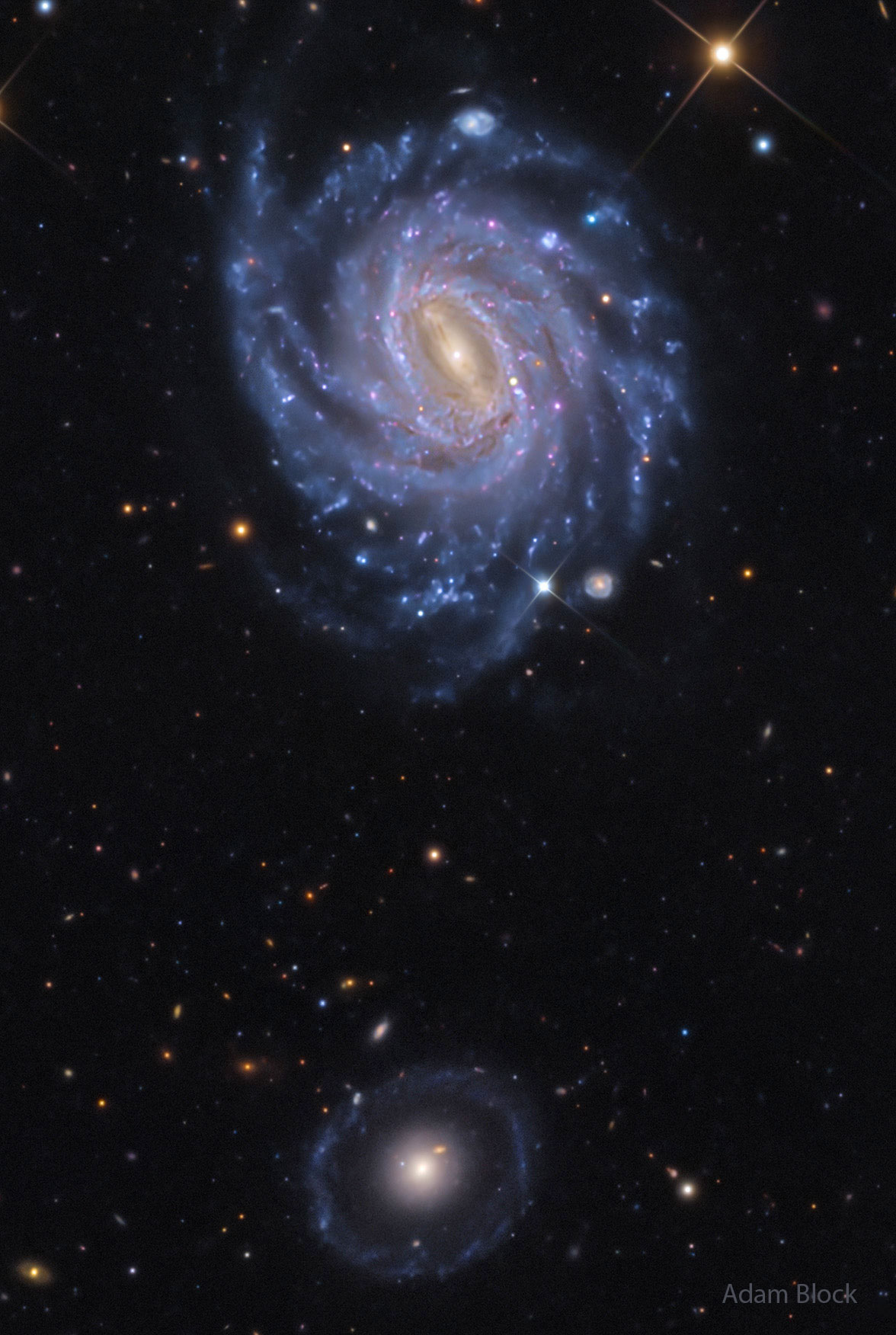
NGC 3660 and Burçin's Galaxy
2026-05-26
The upper galaxy might be more photogenic, but the lower galaxy is more unusual. The galaxy up top is NGC 3660, a spiral galaxy similar to our own Milky Way galaxy in that it has several bright blue spiral arms and a central bar of stars, dust, and gas. Captured by chance in the featured deep and colorful image, surprisingly, is SN 2026cff, a supernova found just to the right of the central bar. Farther in the distance is the bottom galaxy, known informally as Burçin’s galaxy, but formally cataloged as LEDA 1000714. The center of this galaxy appears to be an old elliptical galaxy, but it is strangely surrounded by not one but two rings of stars. What created Burçin's galaxy is a mystery and remains a continuing topic of research, but it likely involves the accretion of one or more smaller galaxies.
via NASA APOD
Article · Português
Uofalberta (asteróide 99906) é um asteróide da cintura principal, a 2,9197322 UA. Possui uma excentricidade de 0,0918717 e um período orbital de 2 105,67 dias (5,77 anos). Uofalberta tem uma velocidade orbital média de 16,61096415 km/s e uma inclinação de 11,6929º. Este asteróide foi descoberto em 17 de Agosto de 2002 por .
Abstract from DBpedia / Wikipedia · CC BY-SA