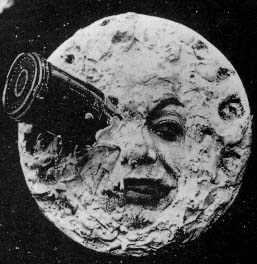
A Trip to the Moon
Also known as Voyage to the Moon, Trip to the Moon, The Journey to the Moon
1902 French black-and-white silent science fiction film directed by Georges Méliès
AI overview
"A Trip to the Moon" is a 1902 French silent film directed by Georges Méliès that tells a science fiction story about traveling to the moon. It matters because it's considered a pioneering work of early cinema, showcasing innovative visual effects and imaginative storytelling techniques that helped establish science fiction as a film genre.
AI-generated from the Wikipedia summary — may contain errors.
Internet Archive
textsThe distance to the moon : a road trip into the American dream
Read online at Internet Archive →via archive.org
Wikidata facts
- FilmAffinity ID
- 363136
- Image
- Le Voyage dans la lune.jpg
Sources (14)
Article
A Trip to the Moon (French: Le Voyage dans la Lune [lə vwajaʒ dɑ̃ la lyn], transl. "The Journey into the Moon") is a 1902 French science-fiction adventure trick film written, directed and produced by Georges Méliès. Inspired by the Jules Verne novel From the Earth to the Moon (1865) and its sequel Around the Moon (1870), the film follows a group of astronomers who travel to the Moon in a cannon-propelled capsule, explore the Moon's surface, escape from an underground group of Selenites (lunar inhabitants), and return to Earth with a captive Selenite. Méliès leads an ensemble cast of French theatrical performers as the main character Professor Barbenfouillis.
Although the film disappeared into obscurity after Méliès's retirement from the film industry, it was rediscovered around 1930, when Méliès's importance to the history of cinema was beginning to be recognised by film devotees. An original hand-colored print was discovered in 1993, and restored in 2011.
Gallery (14)
Connections
Categories
1900s rediscovered films1900s science fiction adventure films1902 films1902 French films1902 science fiction films1902 short filmsFilms based on From the Earth to the MoonFilms based on multiple worksFilms based on science fiction novelsFilms directed by Georges MélièsFilms set on the MoonFrench black-and-white films