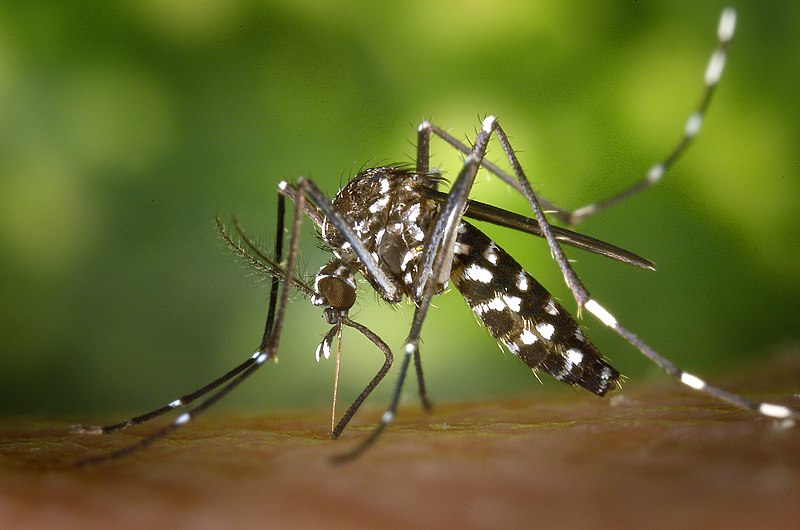
Asian tiger mosquito
Also known as Stegomyia albopicta, Forest day mosquito, Aedes albopictus, Aedes (Stegomyia) albopictus
species of insect
AI overview
The Asian tiger mosquito is a species of insect that has become an invasive species in many parts of the world. It matters because it can transmit diseases like dengue fever and Zika virus to humans.
AI-generated from the Wikipedia summary — may contain errors.
Species
二名法 Aedes albopictus(Skuse, 1895) 深藍:自然分佈深綠:引入 白纹伊蚊(学名:Aedes albopictus)也稱做亞洲虎蚊,屬蚊科,其特徵是有帶白色條紋的腿及小而黑白色的身軀。牠們來自東南亞,散佈於馬達加斯加往東到新幾內亞,北至朝鮮半島的緯度地區。與埃及伊蚊同為登革熱的病媒蚊。國際自然保護聯盟物種存續委員會的入侵物種專家小組(ISSG)列為世界百大外來入侵種。 亞洲虎蚊獨特的一種成員身長約5毫米。像蚊科的其他成員一樣,雌性的蚊子有一個長而細的管狀器官,用來收集血液,餵養牠們的卵;而雄性則吸食花蜜或植物汁液。雌性的蚊子會把卵產在水的附近來繁殖,但不像其他蚊子一樣把卵直接產在水中,典型地會把卵產在死水池中,任何敞開盛了水的容器都可以令幼蟲生長繁殖。 目录 1 亞洲虎蚊與北美洲 2 具攻擊性的種類 3 参考文献 4 參見 5 外部链接 亞洲虎蚊與北美洲 亞洲虎蚊是於1985年在北美洲休斯頓的口岸裝運貨物時被發現的。後來,牠們散佈到美國南部遠至美國東海岸的新澤西州南部,亦繁殖於夏威夷,牠們事實上早在1896年已在當地繁殖。他們與北美洲的其他蚊子如Ochlerotatus canadensis等的腳的形態很相似。 具攻擊性的種類 亞洲虎蚊可以在變化很大的棲息地和環境下存活,適應力很強。大體而言,牠們比其他品種的蚊子更具攻擊性,同時能極快地叮咬動物。 這種蚊子在多個社區中成為了一種人們注意的害蟲,因為牠們與人類有緊密的關聯(而不是住在沼澤地),並且是在日間出動,而不是在夜晚、黃昏或黎明時份。牠們繁殖於容器或泥潭中,只需要數盎司的水就可以繁殖。牠們的飛行距離很短(少於200米),所以繁殖的地點可能處於找到這種蚊子的地方附近[1]。 縱使並不是傳播西尼羅河病毒的媒介,牠們但卻可以帶有東部馬腦炎。牠們亦是在美國中部、美國南部及太平洋登革熱的傳染媒介。 参考文献 ^ Nishida, G.M. and J.M. Tenorio. 1993. What Bit Me? Identifying Hawai'i's Stinging and Biting Insects and Their Kin. University of Hawaii Press, Honolulu. 72 pp. 在西班牙的虎蚊 News tracking the recent spread of the tiger mosquito to Spain 參見 埃及伊蚊 蚊科 害蟲 瘧蚊 登革热 "The Tiger Mosquito - The Film"Under a funny - yet scientifically accurate - angle, this film deals with the biology of the tiger mosquito, an
via
Wikidata facts
- Image
- CDC-Gathany-Aedes-albopictus-2.jpg
Sources (3)
via Wikidata · CC0
Article
Aedes albopictus (synonym Stegomyia albopicta), from the mosquito (Culicidae) family, also known as the (Asian) tiger mosquito or forest mosquito, is a species of mosquito native to the tropical and subtropical areas of Southeast Asia. In the past few centuries, it has spread to many countries through the transport of goods and international travel. It is characterized by the white bands on its legs and body.
This mosquito has become a significant pest in many communities because it closely associates with humans (rather than living in wetlands), and typically flies and feeds in the daytime in addition to at dusk and dawn. The insect is called a tiger mosquito as it has stripes, as does a tiger. Ae. albopictus is an epidemiologically important vector for the transmission of many viral pathogens, including the yellow fever virus, dengue fever, and Chikungunya fever, as well as several filarial nematodes such as Dirofilaria immitis. Aedes albopictus is capable of hosting the Zika virus and is considered a potential vector for Zika transmission among humans.