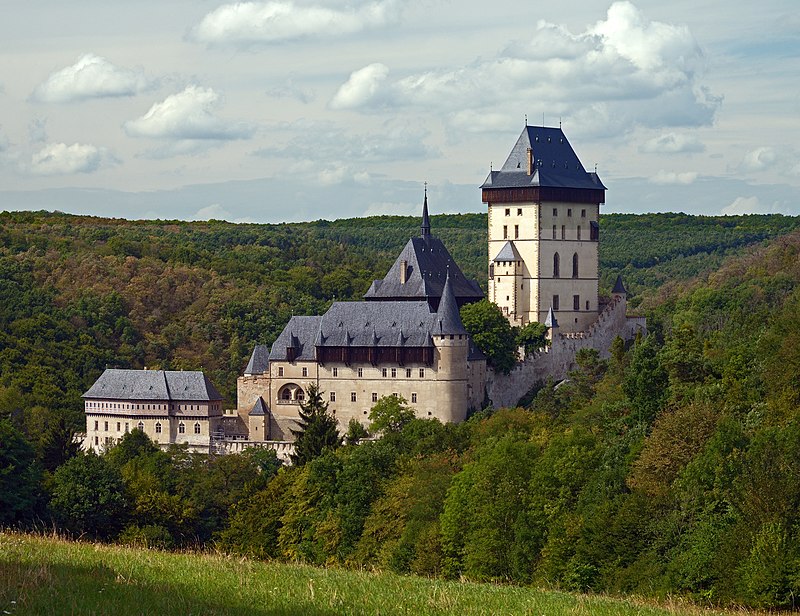
File:Karlštejn_Castle,_Czech_Republic.JPG · Wikimedia Commons · See Wikimedia Commons
Bohemia
Sign in to saveBohemia ( ; ; ) is the westernmost and largest historical region of the Czech Republic. Bohemia can also refer to a wider area consisting of the historical Lands of the Bohemian Crown ruled by the Bohemian kings, including Moravia and Czech Silesia, in which case the term refers to the historical cultural and political space of the Czech people. The smaller region is then referred to as Bohemia proper as a means of distinction.
Bohemia is the westernmost and largest historical region of what is now the Czech Republic. The term can refer either to just this region itself or to a broader area that historically included Moravia and Czech Silesia under Bohemian rule, making it an important geographical and cultural marker for understanding Czech history and identity.
AI-generated from the Wikipedia summary — may contain errors.
Key facts
- Settlement.name
- Bohemia
- Settlement.type
- Historical land
- Settlement.image_shield
- Small coat of arms of the Czech Republic.svg
- Settlement.shield_size
- 70px
- Settlement.image_flag
- Flag_of_Bohemia.svg
- Settlement.image_map
- CZ-cleneni-Cechy-wl.png
- Settlement.map_caption
- Bohemia (green) overlapped with the current regions of the Czech Republic
- Settlement.image_map1
- EU-Bohemia.png
- Settlement.map_caption1
- Location of Bohemia in the European Union
- Settlement.subdivision_type
- Country
- Settlement.subdivision_name
- Czech Republic
- Settlement.seat_type
- Capital
- Settlement.seat
- Prague
- Settlement.area_total_km2
- 52065
- Settlement.population_total
- 6880000
- Settlement.population_as_of
- 2024
- Settlement.population_density_km2
- auto
- Settlement.population_demonym
- Bohemian
via Wikipedia infobox
Wikidata facts
- Instance of
- cultural region
- Named after
- Boii
- Demonym
- boeme
- Country
- Czech Republic
- Located in
- Czech Republic
- Continent
- Europe
- Capital
- Prague
- Area
- 52065
- Highest point
- Sněžka
- Image
- Hrad Karlštejn, pohled od jihu.JPG
- Patron saint
- John of Nepomuk
Show 8 more facts
- topic's main category
- Category:Bohemia
- category of associated people
- Category:People from Bohemia
- category for people who died here
- Q15218302
- Commons category
- Bohemia
- category for people born here
- Q8046629
- different from
- Bohemia
- P6482
- Bohemia
- native label
- Böhmen
via Wikidata · CC0
~30 min read
Encyclopedic overview
18 sectionsContents
- Etymology
- History
- Ancient Bohemia
- Přemysl dynasty
- Luxembourg dynasty
- Hussite Bohemia
- Interbellum
- German occupation and World War II
- Recent history
- Former parts
- Žitava
- Kladsko
- Historical administrative divisions
- See also
- Notes
- References
- Further reading
- External links
Bohemia ( ; ; ) is the westernmost and largest historical region of the Czech Republic. Bohemia can also refer to a wider area consisting of the historical Lands of the Bohemian Crown ruled by the Bohemian kings, including Moravia and Czech Silesia, in which case the term refers to the historical cultural and political space of the Czech people. The smaller region is then referred to as Bohemia proper as a means of distinction.
Bohemians principality became a part of Great Moravia, and then an independent Duchy of Bohemia, which became a kingdom in the Holy Roman Empire. This subsequently became a part of the Habsburg monarchy and the Austrian Empire. After World War I and the establishment of an independent Czechoslovak state, the whole of Bohemia became a part of Czechoslovakia, defying claims of the German-speaking inhabitants that regions with German-speaking majority should be included in the Republic of German-Austria. Between 1938 and 1945, these border regions were annexed to Nazi Germany as the Sudetenland.
Excerpted from Wikipedia’s “Bohemia” article, available under the CC BY-SA 4.0 licence.
Gallery (415)
On the map
31 mapped locations
Available in 99 languages
- Español
- Français
- Deutsch
- 中文
- 日本語
- Русский
- Português
- Italiano
- العربية
- Afrikaans
- Albanian
- Albanian
- Aragonese
- Armenian
- Asturian
- Azerbaijani
- Bahasa Indonesia
- Bangla
Show 80 more
- Basque
- Bavarian
- be_x_old
- Belarusian
- Breton
- Bulgarian
- Burmese
- Catalan
- Chechen
- Croatian
- Czech
- Danish
- Esperanto
- Estonian
- Filipino
- Finnish
- Galician
- Georgian
- Greek
- Hebrew
- Hungarian
- Icelandic
- Ido
- Interlingua
- Interlingue
- Irish
- Javanese
- Kanuri
- Kurdish
- Latin
- Latvian
- Lithuanian
- Lombard
- Low German
- Lower Sorbian
- Macedonian
- Malay
- Malayalam
- Marathi
- Mazanderani
- Mongolian
- nds_nl
- Nederlands
- Norwegian
- Norwegian Nynorsk
- Occitan
- Old English
- Picard
- Polski
- Quechua
- Romanian
- Scottish Gaelic
- Serbian
- Serbian (Latin)
- Silesian
- simple
- Slovak
- Slovenian
- Svenska
- Swahili
- Tiếng Việt
- Türkçe
- Ukrainian
- Upper Sorbian
- Urdu
- Uzbek
- Waray
- Welsh
- West Flemish
- Western Frisian
- Western Panjabi
- Wu Chinese
- Yakut
- Yiddish
- Yoruba
- zh_min_nan
- zh_yue
- فارسی
- ไทย
- 한국어
via Wikidata sitelinks · CC0