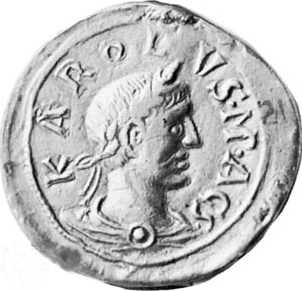
File:Sceau_de_Charles_le_gros.jpg · Wikimedia Commons · See Wikimedia Commons
Charles the Fat
Sign in to saveAlso known as Carolus Crassus, Carolus Magnus, Carolus Tertius, Charles III
Emperor of the Carolingian Empire (839-888) (r. 881-887)
Charles the Fat was a Carolingian emperor who ruled from 881 to 887, a period when the once-powerful empire founded by Charlemagne was fragmenting into separate kingdoms. He is historically significant because his reign marked the beginning of the end of the unified Carolingian Empire, as he proved unable to effectively govern or defend his vast territories against external threats and internal divisions.
AI-generated from the Wikipedia summary — may contain errors.
Wikidata facts
- Instance of
- human
- Given name
- Karl
- Gender
- male
- Spouse
- Richardis
- Child
- Bernard
- Father
- Louis the German
- Mother
- Hemma
- Occupation
- monarch
- Religion
- Christianity
- Family
- Carolingian dynasty
- Image
- Charles le Gros.PNG
Show 11 more facts
- manner of death
- natural causes
- place of burial
- Abbey of Reichenau
- Commons category
- Charles the Fat
- date of birth
- 0832-01-01
- date of death
- 0888-01-13
- owner of
- Nantouillet Castle
- described by source
- New International Encyclopedia
- cause of death
- disease
- name in native language
- Karl der Dicke
- on focus list of Wikimedia project
- Wikipedia:Vital articles/Level/4
- medical condition
- epilepsy
via Wikidata · CC0
~20 min read
Encyclopedic overview
Charles the Fat (839 – 13 January 888) was the emperor of the Carolingian Empire from 881 to 887. A member of the Carolingian dynasty, Charles was the youngest son of Louis the German and Hemma, and a great-grandson of Charlemagne. He was the last Carolingian emperor of legitimate birth and the last to rule a united kingdom of the Franks.
Over his lifetime, Charles became ruler of the various kingdoms of Charlemagne's former empire. Granted lordship over Alamannia in 876, following the division of East Francia, he succeeded to the Italian throne upon the abdication of his older brother Carloman of Bavaria who had been incapacitated by a stroke. Crowned emperor in 881 by Pope John VIII, his succession to the territories of his brother Louis the Younger (Saxony and Bavaria) the following year reunited the kingdom of East Francia. Upon the death of his cousin Carloman II in 884, he inherited all of West Francia, thus reuniting the entire Carolingian Empire.
Excerpted from Wikipedia’s “Charles the Fat” article, available under the CC BY-SA 4.0 licence.
Gallery (6)
Available in 69 languages
- Español
- Français
- Deutsch
- 中文
- 日本語
- Русский
- Português
- Italiano
- العربية
- Albanian
- Asturian
- azb
- Bahasa Indonesia
- Basque
- be_x_old
- Belarusian
- Bosnian
- Breton
Show 50 more
- Bulgarian
- Catalan
- Croatian
- Czech
- Danish
- Egyptian Arabic
- Esperanto
- Estonian
- Finnish
- Galician
- Georgian
- Greek
- Hebrew
- Hungarian
- Ido
- Irish
- Kotava
- Latin
- Latvian
- Lithuanian
- Macedonian
- Malagasy
- Nederlands
- Northern Frisian
- Norwegian
- Norwegian Nynorsk
- Occitan
- Old English
- Polski
- Romanian
- Scots
- Serbian
- Serbian (Latin)
- simple
- Slovak
- Slovenian
- Svenska
- Tiếng Việt
- Türkçe
- Ukrainian
- Welsh
- West Flemish
- Western Frisian
- Wu Chinese
- Yoruba
- zh_min_nan
- zh_yue
- فارسی
- ไทย
- 한국어
via Wikidata sitelinks · CC0