File:Shinobue_and_other_flutes-3.jpg · Wikimedia Commons · See Wikimedia Commons
flute
Sign in to saveAlso known as edge-blown aerophones, transverse flute
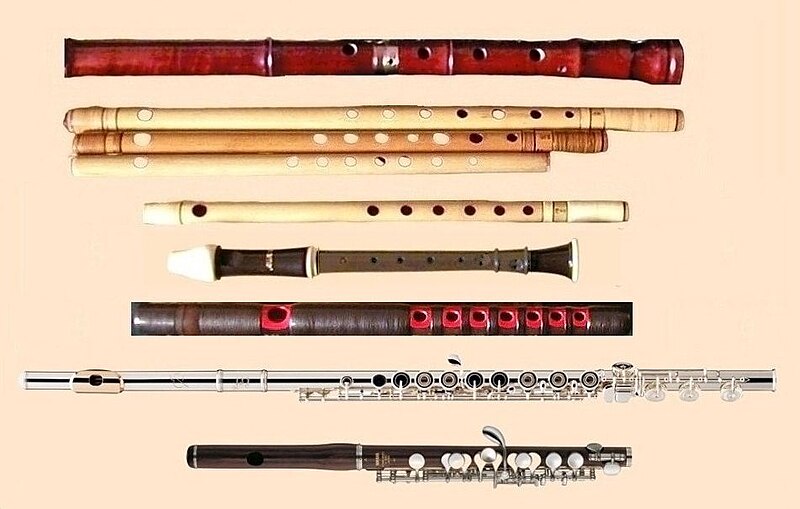
alt=Picture of a collection of flutes. Contains Shinobue and other flutes spread out on a violet velveteen cloth.|thumb|Shinobue and other flutes
A flute is a wind instrument that produces sound when air is blown across or into it, and it comes in many varieties across different cultures, such as the Shinobue. Flutes matter because they are fundamental instruments used in music-making traditions around the world and have been important to human musical expression for centuries.
AI-generated from the Wikipedia summary — may contain errors.
Described at
Skosmos: HornbostelAndSachs: Edge instruments or flutes
mimo-db.eu →Link to a page describing this subject · 4,029 chars · not written by Vinony
~22 min read
Encyclopedic overview
21 sectionsContents
- Etymology and terminology
- History
- Acoustics
- Materials
- Types
- Western transverse
- Wooden one-keyed
- Concert
- Concert variants
- Indian
- Chinese
- Korean
- Japanese
- Sodina and suling
- Sring
- Ọjà
- Breathing techniques
- See also
- References
- Bibliography
- External links
alt=Picture of a collection of flutes. Contains Shinobue and other flutes spread out on a violet velveteen cloth.|thumb|Shinobue and other flutes
The flute is a member of a family of musical instruments in the woodwind group. Like all woodwinds, flutes are aerophones, producing sound with a vibrating column of air. Flutes produce sound when the player's air flows across an opening. In the Hornbostel–Sachs classification system, flutes are edge-blown aerophones. A musician who plays the flute is called a flautist or flutist.
Excerpted from Wikipedia’s “flute” article, available under the CC BY-SA 4.0 licence.
Gallery (36)
Available in 131 languages
- Español
- Français
- Deutsch
- 中文
- 日本語
- Русский
- Português
- Italiano
- العربية
- हिन्दी
- abstract
- Afrikaans
- Albanian
- Albanian
- Aragonese
- Armenian
- Assamese
- Asturian
Show 112 more
- azb
- Azerbaijani
- Bahasa Indonesia
- Balinese
- Bangla
- Bashkir
- Basque
- Batak Toba
- be_x_old
- Belarusian
- Bhojpuri
- Bikol
- Bosnian
- Breton
- Bulgarian
- Buriat
- Burmese
- Catalan
- Central Kurdish
- Cornish
- Crimean Tatar
- Croatian
- Czech
- Danish
- Egyptian Arabic
- eml
- Esperanto
- Estonian
- Faroese
- Fiji Hindi
- Filipino
- Finnish
- Galician
- Georgian
- Gorontalo
- Greek
- Guarani
- Hawaiian
- Hebrew
- Hungarian
- Icelandic
- Ido
- Interlingua
- Irish
- Javanese
- Kannada
- Kazakh
- kbp
- Kurdish
- Kyrgyz
- Latin
- Latvian
- Ligurian
- Lithuanian
- Lombard
- Low German
- Macedonian
- Madurese
- Malagasy
- Malay
- Malayalam
- Nederlands
- Nepali
- Newari
- Northern Frisian
- Norwegian
- Norwegian Nynorsk
- Occitan
- Odia
- Piedmontese
- Polski
- Punjabi
- Quechua
- Romanian
- Rusyn
- Santali
- Scottish Gaelic
- Serbian
- Serbian (Latin)
- Shona
- Silesian
- simple
- Sindhi
- Sinhala
- Slovak
- Slovenian
- Svenska
- Swahili
- Tachelhit
- Tamil
- Telugu
- Tibetan
- Tiếng Việt
- Türkçe
- Ukrainian
- Urdu
- Uzbek
- Veps
- Walloon
- Waray
- Welsh
- Western Frisian
- Western Panjabi
- Wu Chinese
- Yakut
- Yiddish
- Zaza
- zh_min_nan
- zh_yue
- فارسی
- ไทย
- 한국어
via Wikidata sitelinks · CC0