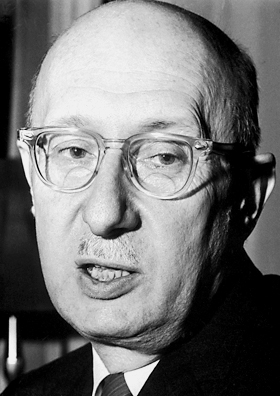
Georg von Békésy
Also known as Georg von Bekesy
Hungarian physicist (1899–1972)
AI overview
Georg von Békésy was a Hungarian physicist who won the Nobel Prize for his discoveries about how the inner ear works, particularly through his detailed studies of sound vibrations in the cochlea. His research fundamentally changed our understanding of hearing and helped explain how the ear converts sound waves into signals the brain can process.
AI-generated from the Wikipedia summary — may contain errors.
Person · Open Library
- Born
- 1899
- Works
- 5
Top works
- Miscellaneous acoustical papers, 1928-1972
- Sensory inhibition
- Experiments in hearing
- Experiments in hearing
- Sensory inhibition
via Open Library + Wikidata
Music · MusicBrainz
- Type
- Person
- Gender
- Male
- Origin
- Germany
- Active from
- 1770-12-17
- Active to
- 1827-03-26
32 sonatasbeethoven gardinerclassicalclassical periodcompletecomposer
Discography
Article
Georg von Békésy (Hungarian: Békésy György, pronounced [ˈbeːkeːʃi ˈɟørɟ]; 3 June 1899 – 13 June 1972) was a Hungarian-American biophysicist.
By using strobe photography and silver flakes as a marker, he was able to observe that the basilar membrane moves like a surface wave when stimulated by sound. Because of the structure of the cochlea and the basilar membrane, different frequencies of sound cause the maximum amplitudes of the waves to occur at different places on the basilar membrane along the coil of the cochlea. High frequencies cause more vibration at the base of the cochlea while low frequencies create more vibration at the apex.
Gallery (2)
Connections
Categories
1899 births1972 deaths20th-century Hungarian physicistsASA Gold Medal recipientsAustrian untitled nobilityHarvard University Department of Psychology facultyHistory of neuroscienceHungarian biophysicistsHungarian emigrants to the United StatesHungarian neuroscientistsHungarian Nobel laureatesHungarian nobility