
Greece
Sign in to saveAlso known as Hellenic Republic, Hellas, gr, el, Greek Republic, Ellada, Hellas, Greece
Greece, officially the Hellenic Republic, is a country in Southeast Europe. Located on the southern tip of the Balkan peninsula, it shares land borders with Albania to the northwest, North Macedonia and Bulgaria to the north, and Turkey to the east. The Aegean Sea lies to the east of the mainland, the Ionian Sea to the west, and the Sea of Crete and the Mediterranean Sea to the south. Greece has the longest coastline on the Mediterranean basin, spanning thousands of islands and nine traditional geographic regions. It has a population of over 10 million (10.482.487 according to the 2021 Greek c
OverviewAI-generated
Greece, officially the Hellenic Republic, is located in Southern Europe. Its capital is Athens, and it lies next to the Mediterranean Sea. The country has a population of 10400720 and covers an area of 131990. The main ethnic group is Greeks. The official name is also listed as Ελληνική Δημοκρατία and République hellénique. The motto is "Freedom or death."
The country uses the euro and modern Greek drachma as currency. Its license plate code is GR, and the top-level domain is .gr. The emergency phone number is 112. Public holidays include New Year, Epiphany, and the Celebration of the Greek Revolution. Greece has diplomatic relations with Italy, Brazil, Germany, and Australia. It was involved in the Macedonia naming dispute and the Prespa agreement. The inception date is 1821-03-25.
Synthesized by Vinony from 67 facts across 9 sources: Wikidata, Open Meteo, Openweathermap, REST Countries, World Bank, OpenStreetMap, PubMed, Vinony graph, Geo. Generated from structured data (not the Wikipedia text) and checked against those facts — may still contain errors.
Weather now
cached 138h ago7-day forecast
via Open-Meteo
Country

- Capital
- Athens
- Population
- 10,400,720
- Region
- Europe · Southern Europe
- Demonym
- Greek
- Currencies
- EUR (€)
- Languages
- Greek
- Calling code
- +30
- Drives on
- Right
- Gini
- 32.9 (2018)
- FIFA code
- GRE
- TLD
- .gr
- Timezones
- UTC+02:00
- Borders
- ALB, BGR, TUR, MKD
via REST Countries
Indicators · World Bank
- GDP
- $256.2B(2024)
- Population
- 10,405,134(2024)
- Life expectancy
- 81.8 yrs(2024)
- Unemployment
- 8.5 %(2025)
- Urban population
- 79 %(2024)
- Internet users
- 86.3 %(2024)
- Forest area
- 30.3 %(2023)
- Renewable energy
- 21.5 %(2021)
via World Bank Open Data · CC BY 4.0
Place details
- Locality
- Δημοτική Ενότητα Μακρακώμης
- Region
- Περιφέρεια Στερεάς Ελλάδας
- Country
- Ελλάς
via OpenStreetMap · GeoNames
Wikipedia views (30d)
205,717 totalvia Wikimedia Pageviews API
Key facts
- Country.religion_year
- 2017
- Country.languages_type
- Official language
- Country.leader_name2
- Kyriakos Mitsotakis
- Country.leader_name3
- Nikitas Kaklamanis
- Country.conventional_long_name
- Hellenic Republic
- Country.image_flag
- Flag of Greece.svg
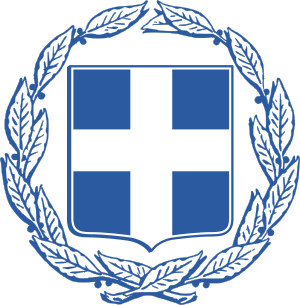
- Country.image_coat
- Coat of arms of Greece.svg
- Country.coa_size
- 90
- Country.common_name
- Greece
- Country.national_motto
- (English: "Freedom or Death")
- Country.national_anthem
- (English: "Hymn to Liberty")
- Country.capital
- Athens
- Country.largest_city
- capital
- Country.languages
- Greek
- Country.government_type
- Unitary parliamentary republic
- Country.leader_title1
- President
- Country.leader_name1
- Konstantinos Tasoulas
- Country.leader_title2
- Prime Minister
via Wikipedia infobox
Research
325,099 papers- Letter from Greece.Respirology (Carlton, Vic.) · 2021Kostikas KDOI: 10.1111/resp.14060
- Lung Cancer in Greece.Journal of thoracic oncology : official publication of the International Association for the Study of Lung Cancer · 2021Mountzios G, Gkiozos I, Stratakos G et al.DOI: 10.1016/j.jtho.2020.11.024
- Women Pursuing a Neurosurgical Career in Greece.ReviewWorld neurosurgery · 2022Lambrianou X, Tasiou ADOI: 10.1016/j.wneu.2022.05.025
- Pharmacies for pain and trauma in ancient Greece.ReviewInternational orthopaedics · 2019Mavrogenis AF, Saranteas T, Markatos K et al.DOI: 10.1007/s00264-018-4219-x
- Radiofrequency Exposure Levels in Greece.Bioelectromagnetics · 2023Tyrakis C, Theodorou K, Kiouvrekis Y et al.DOI: 10.1002/bem.22434
- Respiratory health in Greece.The Lancet. Respiratory medicine · 2020Tsiligianni IDOI: 10.1016/S2213-2600(20)30276-9
- Greece.Department of State publication. Background notes series · 1985United States. Department of State. Bureau of Public Affairs
- Smoking policy and prevalence in Greece: an overview.ReviewEuropean journal of public health · 2007Vardavas CI, Kafatos AGDOI: 10.1093/eurpub/ckl094
via PubMed
Travel guide
Understand
Visitors are drawn to the country's beaches and reliable sunny summer weather, its nightlife, historical sites and natural beauty. In 2018, Greece received 33 million visitors, more than three visitors for each of the country's residents.
thumb|260px|Backstreets of charming Firá, Santoríni The majority of visitors come to Greece from other European countries, although tourists from other world regions have been increasing in number. The vast majority of visitors visit from April through to October. Peak season is between May and September when approximately 75% of all tourists arrive. Most of the tourists and tourism industry are concentrated in Crete, the Dodecanese, Cyclades, and Western Greek Islands, and to a lesser extent the Peloponnese and the Halkidiki peninsula in Macedonia. There are still many rewarding areas in the country free of large-scale tourism.
Many first-time visitors arrive in Greece with specific images in mind and are surprised to discover a country with such regional and architectural diversity. The famous whitewashed homes and charming blue-domed churches only characterise a specific region of the country (the Cyclades Islands). Architecture varies greatly from one region to the next depending on the local history. Visitors will find Neoclassical architecture in the cities of Ermoupolis and Nafplion, Ottoman-influenced buildings in Grevená and Kozáni, whitewashed Cycladic homes on the island of Paros, and pastel-coloured baroque homes and churches o…
Get around
thumb|With 3,000 islands, many of which are popular destinations, getting around Greece often entails boat or plane travel A frequently asked question of travellers in Greece is whether they should rent a car. The primary advantage of having a car is that you can cover a lot more ground per day if you're travelling in rural areas or on the larger islands: you can get almost anywhere in Greece by bus, but some isolated villages may only have one or two buses per day, and having your own car means you don't have to wait in the summer heat for the bus to come. Almost all archaeological sites are accessible by bus, but at some of the more remote, less famous, sites, the bus may drop you off up to a mile away from the site, while with a car you can almost always get right to the site via at least a rough road.
On the other hand, going car-free in Greece is not only possible, but offers significant advantages, while driving involves a number of disadvantages. Though many people find driving in Greece easy and even pleasant, others are concerned by the high accident rate (one of the highest in Europe), the national reputation for risky driving, and the presence of many twisty mountainous roads, sometimes hugging the side of a cliff. Gas is as expensive as anywhere. (For more on driving conditions in Greece see below.) Driving in Athens and other big cities can be a frustrating, and sometimes hair-raising, experience, and finding parking can be very difficult. And having a car great…
See
Few countries can pride themselves on a heritage as important to Western civilization as Greece. A range of first class historic landmarks remind one of the days when the great Greek emperors and writers made their mark on the development of science, literature and democracy. No less than 17 of those monuments are listed as World Heritage Sites. However, the many charming little islands, sandy beaches and picturesque whitewashed coastal towns are at least as much a reason to come for the millions of tourists that this Mediterranean country receives each year.
Apart from that Greece offers a distinct and wonderful flora and fauna, with the odd tortoise appearing on the side of the road more often than you would expect.
Do
Greece offers not only well-known beach and water sports activities but also highly rewarding hiking areas and opportunities for religious and archaeological tourism.
Beaches: In addition to the numerous islands, particularly Crete, Rhodes, Corfu, and Kos, the most famous mainland beaches can be found in Chalkidiki, Epirus, and the Peloponnese. For nude beaches in Greece, see here. The most popular islands for naturist (nudist) beaches include Crete, Zakynthos, Rhodes, Gavdos, and Antiparos.
Religious Tourism: The centers of religious tourism are Mount Athos and the sites that the Apostle Paul visited during his travels, especially Philippi. The Via Egnatia in northern Greece is part of the pilgrimage route to Jerusalem.
Hiking: The most popular hiking areas are Mount Olympus, the gorges in Crete, the national parks in Epirus, and the less-known Rhodope Mountains.
Eat
thumb|Greek (horiatiki (village) salata) salad Greek cuisine is a blend of indigenous traditions and foreign influences. Neighbouring Italy and Turkey have left a major impact on Greek cuisine, and there are shared dishes with both of these nations. The traditional Greek diet is very Mediterranean, espousing vegetables, herbs, and grains native to the Mediterranean biome. Being a highly maritime nation, the Greeks incorporate plenty of seafood into their diet. Greece is also a major producer and consumer of lamb; beef, pork, and especially chicken are also popular. Olive oil is a staple in Greek cooking, and lemon and tomatoes are common ingredients. Bread and wine are always served at the dinner table.
The cuisine in Greece can be radically different from what is offered in Greek restaurants around the world. Greek restaurants abroad tend to cater more to customer expectations rather than offer a truly authentic Greek dining experience. One example is the famous gyros (yee-ros), a common item on Greek menus outside Greece. While it is a popular fast-food item in Greece today, it is a foreign import adapted from the Turkish döner kebap after World War II. It is considered by Greeks as junk food. It is never served in the home and is generally not found on the menus of non-fast-food restaurants.
Drink
Those wishing to booze in Greece would be well advised to stick to the traditional domestic Greek products discussed below, which are freely available, mostly cheap by European standards, and usually of good quality. Any imported, non-Greek alcoholic beverages are likely to be very expensive if genuine and, if cheap, may well be "bomba," a locally distilled alcohol with flavourings which sometimes, especially in island bars catering to young people, masquerade as whisky, gin, etc. If you drink it, you'll be very sorry. Drink in respectable places where you can see the bartender mix your drink.
Sleep
If you enjoy the local traditions and charm, unhurried rhythm of living, small, family-run pensions are the best way to enrich your experience. Owners and personnel there are friendly and open-minded, compared to the impersonal service you normally encounter in large hotels.
If you have a bigger budget, renting a villa is a luxurious and splendid idea. They are normally near or on the beach and provide more space and a great view.
In Greece hotels, especially in the islands but also even in Athens and other big cities, tend to be simple establishments. Rooms are typically small, and bathrooms smaller, with the shower often a hand-held sprayer; if there is a bath-tub, it's often a sit-bath. Sometimes in the most basic places shower curtains are lacking. Closets are often inadequate, and sometimes there is only a wardrobe. On the plus side, such hotels typically have a balcony (though sometimes tiny) or veranda, either private or a large one shared by all the rooms (but these are usually spacious enough not to feel cramped.) Standards of cleanliness are usually good, even in the simpler places. Those who want more luxurious accommodation can usually find it in cities and on the more popular islands but should check the hotel's quality in reliable sources to be sure of what they're getting.
Most Greek hotels now, even the smaller ones, have websites and will take bookings by email, though sometimes fax is a more reliable way to communicate. There are also numerous Greek and i…
Respect
Greeks rate politeness with a person's behaviour and not their words. Furthermore, there is an air of informality; everybody is treated like a cousin. They use their hands to gesture a lot. Have fun with this. Sometimes over-emphasizing politeness in spoken language will only make the person dealing with you think you are pretentious. It's nice to learn basic words like "thank you" (Ευχαριστώ: ef-khah-rees-TOH) or "please" (Παρακαλώ: pah-rah-kah-LOH).
Greeks generally consider it proper etiquette to let the stranger make the first move. You may find that on entering a cafe or passing a group on the street you feel that you're being ignored, but if you take the initiative by saying hello first, you're likely to find that people suddenly turn friendly. In the countryside it is not uncommon that total strangers will greet you, greet them back in kind. Greeks like to smalltalk, and when they get carried away smalltalking, they might even forget what they were doing to begin with, ending up drinking raki with you.
Greeks are often incorrectly stereotyped as "lazy". In actuality, Greeks take leisure very seriously. Don't take perceived laziness or rudeness harshly. Keep in mind that Greeks have a strong work ethic.
Dress codes for churches sometimes include covered shoulders for women and knees covered for both sexes, but generally they don't mind about your clothes as long as they are not very provocative. This tends to be lightly enforced during the height of the summer touri…
Go next
The land border can be crossed to Turkey, Bulgaria, North Macedonia and Albania.
Greece has ultra-low-cost flights to many European countries, Jordan, Israel, Georgia and to the United Arab Emirates.
Travel guide from Wikivoyage (CC BY-SA 4.0)
~40 min read
Encyclopedic overview
57 sectionsContents
- Name
- History
- Prehistory and Aegean civilisations
- Ancient Greece
- Roman province (146 BC – 4th century AD)
- Medieval period (4th–15th centuries)
- Venetian possessions and Ottoman rule (15th century – 1821)
- Modern nation-state
- Greek War of Independence (1821–1832)
- Kingdom of Greece
- Expansion, disaster, and reconstruction
- Dictatorship, World War II, and reconstruction
- Third Hellenic Republic
- Geography
- Islands
- Climate
- Biodiversity
- Politics
- Political parties
- Foreign relations
- Military
- Law and justice
- Administrative divisions
- Economy
- Debt crisis (2010–2018)
- Agriculture
- Energy
- Maritime
- Tourism
- Transport
- Telecommunications
- Science and technology
- Demographics
- Cities
- Languages
- Migration
- Religion
- Education
- Health
- Culture
- Visual arts
- Architecture
- Theatre
- Literature
- Philosophy
- Music and dances
- Cinema
- Cuisine
- Sports
- Public holidays and festivals
- See also
- Notes
- References
- Citations
- Bibliography
- Further reading
- External links
Greece, officially the Hellenic Republic, is a country of 10 million people on the southern tip of the Balkan peninsula in Southeast Europe. With nine regions and thousands of islands, it has the longest coastline on the Mediterranean. The Ionian Sea is west of the mainland, Albania northwest, and North Macedonia and Bulgaria north. Turkey is east both by land and the Aegean Sea. The capital, Athens, is the largest Greek city, followed by Thessaloniki and Patras.
Greece is considered the cradle of Western civilisation and the birthplace of democracy, Western philosophy, Western literature, historiography, political science, major scientific and mathematical principles, theatre, and the Olympic Games. The Ancient Greeks were organised into independent city-states, or poleis (singular polis), that spanned the Mediterranean and Black seas. Philip II of Macedon united most of present-day Greece in the fourth century BC, with his son Alexander the Great conquering much of the known ancient world from the Near East to northwestern India. The subsequent Hellenistic period saw the height of Greek culture and influence in antiquity. Greece was annexed by Rome in the second century BC and became an integral part of the Roman Empire and its continuation, the Byzantine Empire, where Greek culture and language were dominant. The Greek Orthodox Church helped shape modern Greek identity and transmitted Greek traditions to the wider Orthodox world.
Excerpted from Wikipedia’s “Greece” article, available under the CC BY-SA 4.0 licence.
Gallery (59)
On the map
6 mapped locations
Available in 296 languages
- Español
- Français
- Deutsch
- 中文
- 日本語
- Русский
- Português
- Italiano
- العربية
- हिन्दी
- Abkhazian
- abstract
- Acehnese
- Adyghe
- Afrikaans
- Akan
- Albanian
- Albanian
Show 277 more
- Amharic
- ami
- Angika
- Aragonese
- Aramaic
- Armenian
- Arpitan
- Asturian
- Avaric
- Awadhi
- Aymara
- azb
- Azerbaijani
- Bahasa Indonesia
- Balinese
- Bambara
- Bangla
- Bashkir
- Basque
- bat_smg
- Batak Toba
- Bavarian
- be_x_old
- Belarusian
- Betawi
- Bhojpuri
- Bikol
- Bishnupriya
- Bislama
- blk
- Bosnian
- Breton
- btm
- Bulgarian
- Buriat
- Burmese
- Catalan
- cbk_zam
- cdo
- Cebuano
- Central Kurdish
- Chamorro
- Chechen
- Cherokee
- Church Slavic
- Chuvash
- Colognian
- Cornish
- Corsican
- Crimean Tatar
- Croatian
- Czech
- dag
- Danish
- Divehi
- dty
- Egyptian Arabic
- eml
- Erzya
- Esperanto
- Estonian
- Ewe
- Extremaduran
- Faroese
- Fiji Hindi
- Filipino
- Finnish
- fiu_vro
- Friulian
- Fula
- Gagauz
- Galician
- Gan Chinese
- Ganda
- gcr
- Georgian
- Gilaki
- Gothic
- gpe
- Greek
- Guarani
- Gujarati
- Haitian Creole
- Hakka Chinese
- Hausa
- Hawaiian
- Hebrew
- Hungarian
- hyw
- Iban
- Icelandic
- Ido
- Igbo
- Iloko
- Inari Sami
- Ingush
- Interlingua
- Interlingue
- Irish
- Jamaican Creole English
- Javanese
- Kabardian
- Kabyle
- kai
- Kannada
- Kanuri
- Kara-Kalpak
- Karachay-Balkar
- Kashmiri
- Kashubian
- Kazakh
- kbp
- kge
- Khmer
- Kikuyu
- Kinyarwanda
- Komi
- Komi-Permyak
- Kongo
- Konkani
- Kotava
- Kurdish
- Kyrgyz
- Ladino
- Lao
- Latgalian
- Latin
- Latvian
- Lezghian
- Ligurian
- Limburgish
- Lingala
- Lingua Franca Nova
- Lithuanian
- lld
- Lojban
- Lombard
- Low German
- Lower Sorbian
- Luxembourgish
- Macedonian
- Madurese
- Maithili
- Malagasy
- Malay
- Malayalam
- Maltese
- Manipuri
- Manx
- Māori
- map_bms
- Marathi
- Mari
- Mazanderani
- Minangkabau
- Mingrelian
- Mirandese
- mnw
- Moksha
- Mongolian
- Moroccan Arabic
- Navajo
- nds_nl
- Neapolitan
- Nederlands
- Nepali
- Newari
- Northern Frisian
- Northern Sami
- Northern Sotho
- Norwegian
- Norwegian Nynorsk
- Novial
- nrm
- Nyanja
- Obolo
- Occitan
- Old English
- olo
- Oromo
- Ossetic
- Pampanga
- Pangasinan
- Papiamento
- Pashto
- Pennsylvania German
- Picard
- Piedmontese
- Polski
- Pontic
- Punjabi
- Quechua
- roa_rup
- roa_tara
- Romanian
- Romansh
- Romany
- Rundi
- Rusyn
- Samoan
- Sanskrit
- Santali
- Sardinian
- Saterland Frisian
- Scots
- Scottish Gaelic
- Serbian
- Serbian (Latin)
- Shan
- Shona
- Sicilian
- Silesian
- simple
- Sindhi
- Sinhala
- skr
- Slovak
- Slovenian
- Somali
- Sranan Tongo
- Standard Moroccan Tamazight
- Sundanese
- Svenska
- Swahili
- Swati
- szy
- Tachelhit
- Tajik
- Talysh
- Tamil
- Taroko
- Tatar
- tay
- Telugu
- Tetum
- Tibetan
- Tiếng Việt
- Tigrinya
- Tok Pisin
- Toki Pona
- Tongan
- Tsonga
- Tumbuka
- Türkçe
- Turkmen
- Tyap
- Udmurt
- Ukrainian
- Upper Sorbian
- Urdu
- Uyghur
- Uzbek
- Venetian
- Veps
- Volapük
- Walloon
- Waray
- Welsh
- West Flemish
- Western Frisian
- Western Panjabi
- Wolof
- Wu Chinese
- Xhosa
- Yakut
- Yiddish
- Yoruba
- Zaza
- Zeelandic
- zh_classical
- zh_min_nan
- zh_yue
- Zhuang
- Zulu
- فارسی
- ไทย
- 한국어
via Wikidata sitelinks · CC0