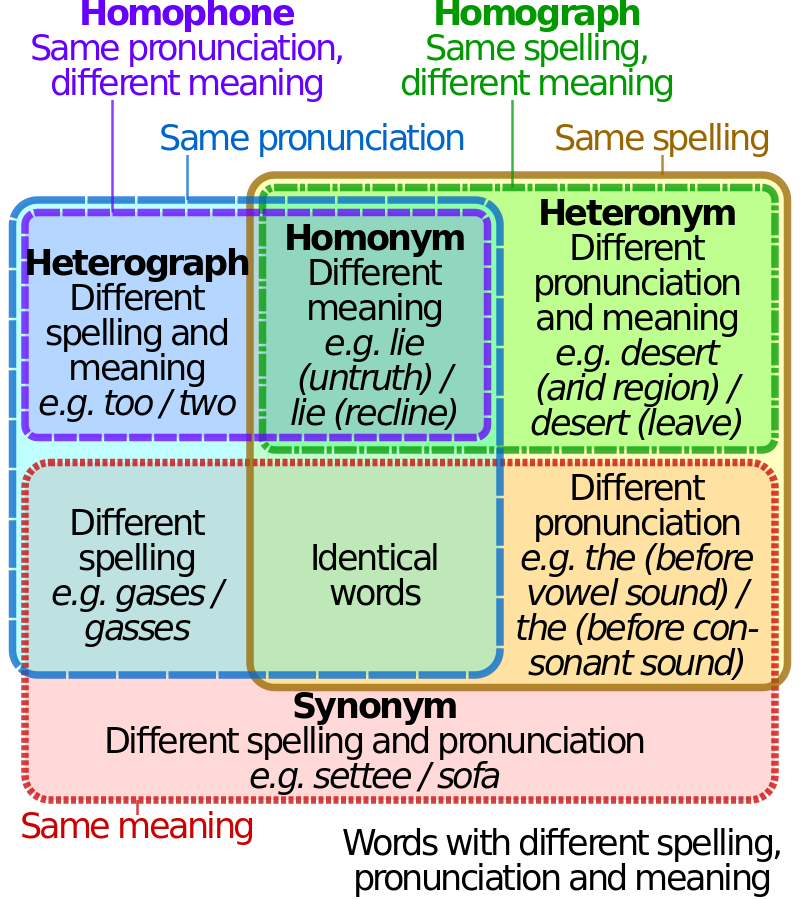
File:Homograph_homophone_venn_diagram.svg · Wikimedia Commons · See Wikimedia Commons
homonym
Sign in to saveIn linguistics, homonyms are words which are either homographs—words that mean different things but have the same spelling (regardless of pronunciation)—or homophones—words that mean different things but have the same pronunciation (regardless of spelling). Using this definition, the words row , row and row are homonyms because they are homographs (though only the first two are homo). So are the words see and sea , because they are homophones (though not homo).
Homonyms are words that sound the same or are spelled the same but have different meanings—like "see" and "sea" (which sound identical) or "row" meaning a line versus "row" meaning a argument (which are spelled the same). Understanding homonyms matters because they can create confusion in writing and speech, making it important to pay attention to context to determine which meaning is intended.
AI-generated from the Wikipedia summary — may contain errors.
Wikidata facts
- Subclass of
- word
- Image
- Homograph homophone venn diagram.svg
Show 4 more facts
- has characteristic
- homonymy
- described by source
- Encyclopædia Britannica 11th edition
- P8168
- Artur Kyshenko
- P13411
- 1962
Sources (2)
via Wikidata · CC0
~9 min read
Encyclopedic overview
8 sectionsContents
- Etymology
- Related terms
- Further examples
- Homonyms in historical linguistics
- See also
- Notes
- References
- Further reading
In linguistics, homonyms are words which are either homographs—words that mean different things but have the same spelling (regardless of pronunciation)—or homophones—words that mean different things but have the same pronunciation (regardless of spelling). Using this definition, the words row , row and row are homonyms because they are homographs (though only the first two are homo). So are the words see and sea , because they are homophones (though not homo).
A more restrictive and technical definition requires that homonyms be simultaneously homographs homophones—that is, they have identical spelling pronunciation but different meanings. Examples include the pair stalk and stalk and the pair left and left .
Excerpted from Wikipedia’s “homonym” article, available under the CC BY-SA 4.0 licence.
Gallery (3)
Available in 64 languages
- Español
- Français
- Deutsch
- 中文
- 日本語
- Русский
- Português
- Italiano
- العربية
- हिन्दी
- Afrikaans
- Albanian
- Armenian
- azb
- Azerbaijani
- Bahasa Indonesia
- Bashkir
- be_x_old
Show 45 more
- Belarusian
- Bulgarian
- Catalan
- Chechen
- Chuvash
- Croatian
- Czech
- Danish
- Esperanto
- Estonian
- Georgian
- Hebrew
- Ido
- Kara-Kalpak
- Kashubian
- Kazakh
- Kyrgyz
- Latvian
- Lingua Franca Nova
- Lithuanian
- Macedonian
- Malay
- Mari
- Moksha
- Nederlands
- Norwegian
- Ossetic
- Polski
- Romanian
- Serbian
- Serbian (Latin)
- simple
- Sindhi
- Slovak
- Slovenian
- Sundanese
- Svenska
- Swahili
- Tajik
- Tatar
- Ukrainian
- Uzbek
- zh_min_nan
- فارسی
- 한국어
via Wikidata sitelinks · CC0