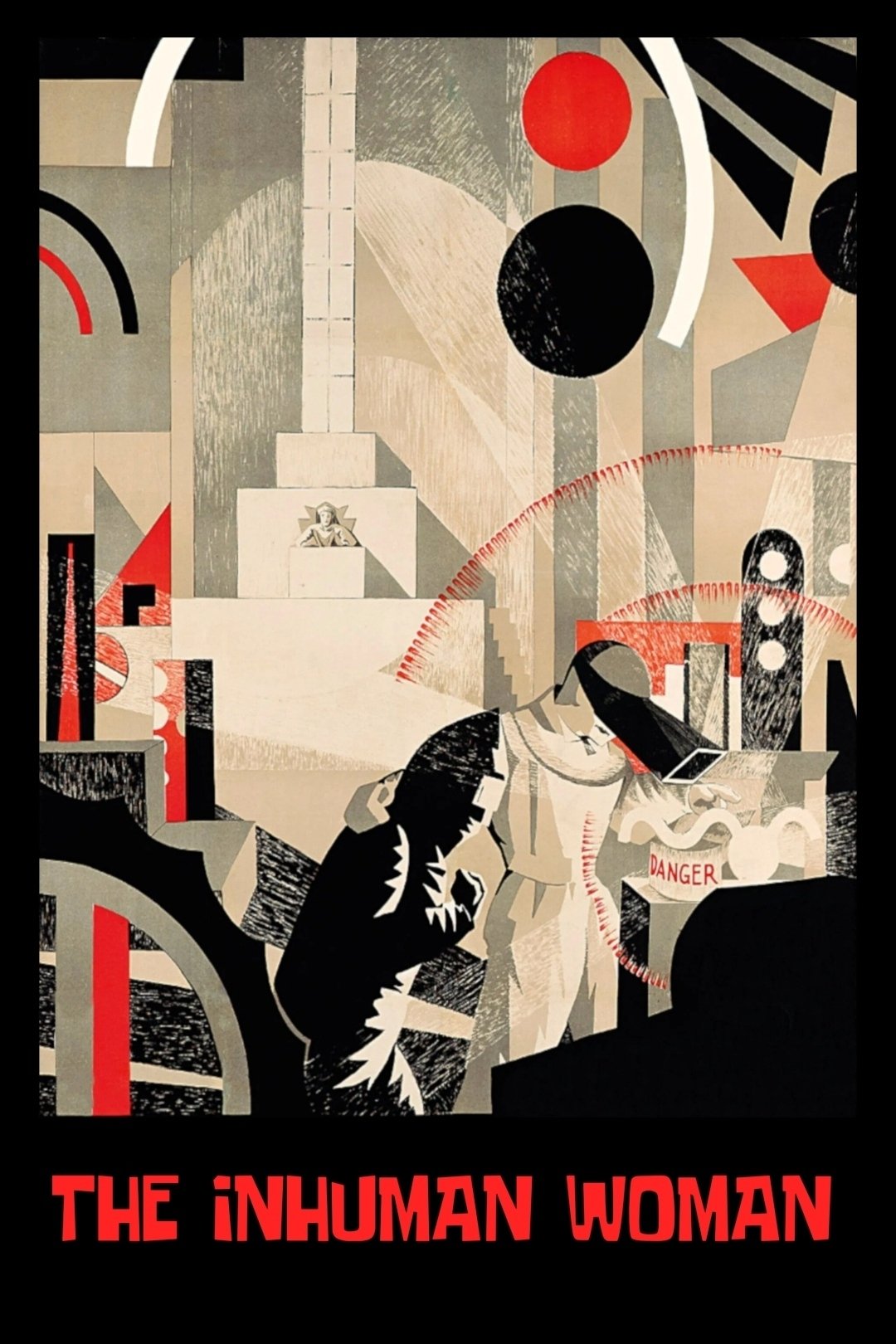
L'Inhumaine
Also known as Inhumaine, The New Enchantment, histoire féerique
'''''L'Inhumaine''''' ("the inhuman woman") is a 1924 French science fiction drama film directed by Marcel L'Herbier. It has the subtitle histoire féerique ("fairy story", "story of enchantment"). ''L'Inhumaine'' is notable for its experimental techniques and for the collaboration of many leading practitioners in the decorative arts, architecture and music. The film caused controversy on its release.
Film · TMDB
6.9A famous singer Claire Lescot, who lives on the outskirts of Paris, is courted by many men, including a maharajah, Djorah de Nopur, and a young Swedish scientist, Einar Norsen. At her lavish parties she enjoys their amorous attentions but she remains emotionally aloof and heartlessly taunts them. When she is told that Norsen has killed himself because of her, she shows no feelings. At her next concert she is booed by an audience outraged at her coldness and she decides to visit the vault in which Norsen's body lies.
Released: 1924-12-12123 minDir: Marcel L'HerbierDrama, Science Fiction
Cast
- Georgette Leblanc as Claire Lescot
- Jaque Catelain as Einar Norsen
- Léonid Walter de Malte as Wladimir Kranine
- Fred Kellerman as Frank Mahler
- Philippe Hériat as Djorah de Nopur
- Marcelle Pradot as The simpleton
This product uses the TMDB API but is not endorsed or certified by TMDB.
Ratings
Article
9 sectionsContents
- Background
- Synopsis
- Cast
- Production
- Reception
- Restorations
- Further reading
- References
- External links
'''''L'Inhumaine''''' ("the inhuman woman") is a 1924 French science fiction drama film directed by Marcel L'Herbier. It has the subtitle histoire féerique ("fairy story", "story of enchantment"). ''L'Inhumaine is notable for its experimental techniques and for the collaboration of many leading practitioners in the decorative arts, architecture and music. The film caused controversy on its release.
==Background== In 1923, while seeking to recover his health after a bout of typhoid, and his fortunes following the collapse of his film adaptation of Résurrection'', Marcel L'Herbier received a proposal from his old friend the opera singer Georgette Leblanc to make a film in which she would star and for which she would secure partial funding from American financiers. L'Herbier revived a scenario which he had written under the title La Femme de glace (Woman of Ice); when Leblanc declared this to be too abstract for her liking and for American taste, he enlisted Pierre Mac Orlan to revise it according to Leblanc's suggestions, and in its new form it became ''L'Inhumaine. The agreement with Leblanc committed her to provide 50% of the costs (envisaged as FF130,000), and she would distribute and promote the film in the United States under the title The New Enchantment''. The remainder of the production costs were met by L'Herbier's own production company Cinégraphic.
Gallery (8)
Available in 10 languages
via Wikidata sitelinks · CC0
Connections
Categories
1920s science fiction drama films1924 drama films1924 films1924 French films1924 French-language films1924 science fiction filmsArt Deco architecture in FranceFilms about resurrectionFilms directed by Marcel L'HerbierFilms with screenplays by Pierre Mac OrlanFrench black-and-white filmsFrench science fiction drama films