
Niger
Sign in to saveAlso known as Republic of Niger, Republic Niger, ne, The Niger, Republic of the Niger
The Niger, officially the Republic of the Niger, is a landlocked country in West Africa. It is a unitary state bordered by Libya to the northeast, Chad to the east, Nigeria to the south, Benin and Burkina Faso to the southwest, Mali to the west, and Algeria to the northwest. It covers a land area of almost , making it the largest landlocked country in West Africa and the second-largest landlocked nation in Africa behind Chad. Over 80% of its land area lies in the Sahara. Its predominantly Muslim population of about million lives mostly in clusters in the south and west of the country. The capi
OverviewAI-generated
Niger, officially the Republic of Niger, is a landlocked sovereign state and republic located in Western Africa. Its capital is Niamey, and it shares borders with Chad, Libya, Algeria, and Mali. The country is named after the Niger River. Hausa is an official language, and the currency used is the West African CFA franc.
The nation has a population of 26,312,034 and covers an area of 1,267,000. It contains administrative entities including the Agadez, Diffa, Dosso, and Maradi Regions. The highest point is Mont Idoukal-n-Taghès. Niger is a member of the United Nations, African Union, World Trade Organization, and Organisation of Islamic Cooperation. Its public holiday is Independence Day, and its anthem is La Nigérienne, L'Honneur de la Patrie.
Synthesized by Vinony from 66 facts across 9 sources: Wikidata, REST Countries, Open Meteo, Openweathermap, World Bank, OpenStreetMap, PubMed, Vinony graph, Geo. Generated from structured data (not the Wikipedia text) and checked against those facts — may still contain errors.
Weather now
cached 10h ago7-day forecast
via Open-Meteo
Country

- Capital
- Niamey
- Population
- 26,312,034
- Region
- Africa · Western Africa
- Demonym
- Nigerien
- Currencies
- XOF (Fr)
- Languages
- French
- Calling code
- +227
- Drives on
- Right
- Gini
- 34.3 (2014)
- FIFA code
- NIG
- TLD
- .ne
- Timezones
- UTC+01:00
- Borders
- DZA, BEN, BFA, TCD, LBY, MLI, NGA
via REST Countries
Indicators · World Bank
- GDP
- $19.9B(2024)
- Population
- 27,032,412(2024)
- Life expectancy
- 61.4 yrs(2024)
- Unemployment
- 0.4 %(2025)
- Urban population
- 18 %(2024)
- Internet users
- 15.6 %(2024)
- Forest area
- 0.8 %(2023)
- Renewable energy
- 79.6 %(2021)
via World Bank Open Data · CC BY 4.0
Wikipedia views (30d)
93,001 totalvia Wikimedia Pageviews API
Key facts
- Country.conventional_long_name
- Republic of the Niger
- Country.common_name
- Niger
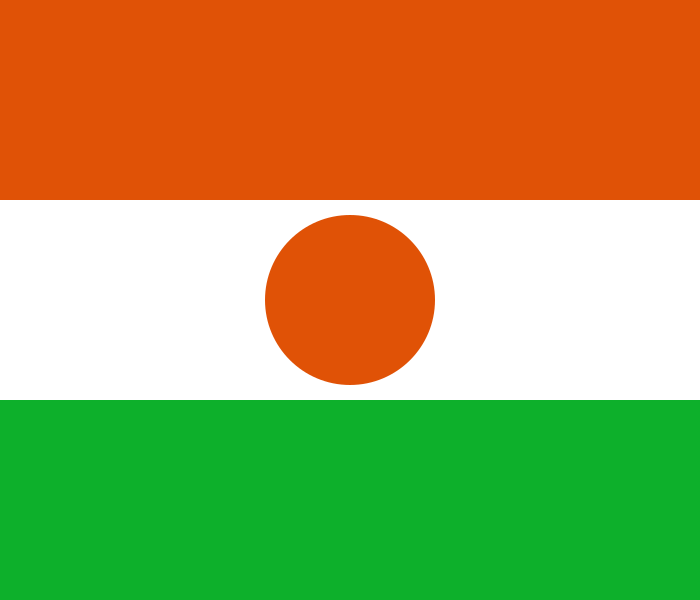
- Country.image_flag
- Flag of Niger.svg
- Country.flag_size
- 100
- Country.image_coat
- Coat of arms of Niger.svg
- Country.coa_size
- 110
- Country.national_anthem
- "The Honour of the Fatherland"
- Country.official_languages
- Hausa
- Country.languages_type
- National languages
- Country.religion_year
- 2012
- Country.demonym
- Nigerien
- Country.capital
- Niamey
- Country.largest_city
- Niamey
- Country.government_type
- Unitary semi-presidential republic under a military junta
- Country.leader_title1
- President and President of the National Council for the Safeguard of the Homeland
- Country.leader_name1
- Abdourahamane Tchiani
- Country.leader_title2
- Vice President of the National Council for the Safeguard of the Homeland
- Country.leader_name2
- Salifou Modi
via Wikipedia infobox
Research
29,313 papers- Epilepsy in Niger: An overview of the current situation.ReviewEpilepsia open · 2023Toudou-Daouda MDOI: 10.1002/epi4.12742
- Niger.Department of State publication. Background notes series · 1987United States. Department of State. Bureau of Public Affairs
- [Niger].Jeune Afrique (Paris, France : 1980) · 1996
- Emergence of Indigenous Dengue Fever, Niger, October 2023.Emerging infectious diseases · 2024Amadou HI, Moussa S, Arzika II et al.DOI: 10.3201/eid3007.240301
- Health transformation toward universal healthcare coverage amidst conflict: examining the impact of international cooperation in Niger.Frontiers in public health · 2024Doutchi M, Ghousmane A, Zampaligre F et al.DOI: 10.3389/fpubh.2024.1303168
- A critical review of oil spills in the Niger Delta aquatic environment: causes, impacts, and bioremediation assessment.ReviewEnvironmental monitoring and assessment · 2022Aa I, Op A, Ujj I et al.DOI: 10.1007/s10661-022-10424-x
- [Acute flaccid paralysis surveillance in Niger from 1998 to 2021].Medecine tropicale et sante internationale · 2024Goni Dit Alassan MB, Abdoulaye ZM, Alkassoum Salifou I et al.DOI: 10.48327/mtsi.v4i4.2024.449
- Genetic modification of the ant Lasius niger using CRISPR-Cas9 technology.Insect molecular biology · 2023Konu M, Kulmuni J, Viljakainen LDOI: 10.1111/imb.12809
via PubMed
Travel guide
Get in
thumb|375px|A map showing the visa requirements of Niger, with countries in green having visa-free access
See
thumb|250px|West Africa's last remaining wild Giraffe herd lives in Niger
Aïr Mountains Ténéré Desert Parque Nacional Du W Du Niger
Do
Watch the observance of Guérewol, an annual courtship ritual amongst the Wodaabe peoples.
Eat
Local, traditional food includes: a dense millet porridge with an okra sauce, a pepper sauce, a tomato sauce, or a squash sauce on top, sometimes with veggies and a couple chunks of meat rice with the above sauces mushy macaroni pasta with an oily red sauce rice & beans corn cous-cous mixed with moringa leaves, black-eyed peas, and sauce (called dumbou in Djera/Zarma, and only available in Djerma/Zarma regions)
thumb|Kilishi Availability varies widely by region, but visitors may wish to try the following delicious specialities, usually available as street food: dumbou (see above) kilishi: beef jerkey that comes in three flavours: regular, peanut-spiced, and hot-pepper-spiced masa: delicious sourdough pancakes eaten with a peanut/hot pepper/ginger spice mix or a brown sauce fari masa: fried dough balls served with either a squash/tomato salsa or sugar chichena: like fari masa above, but made from bean flour instead of wheat flour koudagou (Djerma/Zarma): fried sweet potato chunks with sauce
Less exotic but also tasty: brochettes — meat kebabs made from either beef, lamb or goat omelet sandwiches mangoes: if in season, they are bigger and juicier than any available in the western world yoghurt: pasteurized, sweet, and available wherever there is a fridge fried fish sandwiches ground beef sandwiches plates of garlicky green beans or peas (usually in bars and restaurants)
Be careful of the salads — even in the city, they're usually not OK for western travellers.
Drink
Drink plenty of filtered or bottled water. You will get dehydrated during your trip to Niger at one point. At times it can be hard to find bottled water, but ask for "Purewater" (pronounced pure-wata) that comes in sealed plastic bags for usually CFA 25 (CFA 50 in some hard-to-reach places). You will also need to replenish your salts more frequently than you are accustomed.
Keep in mind that drinking alcohol is generally forbidden in Muslim culture, so take extra care to keep drunken, inappropriate behaviour behind closed doors and out of the public eye.
The national beer is called, appropriately, Biere Niger. The only other locally produced beer is a franchise of the French West-African Flag brewery. While taste is in the eye of the beerholder, Biere Niger is decent. Both are brewed in the same tank from the same ingredients with the slightest variation on how much reconstituted malt they put in each batch. All other beer, boxed wine, and hard liquor is imported.
In rare pockets of the capital you can find millet beer homebrew, brewed by Burkinabe immigrants. This is drunk out of calabash gourd bowls. Some compare the taste to a dry, unsweetened cider. See the Niamey section for directions.
Locally-made non-alcoholic drinks are delicious. Safety depends on the water quality: generally OK in the capital and NOT OK in rural areas. They are either sold by women out of their houses (ask around), by young girls from trays on their heads, or by young boys pushing around cooler…
Stay safe
Niger is politically unstable and lawlessness is widespread. The latest coup d'état in early 2010 increased the unstable situation and every traveller should follow independent news closely and stay in contact with their embassy. Vicious and sadistic Al-Qaeda and Boko Haram members are present in Niger and have kidnapped and killed many, so it is essential to know the off-limit regions and avoid them.
In the region north of Agadez, there have been many carjackings, kidnappings and robberies in the past sixteen or so years. The problems continue, and tourists should consider the area essentially lawless. You should not venture beyond Agadez even if you have a guide and a 4x4 vehicle unless you seriously know what you are doing. The roads past this point are of terrible quality and bandits are abundant.
Avoid driving late at night in a private vehicle. Occasionally armed robbers will operate near the town of Galmi (central Niger) and around Dosso-Doutchi (in western Niger), as well as on the road to Gao, Mali in the Tillabery region. Normally, there are police checkpoints on the main highways which limit criminal activities during the day.
The main annoyances you are likely to meet are young boys shouting "Anasara", which means 'foreigner' in most local languages, derived from the Arabic word. You will also be asked for a 'cadeau' pretty much every time you see a person outside your hotel. The word is French for 'gift,' and it is best not to perpetuate the misery this word c…
Stay healthy
The Centers for Disease Control is an excellent resource for authoritative advice on health issues for travellers to Niger.
Drink lots and lots of water while in Niger because the dry heat will dehydrate you, and you may not realise. It is the best preventative step you can take. Bottled water or water sealed in a bag (called pure-wata) is available in most of the cities but in a pinch, city tap water is reported to be well-chlorinated. Be particularly wary of well water, stream water, and rural water.
Replenish your salts as well as liquids.
Wear loose conservative clothes, big hats, and lots of sunscreen. If in doubt, wear what the locals wear.
Malaria, including encephaletic malaria, is a problem, and is chloroquine resistant in Niger. Take your prophylaxes, use heavy-duty insect repellent (DEET is best, though nasty), and consider carrying a mosquito net to sleep under.
Giardia and amoebic dysentery are common. Be wary of any roadside food, unless you buy it hot off the grill. Even items fried in oil could make you sick if the oil has been heavily used and is old. Best to avoid salads and uncooked veggies. Also, never drink unfiltered water (including ice).
Schistosomiasis is present in most water bodies in Niger, so travellers should avoid going in the water everywhere — except chlorinated swimming pools.
In case you were unable to stay healthy, the Clinique Pasteur (situated in front of the Lycée Fontaine) has clean facilities, sterile needles, and competent, sym…
Respect
Visitors are treated as kings in Niger (there is a Koranic proverb to that effect), so be careful not to abuse the hospitality you will be shown. For the most part, try to accept all the small tokens and gestures (cokes, tea, small gifts, etc.) that you are offered. It isn't good to refuse too much, and don't think "these people are too poor to give me these things". That is offensive as taking good care of guests is a point of honour and gives people great pleasure.
Subjects (politics, religion, family) that are considered private in other parts of the world are discussed openly and freely in Niger.
When speaking to Nigeriens, make direct eye contact and try not to raise your voice.
Nigeriens are well aware that their country has a lot of issues and most Nigeriens are dissatisfied, angry and frustrated with their government. There's nothing wrong with discussing politics so long as you approach the subject with respect and caution.
In the working world, money is one of the most important motivational factors. Given the extremely poor state of the Nigerien economy, many Nigeriens strive to make a lot of money to escape a life of hardship. This sadly is also one of the reasons why fraud and scams are common in the country.
Friendships and relationships are taken seriously in Niger. If someone does something for you, you're expected to return the favour. Not doing so is rude.
Dress conservatively, which means no shorts, no skirts above the knees, and no tank tops. For…
Connect
See the Friends of Niger website for discussion boards where you can ask questions before you go to Niger and maybe get some Nigeriens or others assist.
Travel guide from Wikivoyage (CC BY-SA 4.0)
~40 min read
Encyclopedic overview
54 sectionsContents
- Etymology
- History
- Prehistory
- Empires and kingdoms in pre-colonial Niger
- Mali Empire (1200s–1400s)
- Songhai Empire (1000s–1591)
- Sultanate of Aïr (1400s–1906)
- Kanem–Bornu Empire (700s–1700s)
- Hausa states and other smaller kingdoms (1400s–1800s)
- Colonial (1900–1958)
- Post-colonial (1960–)
- Diori years (1960–1974)
- First military regime (1974–1991)
- National Conference and Third Republic (1991–1996)
- Second and third military regimes (1996–1999)
- Fifth Republic (1999–2009)
- Sixth republic and fourth military regime (2009–2010)
- Seventh Republic (2010–2023)
- Fifth military regime (2023–present)
- Geography
- Climate
- Biodiversity
- Government and politics
- Foreign relations
- Military
- Judicial system
- Law enforcement
- Government finance
- Foreign aid
- Administrative divisions
- Largest cities and towns
- Economy
- Demographics
- Urban settlements
- Ethnic groups
- Languages
- Religion
- Islam
- Education
- Health
- Culture
- Festivals and cultural events
- Guérewol festival
- Cure Salée festival
- Media
- See also
- References
- Notes
- Sources
- External links
- Government
- History
- Tourism
- Maps
Niger, officially the Republic of the Niger, is a landlocked country in West Africa. It is a unitary state bordered by Libya to the northeast, Chad to the east, Nigeria to the south, Benin and Burkina Faso to the southwest, Mali to the west, and Algeria to the northwest. It covers a land area of almost 1.27 million km (490,000 mi), making it the largest landlocked country in West Africa and the second-largest landlocked nation in Africa behind Chad. Over 80% of its land area lies in the Sahara. Its predominantly Muslim population of about 25 million lives mostly in clusters in the south and west of the country. The capital, Niamey, is located in Niger's southwest corner along the namesake Niger River.
Following the spread of Islam to the region, Niger was on the fringes of some states, including the Kanem–Bornu Empire and the Mali Empire before more significant parts of its territory became included in states such as the Sultanate of Agadez and the Songhai Empire. It was colonized by France during the Scramble for Africa as part of French West Africa, becoming a distinct colony in 1922. Since obtaining independence in 1960, Niger has experienced five coups d'état and four periods of military rule. Niger's seventh and most recent constitution was enacted in 2010, establishing a multiparty, unitary semi-presidential system. Following the most recent coup in 2023, the country has been ruled by National Council for the Safeguard of the Homeland, a military junta.
Excerpted from Wikipedia’s “Niger” article, available under the CC BY-SA 4.0 licence.
Gallery (59)
On the map
6 mapped locations
Available in 256 languages
- Español
- Français
- Deutsch
- 中文
- 日本語
- Русский
- Português
- Italiano
- العربية
- हिन्दी
- Abkhazian
- abstract
- Achinese
- Adyghe
- Afrikaans
- Akan
- Albanian
- Albanian
Show 237 more
- Amharic
- ami
- Angika
- Aragonese
- Aramaic
- Armenian
- Arpitan
- Asturian
- azb
- Azerbaijani
- Bahasa Indonesia
- Balinese
- Bambara
- Bangla
- Banjar
- Bashkir
- Basque
- bat_smg
- Bavarian
- be_x_old
- Belarusian
- Betawi
- Bhojpuri
- Bikol
- Bishnupriya
- Bislama
- Bosnian
- Breton
- Bulgarian
- Buriat
- Burmese
- Catalan
- cbk_zam
- cdo
- Cebuano
- Central Kurdish
- Chechen
- Cornish
- Corsican
- Crimean Tatar
- Croatian
- Czech
- dag
- Danish
- Dinka
- Divehi
- dty
- Egyptian Arabic
- Esperanto
- Estonian
- Ewe
- Extremaduran
- Faroese
- Fiji Hindi
- Filipino
- Finnish
- fiu_vro
- Fon
- Frafra
- Fula
- Gagauz
- Galician
- Ganda
- gcr
- Georgian
- Gilaki
- gpe
- Greek
- Guarani
- Gujarati
- guw
- Haitian Creole
- Hakka Chinese
- Hausa
- Hebrew
- Hungarian
- Icelandic
- Ido
- Igbo
- Iloko
- Inari Sami
- Interlingua
- Interlingue
- Irish
- Jamaican Creole English
- Javanese
- Kabyle
- kai
- Kannada
- Kanuri
- Kara-Kalpak
- Karachay-Balkar
- Kashmiri
- Kazakh
- kbp
- kge
- Khmer
- Kikuyu
- Kinyarwanda
- Kongo
- Kotava
- Kurdish
- Kyrgyz
- Ladino
- Latin
- Latvian
- Ligurian
- Limburgish
- Lingala
- Lingua Franca Nova
- Lithuanian
- lld
- Lombard
- Low German
- Lower Sorbian
- Luxembourgish
- Macedonian
- Malagasy
- Malay
- Malayalam
- Maltese
- Manipuri
- Manx
- Māori
- Marathi
- Mazanderani
- Minangkabau
- Mingrelian
- Mirandese
- mnw
- Moksha
- Mongolian
- Moroccan Arabic
- Mossi
- nds_nl
- Nederlands
- Nepali
- Newari
- Northern Frisian
- Northern Sami
- Northern Sotho
- Norwegian
- Norwegian Nynorsk
- Novial
- nup
- Obolo
- Occitan
- Old English
- olo
- Oromo
- Ossetic
- Pampanga
- Papiamento
- Pashto
- Picard
- Piedmontese
- Polski
- Punjabi
- Quechua
- rki
- Romanian
- Rusyn
- Samoan
- Sango
- Sanskrit
- Santali
- Sardinian
- Saterland Frisian
- Scots
- Scottish Gaelic
- Serbian
- Serbian (Latin)
- Shan
- Shona
- Sicilian
- Silesian
- simple
- Sindhi
- Sinhala
- Slovak
- Slovenian
- Somali
- Southern Sotho
- Standard Moroccan Tamazight
- Sundanese
- Svenska
- Swahili
- Swati
- szy
- Tachelhit
- Tajik
- Talysh
- Tamil
- Taroko
- Tatar
- tay
- Telugu
- Tibetan
- Tiếng Việt
- Tigrinya
- Toki Pona
- Tsonga
- Tumbuka
- Türkçe
- Turkmen
- Tyap
- Udmurt
- Ukrainian
- Upper Sorbian
- Urdu
- Uyghur
- Uzbek
- Venetian
- Veps
- Volapük
- Walloon
- Waray
- Welsh
- Western Frisian
- Western Mari
- Western Panjabi
- Wolof
- Wu Chinese
- Xhosa
- Yakut
- Yiddish
- Yoruba
- Zaza
- Zeelandic
- zh_classical
- zh_min_nan
- zh_yue
- Zhuang
- Zulu
- فارسی
- ไทย
- 한국어
via Wikidata sitelinks · CC0