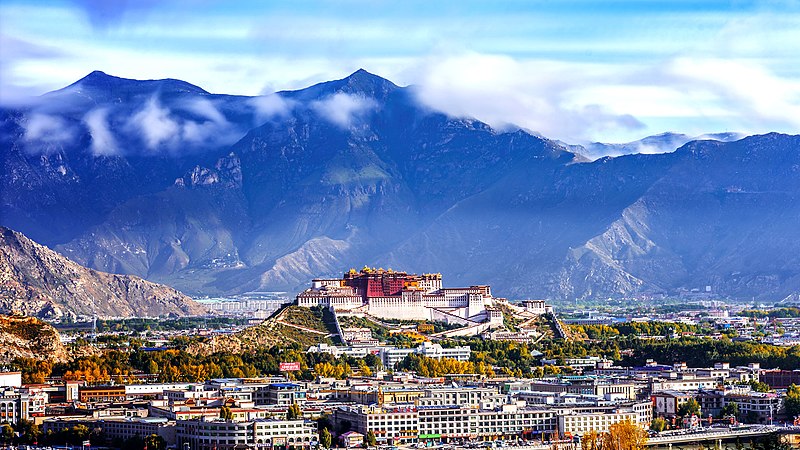
File:Potala_Palace_HQ.jpg · Wikimedia Commons · See Wikimedia Commons
Potala Palace
Sign in to saveAlso known as Potala, Botala, Budala, Budalagong, Budala Gong, Pu-ta-la, Pu-ta-la-kung, Pu-ta-la Kung
7th-century Tibetan fortress and palace in Lhasa, rebuilt in the 17th century as the winter seat of the Dalai Lamas
Potala Palace is a massive fortress and palace located in Lhasa, Tibet, originally built in the 7th century and rebuilt in the 17th century. It served as the winter residence of the Dalai Lamas, the spiritual leaders of Tibetan Buddhism, making it a significant religious and political center in Tibetan history.
AI-generated from the Wikipedia summary — may contain errors.
Wikidata facts
- Instance of
- sacred place
- Country
- Tibet
- Located in
- Lhasa District
- Area
- 13
- Official website
- www.potalapalace.cn
- Image
- Potala.jpg
- Height
- 117
- Width
- 350
- Length
- 400
- Has use
- official residence
Show 8 more facts
- native label
- རི་བོ་གྲུ་འཛིན་ཕོ་བྲང་པོ་ཏ་ལ།
- architectural style
- dzong
- nature of statement
- occupied territory
- inception
- 0637-00-00
- catalog code
- 107
- Commons category
- Potala Palace
- Commons gallery
- 布达拉宫 པོ་ཏ་ལ།
- on focus list of Wikimedia project
- Wikipedia:Vital articles/Level/4
Sources (3)
via Wikidata · CC0
~15 min read
Encyclopedic overview
Potala Palace (Tibetan: ཕོ་བྲང་པོ་ཏ་ལ་, Wylie: pho brang po ta la; Chinese: 布达拉宫; pinyin: Bùdálā Gōng) is a museum complex in Lhasa, the capital of the Tibet Autonomous Region of China. It was formerly the winter palace of the Dalai Lamas, built in the dzong style on Marpo Ri (Red Mountain). From 1649 until 1959 it served as the Dalai Lamas' residence, after which it became chiefly a museum following the annexation of Tibet by the People's Republic of China.
The palace is named after Mount Potalaka, regarded in Buddhist tradition as the mythical abode of the bodhisattva Avalokiteśvara. Construction of the present structure was begun in 1645 at the order of the 5th Dalai Lama, advised by Konchog Chophel, the Thirty-fifth Ganden Tripa of the Gelug school. It was built on the site of an earlier palace attributed to Songtsen Gampo (traditionally dated to 637).
Excerpted from Wikipedia’s “Potala Palace” article, available under the CC BY-SA 4.0 licence.
Gallery (12)
On the map
Available in 79 languages
- Español
- Français
- Deutsch
- 中文
- 日本語
- Русский
- Português
- Italiano
- العربية
- हिन्दी
- Afrikaans
- Albanian
- Armenian
- Asturian
- Azerbaijani
- Bahasa Indonesia
- Bangla
- Bashkir
Show 60 more
- Basque
- Belarusian
- Breton
- Bulgarian
- Buriat
- Burmese
- Catalan
- Central Kurdish
- Croatian
- Czech
- Danish
- Dzongkha
- Egyptian Arabic
- Esperanto
- Estonian
- Filipino
- Finnish
- Galician
- Georgian
- Greek
- Hebrew
- Hungarian
- Javanese
- Khmer
- Latin
- Latvian
- Lithuanian
- Malayalam
- Maltese
- Marathi
- Mongolian
- Nederlands
- Nepali
- Norwegian
- Occitan
- Polski
- Punjabi
- Romanian
- Santali
- Serbian
- Serbian (Latin)
- simple
- Slovak
- Slovenian
- Svenska
- Tamil
- Tatar
- Tibetan
- Tiếng Việt
- Türkçe
- Ukrainian
- Urdu
- Uyghur
- Waray
- Wu Chinese
- zh_min_nan
- zh_yue
- فارسی
- ไทย
- 한국어
via Wikidata sitelinks · CC0