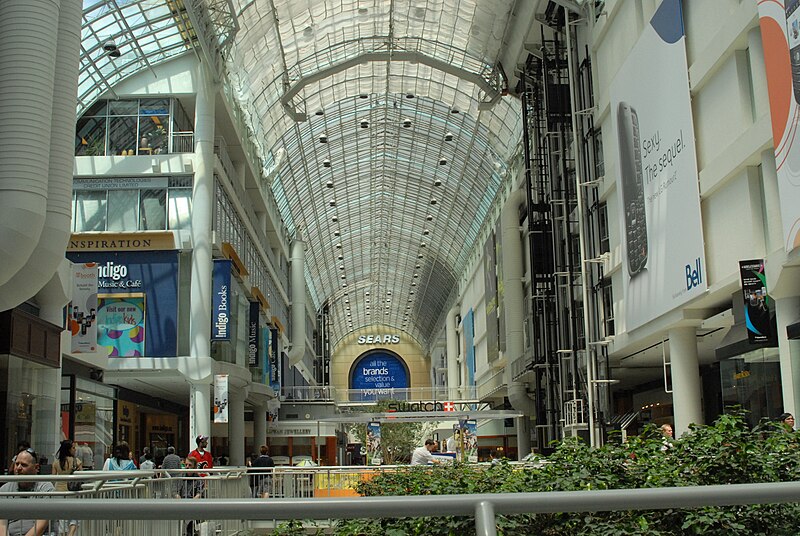
File:Eatoncentrertorontohall.JPG · Wikimedia Commons · See Wikimedia Commons
shopping center
Sign in to saveAlso known as shopping mall, shopping centre, trade center, trade centre, Shopping Resort
complex of shops
A shopping center is a group of stores built together in one location, making it convenient for customers to visit multiple shops in a single trip. These centers matter because they efficiently bring together various retailers, saving shoppers time and effort compared to visiting scattered individual stores.
AI-generated from the Wikipedia summary — may contain errors.
Wikidata facts
- Subclass of
- organization
- Image
- Tiranë, Albania January 2023 - Toptani Qendra tregtare shopping center Christmas tree.jpg
Show 7 more facts
- OpenStreetMap tag
- shop=mall
- topic's main category
- Category:Shopping malls
- equivalent class
- schema.org/ShoppingCenter
- described at URL
- github.com/whosonfirst/whosonfirst-placetypes#arcade
- Commons category
- Shopping malls
- different from
- shopping mall
- on focus list of Wikimedia project
- Wikipedia:Vital articles/Level/4
via Wikidata · CC0
~26 min read
Encyclopedic overview
The interior of the Toronto Eaton Centre in Toronto, Ontario, Canada, a 201,320-square-metre (2,167,000 sq ft) super-regional shopping mall Interior of the Galerie Vivienne in Paris, by Francois Jean Delannoy, 1823-1826 A shopping center in American English, shopping centre in Commonwealth English (see spelling differences), shopping complex, shopping arcade, shopping plaza, or galleria, is a group of shops built together, sometimes under one roof.
The first known collections of retailers under one roof are public markets, dating back to ancient times, and Middle Eastern covered markets, bazaars and souqs. In Paris, about 150 covered passages were built between the late 18th century and 1850, and a wealth of shopping arcades were built across Europe in the 19th century. In the United States, the widespread use of the automobile in the 1920s led to the first shopping centers consisting of a few dozen shops that included parking for cars. Starting in 1946, larger, open air centers anchored by department stores were built (sometimes as a collection of adjacent retail properties with different owners), and then enclosed shopping malls starting with Victor Gruen's Southdale Center near Minneapolis in 1956.
Excerpted from Wikipedia’s “shopping center” article, available under the CC BY-SA 4.0 licence.
Gallery (12)
Available in 68 languages
- Español
- Français
- Deutsch
- 中文
- 日本語
- Русский
- Português
- Italiano
- العربية
- हिन्दी
- Afrikaans
- Albanian
- Aragonese
- Armenian
- Asturian
- azb
- Azerbaijani
- Bahasa Indonesia
Show 49 more
- Bangla
- Basque
- Belarusian
- Bulgarian
- Catalan
- Cherokee
- Chuvash
- Croatian
- Czech
- Danish
- Esperanto
- Estonian
- Faroese
- Finnish
- Galician
- Greek
- Hebrew
- Hungarian
- Icelandic
- Irish
- Kazakh
- Latin
- Latvian
- Lithuanian
- Macedonian
- Malay
- Nederlands
- Norwegian
- Norwegian Nynorsk
- Polski
- Quechua
- Romanian
- Serbian
- Serbian (Latin)
- Sindhi
- Slovak
- Svenska
- Tamil
- Tiếng Việt
- Türkçe
- Ukrainian
- Urdu
- Western Frisian
- Wu Chinese
- Yiddish
- zh_yue
- فارسی
- ไทย
- 한국어
via Wikidata sitelinks · CC0