File:Increasing_disorder.svg · Wikimedia Commons · See Wikimedia Commons
Wikidata facts
- Instance of
- branch of physics
- Subclass of
- physics
Show 5 more facts
- topic's main category
- Category:Statistical physics
- Commons category
- Statistical mechanics
- Stack Exchange tag
- cstheory.stackexchange.com/tags/statistical-physics
- studied by
- probability theory
- facet of
- probability theory
Sources (2)
via Wikidata · CC0
~28 min read
Encyclopedic overview
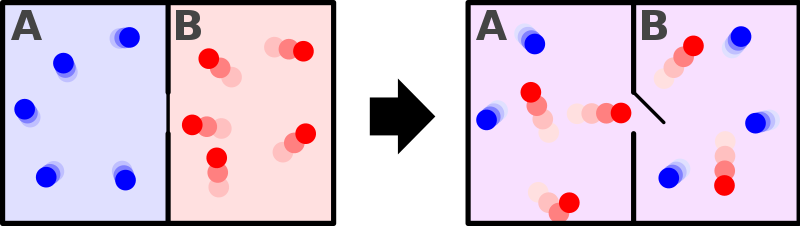
In physics, statistical mechanics is a mathematical framework that applies statistical methods and probability theory to large assemblies of microscopic entities. Sometimes called statistical physics or statistical thermodynamics, its applications include many problems in a wide variety of fields such as biology, neuroscience, computer science, information theory and sociology. Its main purpose is to clarify the properties of matter in aggregate, in terms of physical laws governing atomic motion.
Statistical mechanics arose out of the development of classical thermodynamics, a field for which it was successful in explaining macroscopic physical properties—such as temperature, pressure, and heat capacity—in terms of microscopic parameters that fluctuate about average values and are characterized by probability distributions.
Excerpted from Wikipedia’s “statistical physics” article, available under the CC BY-SA 4.0 licence.