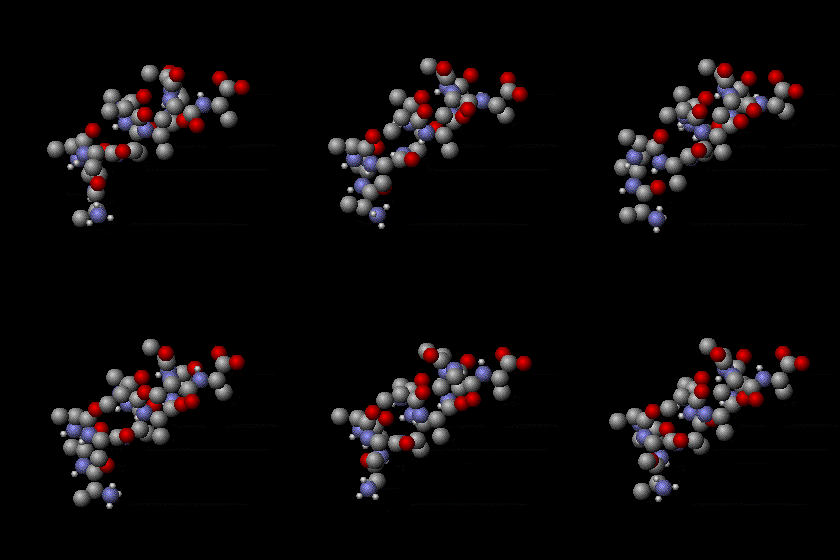
File:Thermally_Agitated_Molecule.gif · Wikimedia Commons · See Wikimedia Commons
I don't see any context provided in your message (the {dS} appears to be a placeholder without content). Could you please provide the actual context material you'd like me to base the overview on?
AI-generated from the Wikipedia summary — may contain errors.
Key facts
- Physical quantity.name
- Temperature
- Physical quantity.image
- Thermally Agitated Molecule.gif
- Physical quantity.caption
- Thermal vibration of a segment of a protein's alpha helix. Its amplitude increases with temperature.
- Physical quantity.unit
- K
- Physical quantity.otherunits
- °C, °F, °R, °Rø, °Ré, °N, °D, °L, °W, Planck units
- Physical quantity.dimension
- wikidata
- Physical quantity.intensive
- Yes
- Physical quantity.derivations
- \frac{pV}{nR}, \frac{dq_\text{rev
via Wikipedia infobox
Research
1,222,479 papersvia PubMed
~61 min read
Encyclopedic overview
42 sectionsContents
- Effects
- Scales
- Absolute zero
- Absolute scales
- Kelvin scale
- Statistical mechanical ''versus'' thermodynamic temperature scales
- Classification of scales
- Empirical scales
- Theoretical scales
- Microscopic statistical mechanical scale
- Macroscopic thermodynamic scale
- Ideal gas
- Kinetic theory approach
- Thermodynamic approach
- Intensive variability
- Local thermodynamic equilibrium
- Basic theory
- Bodies in thermodynamic equilibrium
- Bodies in a steady state but not in thermodynamic equilibrium
- Bodies not in a steady state
- Thermodynamic equilibrium axiomatics
- Heat capacity
- Measurement
- Units
- Historical scales
- Plasma physics
- Continuous or discrete
- Theoretical foundation
- Kinetic theory of gases
- Zeroth law of thermodynamics
- Second law of thermodynamics
- Definition from statistical mechanics
- Generalized temperature from single-particle statistics
- Negative temperature
- Examples <span class="anchor" id="Table of common temperatures"></span>
- See also
- Notes and references
- Notes
- Citations
- Bibliography of cited references
- Further reading
- External links
{{Infobox physical quantity | name = Temperature | image = Thermally Agitated Molecule.gif | caption = Thermal vibration of a segment of a protein's alpha helix. Its amplitude increases with temperature. | unit = K | otherunits = °C, °F, °R, °Rø, °Ré, °N, °D, °L, °W, Planck units | symbols = | dimension = wikidata | intensive = Yes | derivations = \frac{pV}{nR}, \frac{dq_\text{rev}}{dS} }}
In classical thermodynamics and kinetic theory, temperature reflects the average kinetic energy of the particles in a system, providing a quantitative measure of how energy is distributed among microscopic degrees of freedom. Temperature reflects the average kinetic energy of the vibrating and colliding atoms making up a substance. It is a numerical expression of the everyday experience of hotness or coldness.
Excerpted from Wikipedia’s “temperature” article, available under the CC BY-SA 4.0 licence.
Gallery (14)
Available in 158 languages
- Español
- Français
- Deutsch
- 中文
- 日本語
- Русский
- Português
- Italiano
- العربية
- हिन्दी
- abstract
- Afrikaans
- Albanian
- Albanian
- Angika
- Aragonese
- Armenian
- Assamese
Show 139 more
- Asturian
- azb
- Azerbaijani
- Bahasa Indonesia
- Bangla
- Bashkir
- Basque
- bat_smg
- Bavarian
- be_x_old
- Belarusian
- Bhojpuri
- Bikol
- Bosnian
- Breton
- Bulgarian
- Buriat
- Burmese
- Catalan
- Cebuano
- Central Kurdish
- Chuvash
- Croatian
- Czech
- Danish
- Egyptian Arabic
- Esperanto
- Estonian
- Extremaduran
- Fiji Hindi
- Fijian
- Filipino
- Finnish
- fiu_vro
- Galician
- gcr
- Georgian
- Greek
- Guarani
- Gujarati
- Haitian Creole
- Hausa
- Hebrew
- Hungarian
- Iban
- Icelandic
- Ido
- Iloko
- Interlingua
- Interlingue
- Irish
- Jamaican Creole English
- Javanese
- Kabyle
- Kalmyk
- Kannada
- Kara-Kalpak
- Karachay-Balkar
- Kashmiri
- Kazakh
- Kinyarwanda
- Kurdish
- Kyrgyz
- Latin
- Latvian
- Limburgish
- Lithuanian
- Lombard
- Low German
- Luxembourgish
- Macedonian
- Malagasy
- Malay
- Malayalam
- Marathi
- Minangkabau
- Mongolian
- Moroccan Arabic
- nds_nl
- Nederlands
- Nepali
- Northern Frisian
- Norwegian
- Norwegian Nynorsk
- Occitan
- Oromo
- Pashto
- Piedmontese
- Polski
- Punjabi
- Quechua
- rki
- Romanian
- rsk
- Sardinian
- Scots
- Scottish Gaelic
- Serbian
- Serbian (Latin)
- Shona
- Sicilian
- simple
- Sindhi
- Sinhala
- Slovak
- Slovenian
- Somali
- Sundanese
- Svenska
- Swahili
- Tachelhit
- Tamil
- Tatar
- Telugu
- Tibetan
- Tiếng Việt
- Toki Pona
- Türkçe
- Ukrainian
- Urdu
- Uzbek
- Venetian
- Veps
- Volapük
- Walloon
- Waray
- Welsh
- Western Frisian
- Western Panjabi
- Wu Chinese
- Yiddish
- zh_classical
- zh_min_nan
- zh_yue
- Zhuang
- Zulu
- فارسی
- ไทย
- 한국어
via Wikidata sitelinks · CC0