Artwork
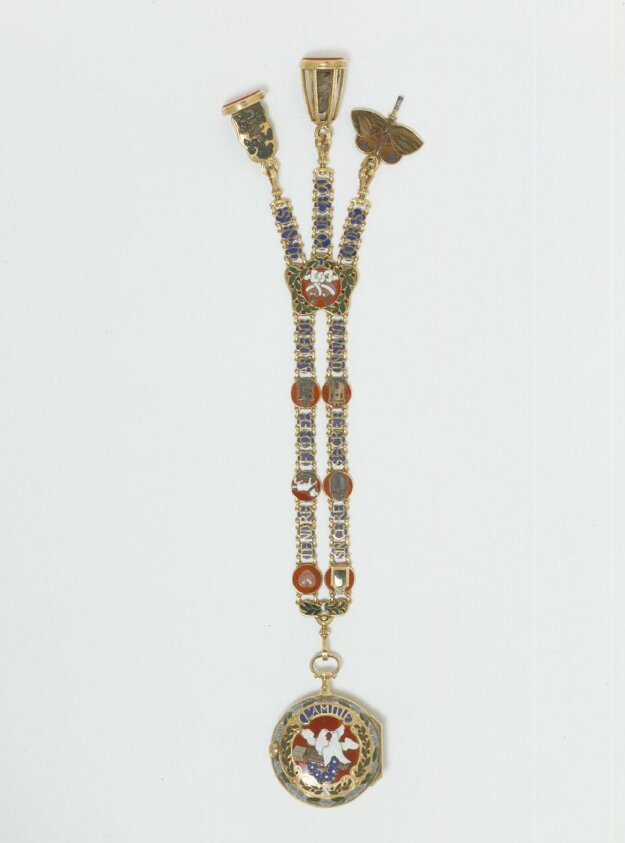
Chatelaine — Neuber, Johann Christian — 1770-85
Sign in to saveThe watch of the chatelaine is inlaid with hardstones mounted in gold with courting doves sitting on a garlanded quiver of arrows, forget-me-nots and fruiting laurel symbolising the triumph of love. Above the doves is the word 'L'AMITIE' (friendship). On the chatelaine is the declaration of the lover, each word spelt out in gold letters on a lapis lazuli ground and accompanied by a symbol inlaid into a circle of carnelian. He is ‘TENDRE’ (heart), ‘FIDEL’ (sic , dog), ‘ARDENT’ (altar of love), ‘SINCERE’ (mirror symbolising truthfulness), ‘SECRET’ (padlock) and ‘CONSTANT’ (fortress). The lovers are united for ever, ‘UNIS POUR TOUJOURS’, their hearts tied in a lover’s knot. Geoffrey Munn (see references) interprets the pendants as depicting Adam and Eve (the first lovers), a caged owl (wisdom enslaved by love) and a butterfly (symbol of the soul), 'an allusion to time flying but love remaining'. On the reverse, the chatelaine is decorated with forget- me-nots and laurels together with Cupid's arrows and the lamp of love. A short section of the back rim of the case can be depressed to allow the back of the case to swing open to reveal a portrait mounted in a glazed oval compartment of the Empress Joséphine. The portrait was presumably added later to replace an earlier portrait, perhaps of the donor, which he had intended for contemplation by his beloved. The present portrait of Joséphine is after Daniel Saint. It is not known when it was inserted. The watch has a white enamel dial with Roman hour numerals and Arabic minute numerals, 5 to 60, and the name of the maker: 'Lépine / Hger Du Roy'. The top plate of the movement is inscribed 'Lépine Horloger du Roy A . PARIS'. Joanna Whalley, FGA, has made the following comments on the hardstones: Jasper varieties: varigated; streaked; yellow; white; pink; bloodstone. Agates: silicified wood (the carved hearts and tower); moss agate; prase. Chalcedonies: carnelian; grey; reverse-painted colourless chalcedony (butterfly fob). Lapis lazuli: good quality even colour, with pyrite inclusions; the wings of the butterfly fob contain notable calcite inclusions, whereas that behind the lettering has very little, which enhances the definition of the letters. Turquoise: some of the turquoise contains straight layered colour zoning (visible under strong light) suggestive of odontolite; others contain small black granular inclusions and pale whitish cloud-like inclusions, more typical of turquoise. It is possible that there may be a mixture of like material present. Garnets: dark purplish red, very few black crystalline inclusions. Most likely pyrope.
Artwork · Victoria & Albert Museum
Chatelaine- Artist
- Neuber, Johann Christian
- Date
- 1770-85
- Medium
- Chatelaine
View at Victoria & Albert Museum · Open Access