Artwork
painting — 1800 - 1920
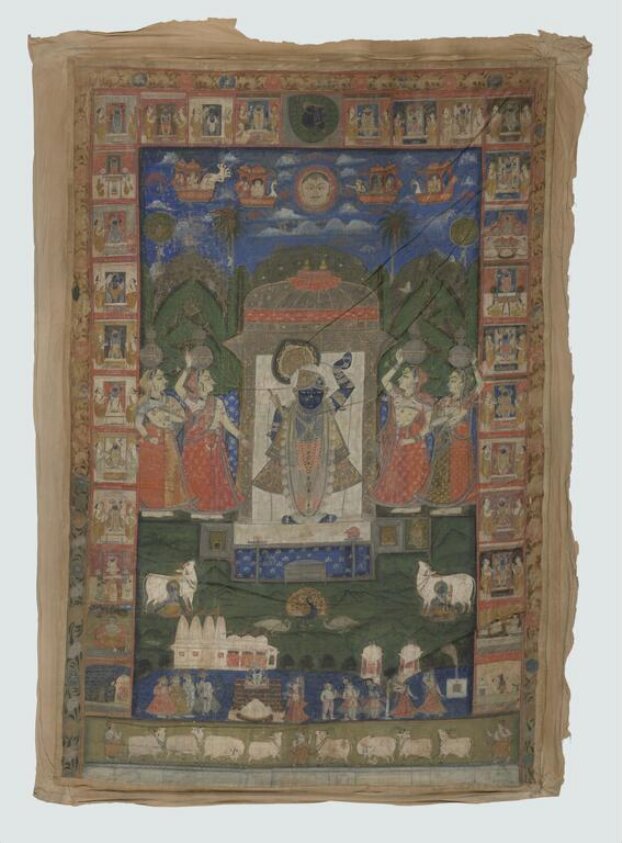
Sign in to saveLarge painted cloth or <i>pichwai</i> made to be hung behind the stone relief sculpture of Srinathji, a form of Krishna as a child, whose principal temple or <i>haveli</i> is a Nathdwara in Rajasthan. In the centre is a pavilion shrine with an image in of Srinathji, who is depicted dark blue and raising his left (proper) hand raised to lift up Mount Govardhan, with which he sheltered the local cowherds from a storm sent by the god Indra. He wears a large and distinctive turban ornament, robes, necklaces and other jewels. This shrine is flanked by four <i>gopis</i> or milkmaids carrying vessels on their heads. They are set in a landscape of trees and hills under blue skies and white clouds. Above left, Indra is flying in his celestial chariot with his 6-trunked elephant along with three other celestial vehicles and the sun with a human face in the centre. Below the shrine there is a peacock with two peahens and on either side a small image of Krishna milking a white cow. Below, on the left side is a white temple with four towers and below that is a small image, near the bottom centre, with Krishna sitting over a large pile of rice and bowls of food behind it To the right of this is <i>Dana Lila </i>(‘the demanding of toll’) where Krishna tips curds from a pot carried by a <i>gopi</i> or cowherd woman carrying. There are 28 smaller panels around the left, top and right margins showing the darshan or viewing (worship) of Srinathji at different seasonal festivals, wearing different costumes, while in the centre of the top margin is an image of the baby Krishna floating on a banyan leaf during the dissolution of the universe. Between each of these margins and the edge of the painting are thin bands of floral decoration. At the bottom of the painting is a row of cattle, frequently shown because Krishna grew up among the cowherding people, above a grey bottom edge.
Artwork · Victoria & Albert Museum
painting- Date
- 1800 - 1920
- Medium
- painting
View at Victoria & Albert Museum · Open Access