Artwork
Furnishing — ca. 1825
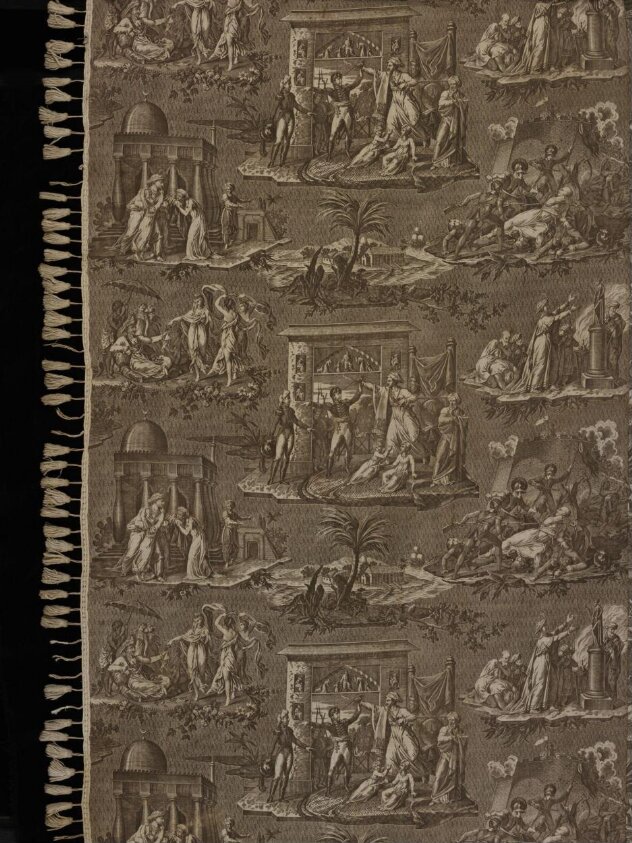
Sign in to saveRoller (plate) printed in sepia on white cotton, with six scenes against a fancy ground. The cotton is made up as a curtain, with white cotton braid and tassels applied to the left side. Much of the imagery is classical, notably the architecture and the women in the harem, who look like the three Graces. The scenes depict the last years of Tipu Sultan, ruler of Mysore from 1782 to 1799: 1. Tipu reclines on cushions beneath an umbrella held by a youth, watching three dancing girls, with a musician and two women in the foreground. 2. Tipu in his palace, with two boys at his feet and an elderly man standing at one side, tries to stab one of two English officers who were coming to take the boys as hostages in accordance with treaty of Seringapatam of 1792. 3. Tipu with his sons and elders in supplication before a statue. 4. Tipu bids farewell to his wife and two children. 5. A Indian fishes beneath a palm tree. 6. Tipu lies on a heap of corpses about to be killed by the English beneath the walls of Seringapatam in 1799.
Artwork · Victoria & Albert Museum
Furnishing- Artist
- Unknown
- Date
- ca. 1825
- Medium
- Furnishing
View at Victoria & Albert Museum · Open Access