Artwork
Clock — 1585-1600
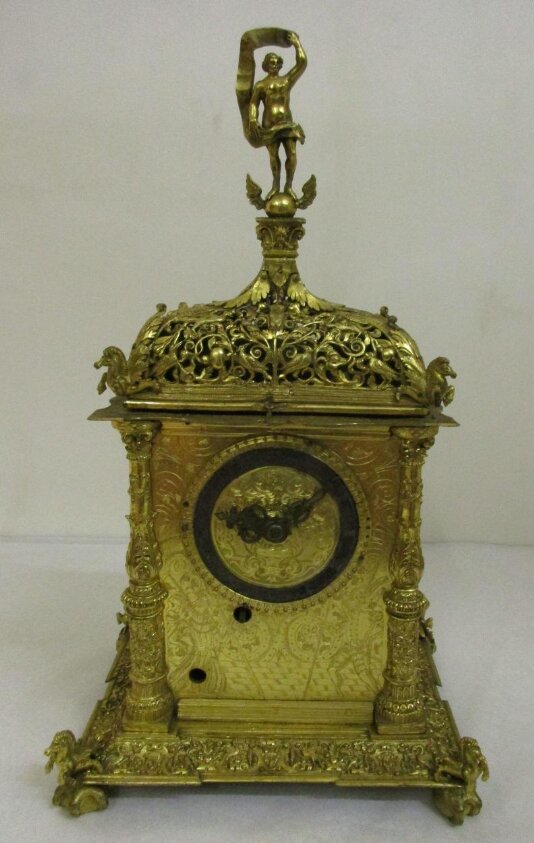
Sign in to saveSquare clock of gilded brass surmounted by a cast, gilded finial representing Fortune, supported by four ball and claw feet surmounted by sea horses. The sides and dial are engraved, gilded plaques framed by cast metal, gilded, columns. The base is cast and chased with grotesque ornament, the pierced cover cast with scrolls and birds. Case: Rectangular gilt copper alloy case of architectural form on flanged base supported by four ball-and-claw feet (probably later additions). The base is cast and chased in relief with strapwork, foliage, birds, grotesque figures and mascerons. Applied hippocamps at the lower corners. At the corners above are multiple baluster-shaped three-quarter columns with Corinthian capitals decorated in relief with acanthus and other foliage and swags held in the mouths of the mascerons. The sides of the case and flanges of the dial are engraved with arabesques and strapwork, framing on the front; two landesknechts in 16th century dress and armour with halberds; on the back; David and Goliath; on the sides; paired figures in arches possibly representing the quadrivium of the Liberal Arts, Geometry, Arithmetic, Astronomy and Music. Above the cornice, a rectangular ogee-shaped cupola is pierced with interlaced foliage and birds. Dials: The Front dial is 8.9 cm in diameter. The outer minute ring with a touch pin for each number; inside this; an inset silver chapter-ring 0.6 cm broad with Roman numerals I-XII and minute marks (a later replacement). The central brass disc signed 'Friede En Munich 1587'. The hands are pierced brass. The rear dial is 10.2 cm diameter. The outer ring with I to XII in Roman numerals with touch points 1 to 24 in arabic inside. The central disc of the dial 6.3 cm inches diameter now missing, probably an astronomical dial. The hands are missing. Movement: The going train in the centre, now with brass wheels and anchor escapement. The crutch with pin and pendulum missing. The fusee and chain wound through a gearing through a hole in the front plate. Drive to the hour-hand through reduction gearing from the fusee. Step-up drive to the minute hand. The drive to the rear dial now missing. In left part of the movement, locking-plate, striking rain, placed transversely, with brass barrel, iron fusee and chain and iron wheels. Brass count wheel and click, probably somewhat later replacements. Striking on larger bell. In right part of movement; chime train, also transverse, with brass barrel, iron fusee, chain and wheels. Chiming on smaller bell. Brass count-wheel, probably later replacement. Probablyu a former alarm train at lower left of movement. Striking winding hole marked S; quarter chime wind hole marked V
Artwork · Victoria & Albert Museum
Clock- Date
- 1585-1600
- Medium
- Clock
View at Victoria & Albert Museum · Open Access