Artwork
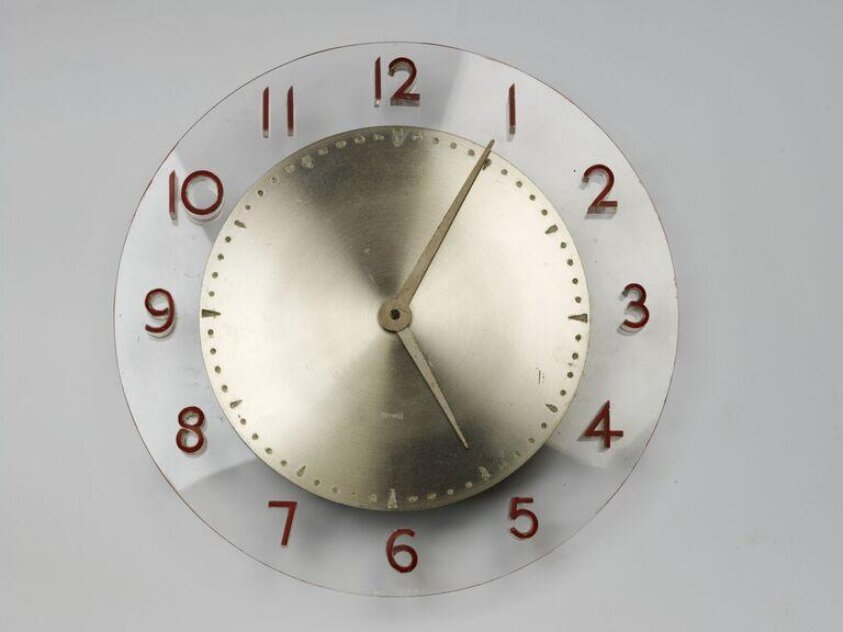
Wall clock — Nicholson, Christopher — 1946
Sign in to saveThe clock is round with an outer ring of acrylic (perspex). Three dimensional acrylic numbers have been adhered to the ring and are edged in red, painted by hand. The outer rim is considerably worn but significant amounts of red paint survive there too. The inner dial is metal (possibly aluminium) onto which the minute and hour markers appear to have been hand-stamped. The Ferranti logo is at the bottom of the face, but is upside down as the face has been rotated 180 degrees. The reason for the rotation of the inner face is because the acrylic ring is broken below the number 12 at the top. Four holes pierce the acylic to allow for the fixing of the metal face; the top one has suffered damage and this is probably when the inner face was rotated. The acrylic is 2-3 mm thick and the damage is not visible from the front. The clock is fitted with a standard electric clock, labelled Ferranti, which originally had mains wiring. Although the aesthetic is machine made, the elements and construction of the wall clock show a considerable degree of handwork as though the object were a prototype.
Artwork · Victoria & Albert Museum
Wall clock- Artist
- Nicholson, Christopher
- Medium
- Wall clock
View at Victoria & Albert Museum · Open Access