Artwork
Clock — Moody, Francis Wollaston — 1857-62
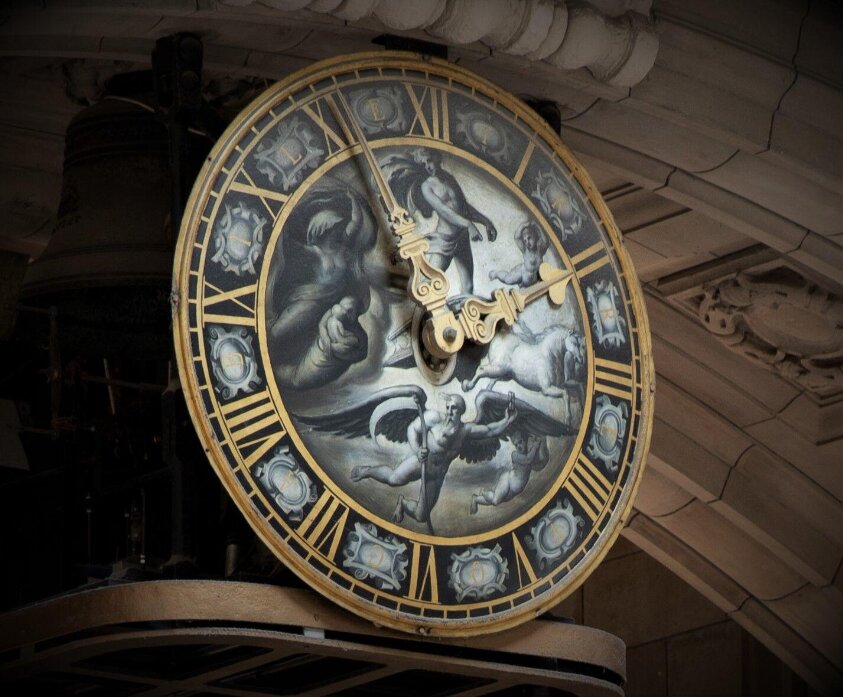
Sign in to savePendulum clock with two weights. Highly decorated faces depicting bearing the same design, executed by F.W. Moody, showing allegorical figures of Day in a chariot followed by a cloaked woman representing Night, with - below, the figure of Time, with his hour glass and scythe. The irrevocability of Time is represented by the letters of the Latin word IRREVOCABLE spaced out between the Roman numerals around the faces. The hands, a later addition, of wood are scrolled and gold in colour. Extract from the Illustrated Catalogue of the London International Exhibition 1862, Volume II. Eight-day turret or church clock, of the same construction and material as that supplied by the exhibitors to the order of the Government Department of Science and Art, and which may be seen in the Museum, South Kensington. The wheels and bosses for the pivots to act in are of gun metal, the mixture being the same as that used for the manufacture of ordnance bearings, the pinions of wrought steel, cut and finished in an engine as well as the wheels; thus securing the greatest possible accuracy. the frames are of iron, and so constructed that any part can be removed for cleaning without disturbing the remaining parts. The escapement is on the principle of Graham's deadbeat, and the steel pads are made to slide in turned grooves, so as to set the pitch with the greatest exactness; they may be removed as they are secured by screws. The striking apparatus is on the repeating principle, which prevents the possibility of striking wrong hours - a fault so common to many clocks with locking plates. The maintaining power to keep the clock going during winding is by lever and bolt; there is a small inside dial to set the hands by. The pendulum has a heavy spherical ball, and the rod, which is of prepared pine, coated with varnish and afterwards French polished, is thus secured against the action of air or damp; the pendulum is set in beat by means of a traversing screw, and the crutch has also two large screws to regulate and reduce its friction.
Artwork · Victoria & Albert Museum
Clock- Artist
- Moody, Francis Wollaston
- Date
- 1857-62
- Medium
- Clock
View at Victoria & Albert Museum · Open Access