Artwork
Bracket clock — Prior, George — ca. 1790
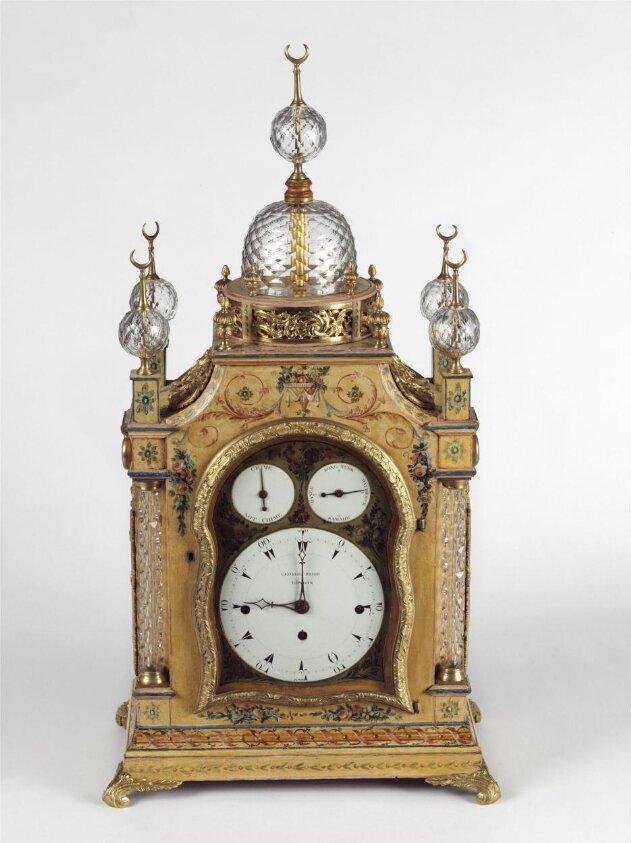
Sign in to save<b>Summary description</b> A large table clock with a cream and floral painted case, cut-glass columns, glass dome and spheres, with gilt-brass fittings including crescent moon finials. The clock face has Arabic numerals. <b>Decorative scheme</b> The clock case has a complex decorative scheme evoking fantasy architecture, the top decorated to suggest minarets with fixed, facetted glass spheres which sparkle in the light. The reflective gilt-brass fittings and the pastel painted decorative scheme also give a light and airy impression. In the centre a cut-glass sphere rises above a facetted and textured cut-glass dome, both held in place by a vertical gilded wood rod. Above this is a tall brass finial surmounted by an upturned crescent moon. There are four matching glass spheres with tall crescent finials, one at each corner of the case, supported on small painted pedestals. The dome is raised on a drum-shaped platform, painted with pink and cream bands and decorated with four pierced gilt-brass panels and surmounted by four small gilt-brass urns with flame finials. This platform rests on the flat top of the clock case surrounded by four larger gilt-brass flaming urn finials, one at each corner. The clock case is painted with floral swags and scrolls in pastel colours on a cream background. In the centre above the clock face is a delicately painted Neoclassical swagged urn with fruit and foliage spilling out from the top. Facetted glass columns are fitted into recesses in the front corners of the case, held in place by brass fittings at top and bottom. The frame of the clock-face cover, the carrying handles at each side, the pierced panels at the sides and the scrolled feet are also gilt brass. The gilt-brass side panels, possibly later replacements, are decorated with Rococo motifs including scrollwork, flowers and leaves. They are lined with a 20th century red plush fabric, probably a silk-cotton mix. In places the pile has worn down showing the weave, suggesting that the fabric has previously been used for another purpose. The white enamel clock face, protected by a shaped glass cover, is inscribed 'GEORGE PRIOR/LONDON'. The dial has two pierced brass hands and is marked with hours and minutes in Arabic numerals of a form seen on many British clocks made for the Middle-Eastern market, using thick, wedge-shaped uprights. These are presumably designed to be seen with clarity from a distance. There are three winding holes, for the movement, the striking and the musical mechanisms. Above the clock face are two smaller dials with one hand each, one to turn the chime on or off and one to select the tune. The dials are set against a background painted cream with floral decoration. The clock case stands on a pedestal with convex and concave mouldings painted with two bands of running ornament composed of ribbons, flowers and berries in pink and green. <b>The movement</b> The brass movement is held in place inside the case by brackets bolted to the sides of the case. It has a verge escapement and bells are in two trains, or sets, one for striking and one one for music, the latter with ten bells. The brass front plate, which cannot be seen when the movement is fitted into the case, is signed 'I.Thwaites 9'. This probably refers to John Thwaites. The back plate, which is visible through a glass door, is engraved in script 'George Prior/London' and is scratched in the corners with at least three sets of marks, probably to record repairs. Around the edge of the backplate is an engraved border with intertwined undulating motifs. The original front lock has been removed and there is now a brass hook on the inside holding the dial cover closed. <b>Structure and materials</b> The wood of the carcase is difficult to identify because it has been painted inside with a reddish stain, probably during restoration, but is probably oak. The weight of the superstructure is supported by substantial wooden uprights inside the back corners of the case and curving front uprights which are hollowed out externally to receive the glass columns. The front, which consists of an arched frame to take the clock face, is made of four pieces of wood lap-jointed together and veneered on the front as a basis for the paintwork. The side panels are each made of one piece of wood cut with a hole over which is fixed fabric and gilt-brass panels. The back of the clock is made of four pieces but not veneered. The lower rail is rebated into the side uprights. A glazed arched door at the back is made of five pieces lap-jointed together and veneered on the outside to hide the joints. Holes are cut into the sides and curved shoulders of the case to allow the bells to be heard, and covered by the pierced brass panels. The ceiling of the case is solid beneath the drum platform.The corner pedestals are dowelled into the top of the case. <b>Painted decoration</b> The wooden case is covered in a thin layer of gesso to provide a smooth surface for the paint. The paintwork appears fresh and in all likelihood approximates to its original appearance, because most of it was cleaned and conserved by the Museum in 1989 except for a small section at the back and the area around the clock face, which were left untreated and appear darker. In 1989 the considerable overpainting and varnishing which had been carried out before it came to the V&A was removed, and the gaps filled and repainted. Finally a glaze was applied in the repainted areas and to areas where glaze was missing on the original paintwork. The paintwork on the front of the case is in substantially original condition. At the same time the red plush fabric was washed. The brass panels appear to have been regilded.
Artwork · Victoria & Albert Museum
Bracket clock- Artist
- Prior, George
- Date
- ca. 1790
- Medium
- Bracket clock
View at Victoria & Albert Museum · Open Access