Artwork
Clock — Gregory, Jeremie — c.1685
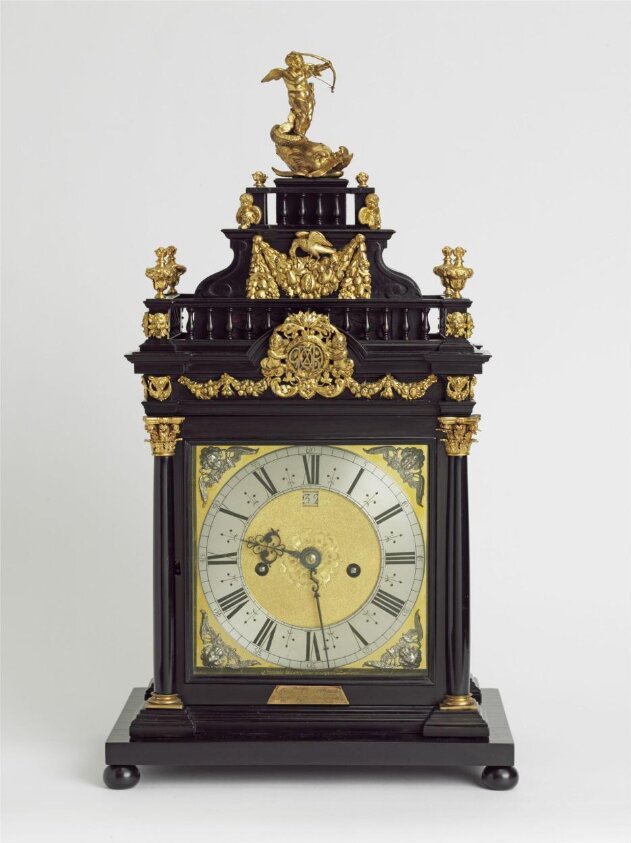
Sign in to save<b>Summary description</b> A large bracket clock in solid oak and veneered in ebony decorated with gilt brass mounts and surmounted by a figure of Cupid standing on the back of a dolphin. The clock is architectural in form with two tiers of balustrading and is decorated on all four sides. Above the clock face is a cartouche enclosing a royal cypher. <b>Decorative scheme </b> The rectangular clock case, glazed on all four sides, is articulated by four Corinthian columns with gilt brass capitals and bases, outset at the corners, and stands on a plain rectangular plinth raised on four ball feet. The dial has an engraved rose in the centre, a silvered dial ring and silver winged cherubs in the spandrels. The lacquered brass back plate of the clock movement is finely engraved with tulips arising from a Neoclassical urn. The clock has an elaborate superstructure comprising four tiers of finely cast gilt-brass mounts set against an ebony background, surmounted by a cast bronze or brass group of a naked and winged Cupid, blindfolded and holding a bow in his outstretched arm, standing on the back of stylised dolphin. The columns are surmounted by an entablature comprising a small cornice, a frieze, and a larger arched cornice, each cornice with outset corners. The frieze is decorated with gilt-brass swags of fruit, and with a small swagged lion mask at each end, above the columns. On the front and back of the clock, the swags are centred on a circular medallion, which is enclosed in a laurel wreath, supported by cherubs, with an acanthus cresting, a mask below and swags of fruit and leaves on either side. Within the cartouche is a royal cipher which appears to relate to King George I, but which is evidently a later addition of uncertain date. The entablature is surmounted by a balustrade, framed by outset plinths at the corners and moulded rails above and below. The outer faces of the plinths have applied gilt-brass grotesque masks, possibly 'green men' with horns, pointed ears and sprouting leaves. Each plinth supports an urn decorated with leaves and flowers and surmounted by a leaf finial. Behind the balustrade is a platform with voluted sides, and with a gilt-brass relief on the front and back faces comprising a swag of leaves and fruit, with pears, grapes and a central pomegranate. A bird stands on the top of the swag pecking at a piece of fruit. This platform supports a second, smaller plinth, enclosed by a second, narrower balustrade formed of turned ebony balusters, the small corner plinths embellished with winged cherubs and supporting leaf finials. On the plinth stands the figurative group. <b>Structure and materials</b> The structure of the clock case is oak painted black inside and veneered in ebony on the outside. All the turned parts, such as the corner columns and small balusters, are in solid ebony. There appears to be a surface coating possibly of dark-coloured wax to deepen the colour of the ebony, which is rubbing off in places revealing the marginally lighter wood underneath. The columns are each rebated on their inside back edge to fit around the square corners of the case. The clock case rotates on a plinth veneered in ebony. The figure of cupid on a dolphin was made in two parts, soldered together at the feet and the dolphin's tail. The internal iron armature can be glimpsed where a section of wing is slightly broken. A wooden peg is fitted into the bottom of the dolphin for attaching it to the clock case. <b>Repairs, alterations and problems</b> Ronald Lee, the antique dealer who sold the clock to the Museum, listed his repairs. The plinth forming the turntable was a modern replacement copied from a contemporary example. Some of the mouldings and balustrades were replaced where damaged. The applied ebony scrolls either side of the bird mount had been replaced. One winged cherub metal mount, the small finials on the top gallery and the vase finials were replaced. New hour and minute hands in blued steel were fitted and the movement was reconverted from an anchor escapement to verge. Ronald Lee, the major clock dealer in Britain of the 20th century, often extensively repaired and improved his clocks. Close examination and discussion of the clock in preparation for display in 2012 have raised various issues. Any alterations were done with expertise and skill, possibly suggesting that they were carried out relatively late, in the 20th century, when expertise was available. Many of the mounts may be later replacements or additions. Firstly it is unusual for the back of a clock to be fitted with mounts. The fruit swag on the back of the clock differs in detail from that on the front and is not such high quality, so may be a later addition. The mounts themselves vary widely in quality; the Corinthian capitals are very high quality, and are evidently original. There is a small group of clocks of this date with very similar gilt brass capitals. However there are no parallels with the mounts applied to the sides of the small corner pedestals, and the grotesque masks applied there are poorly chased, suggesting that they may be later additions. Cupid's bow is evidently a replacement as it is rather crudely made and is without an arrow. The engraved name plate attached to the front of the case is unusual for its date and could have been moved from another clock. Analysis shows that the brass used for the name plate is 20% zinc to 80% copper, a ratio usually associated with 19th century brass, and it is not gilded as are all the other mounts. The clock case itself looks authentically 17th century, (except for alterations to the superstructure mentioned by Ronald Lee), but has cuts and niches inside which are not explained by the current arrangement of the movement. The hinges of the door at the back have been renewed. Much of the superstructure looks very fresh, so perhaps this was replaced or even augmented to make the clock more impressive. The underside of the case has holes in the four corners, presumably for feet which were present before the turntable was added. The movement (a striking 8-day movement with a verge escapement), the bell, the chapter ring and calendar ring are all correct for the period. The dial plate looks authentically 18th century, with hammer marks on the back, and engraved doodles of a bent spring and linear marks which might have been an aid to positioning. It has splashes of mercury gilding, an early technique, around the holes, but it has been regilded using electrogilding. However it looks as though it has been cut down on all four sides, perhaps along a scribing mark like those on the dials of similar clocks. In support of this theory the signature engraved along the bottom edge of the dial plate has been cut through its lower loops, and the chapter ring is very close to the edge of the plate. All these factors combined suggest the possibility that the clock is a 'marriage', ie. the dial plate and possibly also the movement might not originally have been used in this clock case and were originally housed in a slightly larger case.
Artwork · Victoria & Albert Museum
Clock- Artist
- Gregory, Jeremie
- Date
- c.1685
- Medium
- Clock
View at Victoria & Albert Museum · Open Access