Artwork
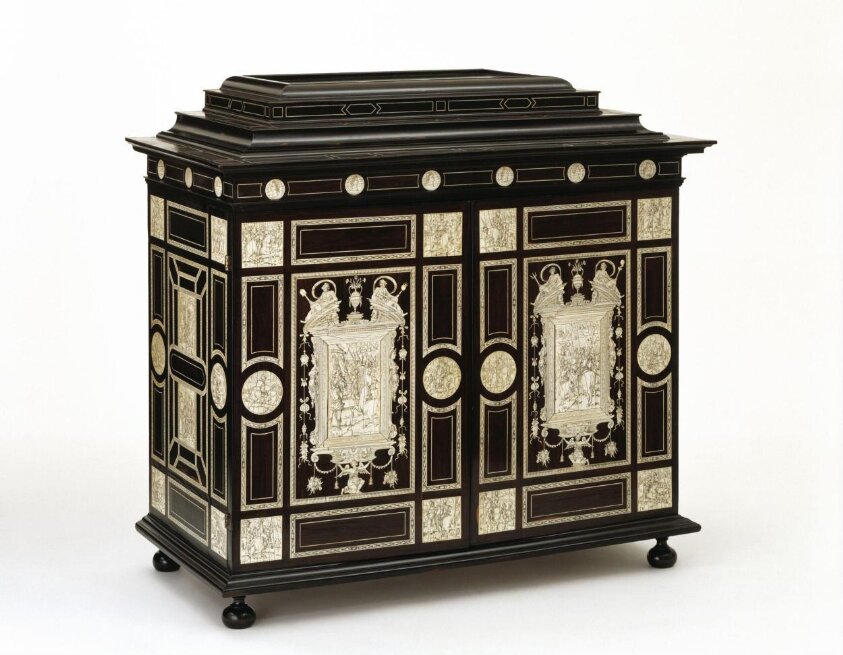
Cabinet — Fiamengo, Iacopo — about 1600
Sign in to saveRectangular cabinet with two doors and raised top containing cupboards and numerous drawers, veneered in ebony, with ivory stringing and engraved ivory plaques mostly telling the story of Romulus and Remus, derived from a series of engravings published by Giovanni Battista Fontana (1524 - 1587) in 1573 and dedicated to Arch Duke Ferdinand of Austria. The Metamorphoses images on the 10 drawers on the removeable central unit are (at least partially) derived from La Métamorphose d'Ovide figurée (Lyon 1557) with illustrations by Bernard Solomon. Design Rectangular cabinet with two doors and raised top section. The top section with a lifting panel revealing an undecorated well (17cm deep) fitted for five plain softwood drawers at the left sides (1 missing), five plain softwood drawers at the right side (2 missing) and sixteen plain softwood drawers along the front (all missing), ie 7 drawers survive of 26. The drawers with cord handles. The top-most drawer without a pull (presumably to conceal it), and secured through the back by a removeable(?) iron nail with quatrefoil head on the outside of the cornice. The crudeness with which this hole has been cut suggests that it may be a modification, perhaps necessary after the removal of the top-most box from the top section. The two main doors (without a lock) open onto an interior of architectural form in four main tiers: 1) top tier (a series of tabernacles with pediment and volutes) with three large drawers separated by two sliding covers, each concealing 3 plain ebony-fronted drawers. Behind each bank of 3 drawers, accessed from within (the central drawer removed), are 3 secret, small plain drawers with cord pulls. 2) second frieze tier with five shallow drawers. 3) main tier (three large tabernacles, each flanked by a pair of columns), with three hinged doors, enclosing, in the centre a removeable unit of 10 drawers (one of which with a double front appears to be two), and on either side four ebony-fronted drawers with ivory stud handles and ivory stringing, above a fifth, similar drawer concealed behind a base frontage held by a metal pin. Behind each of the two, removeable columns at the far right and left are five small ebony-fronted drawers. Behind each of the two, fixed, narrow niches between the main three tabernacles, and set laterally, is a bank of twelve drawers; this is accessed via sliding panels to the mid-section, once the removeable unit has been withdrawn. 4) bottom pedestal tier with three large concealed drawers. In total the cabinet was designed with seventy-seven drawers in the main body, and twenty-six in the top section (of which nineteen are missing). The back is rosewood veneered with ivory stringing arranged in rectangular geometric patterns. The cabinet rests on four turned ebony(?) bun feet, which appear to be 20th century in date. Construction The carcase wood is mostly pine and cedar, with beech used in the blocks below the six columns and the fronts of the drawers. The drawers are finely constructed using dovetails, with the bottoms glued in place. Iconographic design The top of the cabinet is step-moulded with a deep cornice, below which are twelve medallions of the <i>Twelve Caesars</i>, starting off with Julius Caesar and ending with Domitian. The sides of the cabinet have two larger ivory plaques in the centre, representing episodes from the Sabine War, flanked with three smaller plaques on each side, the middle ones round and the upper and lower ones square, depicting the twelve months. Each door on the outside has one large ivory plaque in the centre, set in an inlaid aediculed frame of engraved ivory, and a series of smaller engraved ivory plaques at the sides, arranged like those at the sides of the cabinet. They depict various battle scenes presumably from the legend of Romulus and Remus, although these are the only large plaques without any inscriptions. All the plaques on both sides of each door are arranged in the same way as the sides, and they recount the Sabine War. The doors open onto an interior horizontally divided into three main tiers containing large drawers and concealing series of smaller ones, and vertically divided into three broad and two narrow sections articulated with engraved ivory Corinthian columns, inscribed <i>Fortitudo</i> (courage), <i>Iustitia</i> (Justice), <i>Spes</i> (Hope), <i>Prudentia</i> (Foresight), <i>Temperantia</i> (Moderation), and <i>Cognitio Dei</i> Knowing God. The three larger doors in the central tier are decorated with ivory plaques telling of Romulus' capture of Caenina, Romulus' hanging a trophy of weapons on a sacred oak on the Capitoline Hill in Rome, and Romulus being carried up to the Heavens, while carrying out a review on the field of Mars. The smaller plaques depict Apollo and other deities, grotesques and earlier episodes in the lives of Romulus and Remus. Inside the central door is a small removable cabinet with ten drawers (though appearing to have eleven) with ivory stud handles, and ebony and engraved ivory fronts, depicting various myths such as Nesus and Deianeira and Pan and Syrinx. To the sides of this small cabinet are ebony panels with broad, engraved ivory stringing, arranged in rectangular geometrical patterns. These slide forward to reveal twelve ebony and engraved ivory drawers with ivory stud handles on each side, decorated with hunting scenes. Modifications The top section reduced in height after 1880, with the loss of a lockable box about 10cm high, with engraved medallions and plaques. A lockplate on the right door, and bolts in the left door removed after 1880, and the holes patched. The ivory plaque in this position, and present in 1981 was believed by Museum curators to be a modern addition (missing 4/12/1989, visible in photos c2006, missing 2009). The urns of turned ivory on the inside of both doors added after 1880. Evidence on cabinet sides of removal of one or more handles. Support batten added on both sides of the cabinet, with modifications to one small drawer on both sides (concealed behind the columns at far right and far left). At bottom of main tier (interior), the locking devices to the two frontages concealing a drawer now missing. At top tier, the sliding covers rebuilt. At second frieze tier, drawer at left repaired. Drawer sizes (HWD cm) Top section, internal, at ends: 3.4 x 24.8 x 6.6 (x2); 4.1 x 11.9 x 11.6 (x4); 6.6 x 12 x 17.7 (x4) Top section, internal, along front: 3.9 x 13 x 7 (x4); 4.1 x 13 x 12 (x4); 6.7 x 13 x 18 (x4); Internal, top tier: right and left drawers 13.7 x 20.5 x 34.8cm; two groups of three small drawers 13.7 x 22.6 x 35.2; central drawer 13.7 x 22.6 x 35.2; 6 secret plain drawers hidden behind the two banks of concealed drawers (size tbc) Internal, second frieze tier: right and left outer drawers 2.8 x 21.7 x 35.1; right and left inner drawers 2.8 x 11.8 x 34.7; central drawer 2.8 x 24.7 x 34.1 Internal, main tier: two columns of five small drawers at right and left 5.5 x 4.1 x 29.2 two columns of four drawers behind left and right doors, 5.1 x 15.7 x 29.1; concealed drawer below 5.8 x 15.6 x 33.3 central mini-cabinet: 4.9 x 9.3 x 12.7 (x2), 4.8 x 6.1 x 12.8 (x3), 1.3 x 6.1 x 12.8 (x2), 4.7 x 6.1 x 12.8 (x2), 4.9 x 19.4 x 12.6 (single drawer with false double front) two banks of 12 drawers concealed behind sliding panels to the left and right of the moveable central mini-cabinet: 5.3 x 11.4 x 11.7 (x2); 5.3 x 9.6 x 11.7 (x3), 5.2 x 9 x 11.7 (x4), 11.2 x 9.6 x 11.7 (x1), 4.7 x 14 x 11.7 (x2)
Artwork · Victoria & Albert Museum
Cabinet- Artist
- Fiamengo, Iacopo
- Date
- about 1600
- Medium
- Cabinet
View at Victoria & Albert Museum · Open Access