Artwork
Persian carpet — 1876
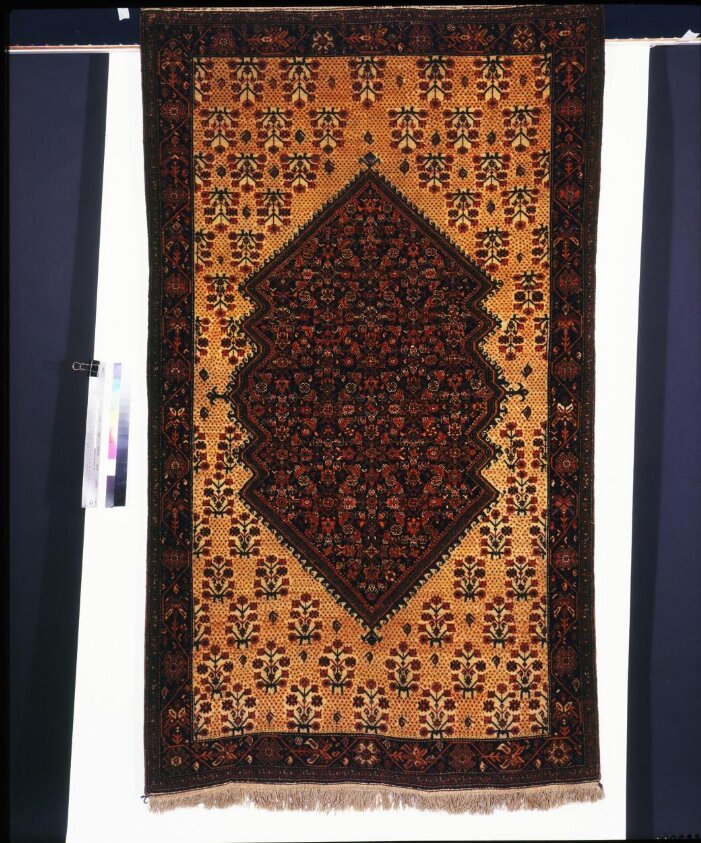
Sign in to saveWarp: white cotton; Z4S; 32 threads to the inch (128 per dm); depressed. Weft: white cotton and blue cotton (see main border below); Z4S; 2 shoots after each row of knots; 14 knots per inch (56 per sq. dm). Pile: wool; 11 colours: dark red, red, light red, orange, yellow, green, dark blue, blue, purple, dark brown, white; asymmetrical knot open to the left and tied around 2 warps; 224 knots per sq. inch (3584 per sq. dm). Side finish: one cord oversewn with red wool. End finish: Lower: 1 cm warp-faced plain weave above one row of weft twining in red and blue; loose warp fringe 4.5cm long. Upper: as lower but 2.5cm plain weave. Design: Field: white ground with a large, irregular medallion indented along the sides. It has a dark blue ground covered with a small-scale Herati pattern with red diamonds and leaves in two shades of red. The medallion is outlined with blue hooks, one line of which has been omitted from a small section on both sides in the lower third. Also omitted (only on the left) is the inner line of indentations. The rest of the field has a white ground with off-set floral sprays in red and blue. The direction of the sprays is reversed mid-way down the field. These are surrounded by a small diaper pattern of orange diamonds with coloured centres. Small botehs appear occassionally, only three of which are inverted in the upper half. Main border: dark blue ground with an angular floral meander in yellow and red. This bears alternating stylised octagonal blossoms and palmettes - the latter branch out from the lower left hand corner. Blue weft is used across the lower width of the carpet and then is replaced with white weft used for the field, although the blue continues in the border. This was done for the first 5cm of the border and then the white weft was used throughout, perhaps because the change was time-consuming or perhaps because of the structural weakness. No inner border. Outer border: dark red ground with a small floral meander with a significant colour change in the ground colour 20cm from the lower end.
Artwork · Victoria & Albert Museum
Persian carpet- Artist
- Unknown
- Medium
- Persian carpet
View at Victoria & Albert Museum · Open Access