Category
page 11st-century people

John the Baptist
1st-century Jewish itinerant preacher (Bible)

Andrew the Apostle
religious figure of the Christian faith

Josephus
Flavius Josephus (born Yosef ben Mattityahu; ) was a Roman–Jewish historian and military leader. Best known for writing The Jewish War, he was born in Jerusalem—then part of the Roman province of Judea—to a father of priestly descent and a mother who claimed Hasmonean royal ancestry.
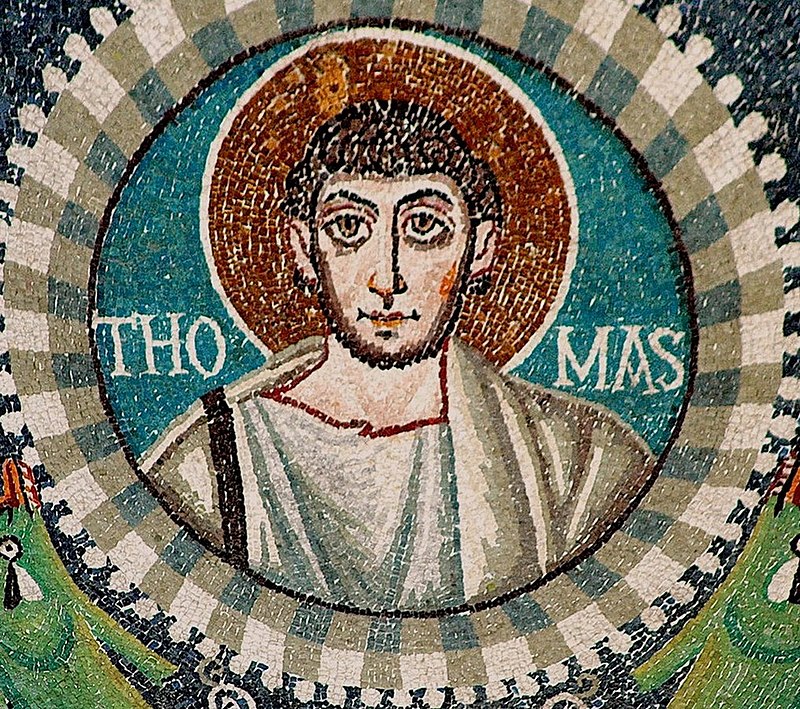
Thomas the Apostle
Apostle of Jesus Christ

Saint Stephen
Deacon, martyr, and saint

Philo of Alexandria
Philo of Alexandria (; ; ; ), also called '''''', was a Hellenistic Jewish philosopher who lived in Alexandria, in the Roman province of Egypt.

Barnabas
Barnabas (; ; ), born Joseph () or Joses (), was a prominent Christian disciple, identified as an apostle in Acts 14:14. According to Acts 4:36, he was a Cypriot Levite. He undertook missionary journeys as a companion of Paul the Apostle, evangelizing among the "God-fearing" Gentiles who attended synagogues in some of the Hellenized cities of Anatolia. He participated in the Council of Jerusalem ( AD).

Herod Antipas
1st century AD tetrarch of Galilee and Perea

James the Just
Jewish bishop of Jerusalem figure in Early Christianity

Joachim
Joachim was, according to Christian Sacred tradition, the husband of Saint Anne, the father of Mary and grandfather of Jesus. The story of Joachim and Anne first appears in the Gospel of James, part of the New Testament apocrypha. His feast day is 26 July, a date shared with Saint Anne.

Salome
Salome (; , related to , "peace"; ), also known as Salome III, was a Jewish princess, the daughter of Herod II and princess Herodias. She was granddaughter of Herod the Great and stepdaughter of Herod Antipas. She is known from the New Testament, where she is not named, and from an account by Josephus. In the New Testament, the stepdaughter of Herod Antipas demands and receives the head of John the Baptist. According to Josephus, she was first married to her uncle Philip the Tetrarch, after the death of which in AD 34, she married her cousin Aristobulus of Chalcis, thus becoming queen of

Agrippa I
King of Judaea (11 BC-44 AD) (r. 41-44 AD)

Simon Magus
religious figure who confronted Peter

Herod Archelaus
Ethnarch of Samaria/Judea/Idumea from 4 BC to 6 AD

Agrippa II
king of Chalcis (Syria) from Herodian dynasty (28-100)
.jpg)
Herodias
Herodias (; ; c. 15 BC – after AD 39) was a princess of the Herodian dynasty of Judaea during the time of the Roman Empire. Christian writings connect her with the execution of John the Baptist.

Berenice
1st century CE member of the Herodian Dynasty that ruled the Roman province of Judaea

Philip the Evangelist
Ancient Roman saint

Philip the Tetrarch
son of Herod the Great and ruler of the northeast part of his father's kingdom (r. 4 BCE-34 CE)
Judas of Galilee
1st-century Jewish revolutionary
Herod II
son of Herod the Great of Judea and Mariamne II (c. 27 BC - 33/34 AD)

Thusnelda
alt=|thumb|Thusnelda statue in Loggia dei Lanzi, Florence.
thumb|The Wife of Arminius Brought Captive to Germanicus by [[Benjamin West, 1773]]
thumb|Hermann and Thusnelda (Johann Heinrich Wilhelm Tischbein|Tischbein, 1822)
alt=|thumb|241x241px|Thusnelda at the Roman triumph|Triumph of Germanicus, by [[Karl von Piloty, 1873]]
thumb|Arminius says goodbye to Thusnelda, Johannes Gehrts (1884)
Thusnelda (; 10 BC – after AD 17) was a Germanic Cheruscan noblewoman who was captured by the Roman general Germanicus during his invasion of Germania. She was the wife of Arminius. Tacitus and Strabo cite he
Salome I
politician
Thaddeus of Edessa
Christian saint and one of the seventy disciples of Jesus
Herod of Chalcis
Roman client king of Chalcis in Iturea (ruled 41–48 AD)
Theudas
Theudas (; ; died ) was a Jewish rebel of the 1st century AD. Scholars attribute to his name a Greek etymology and according to Thayer, is a contraction of Theodore, and Hitchcock, for his part, says it means "flowing with water" , although with a Hellenist-styled ending. At some point between 44 and 46 CE, Theudas led his followers in a short-lived revolt.
Yde Girl
Iron Age bog body found in the Netherlands

Glaphyra
thumb|Glaphyra from Promptuarium Iconum Insigniorum|Promptuarii Iconum Insigniorum
Glaphyra (; ) was an Anatolian princess from Cappadocia, and a Queen of Mauretania by her second marriage to King Juba II of Mauretania. She was related to the Herodian dynasty by her first and third marriage, to Alexander, son of Herod and Herod Archelaus, respectively.
Simon bar Giora
leader of one of the major Judean rebel factions during the First Jewish–Roman War
Aristobulus of Chalcis
1st century AD King of Chalcis and Lesser Armenia
Jason of Thessalonica
Anatolian saint (Acts of the Apostles)

Veleda
thumb|Statue of Veleda by Laurent Marqueste ()
thumb|"Veleda, prophetess of the Germans," by Juan Scherr (1882)
Veleda () was a seeress of the Bructeri, a Germanic people who achieved some prominence during the Batavian rebellion of AD 69–70, headed by the Romanized Batavian chieftain Gaius Julius Civilis, when she correctly predicted the initial successes of the rebels against Roman legions.
Caecilius of Calacte
Greek critic and rhetorician during the reign of Augustus
Helena of Adiabene
1st century AD queen of Adiabene and consort of Abgar V, King of Osrhoene
Aristobulus Minor
1st century prince from the Herodian Dynasty
Iotapa
daughter of Artavasdes I of Media Atropatene
John of Giscala
Leader of the Jewish revolt against the Romans in the First Jewish-Roman War
Pseudo-Philo
Pseudo-Philo is the name commonly used for the unknown, anonymous author of the Biblical Antiquities. This text is also commonly known today under the Latin title Liber Antiquitatum Biblicarum (Book of Biblical Antiquities), a title that is not found in the Latin manuscripts. Although probably originally written in Hebrew, it is preserved today only through a Latin translation found in 18 complete and 3 fragmentary manuscripts that date between the eleventh and fifteenth centuries CE. In addition, material paralleling that in the Biblical Antiquities is also found in the Chronicles of Jerahmee
Menahem ben Judah
1st century CE Jewish Messiah claimant

Mary, mother of John Mark
Biblical character
Antiochis
The name Antiochis () is the female name of Antiochus.

Eunice
mother of Timothy
Jesus Justus
one of several Jewish Christians in the church at Rome (Epistle to the Colossians)
Marcus Julius Alexander
Alexandrian Jewish merchant (16-44 CE)
Eleazar ben Simon
Zealot leader during the First Jewish-Roman War
Ima Shalom
1st century CE wife of Eliezer ben Hurcanus, a Mishnaic sage, and sister of Rabban Gamaliel II
Julia Iotapa
Roman noblewoman, daughter of Antiochus III of Commagene
Lois
biblical figure mentioned in Timothy
Alexander
1st century AD Prince of Judea
Iotapa of Commagene
Queen of Commagene, daughter of king Mithridates III
Zenaida and Philonella
Eastern Orthodox saints
Athronges
thumb|Emmaus 1886
The Egyptian
messianic Jewish revolt leader
Monobaz II
1st century king of Adiabene
Phasaelis
first wife of Herod Antipas
Simon the Pharisee
Pharisee mentioned in the Gospel of Luke (Luke 7:36-50) as the host of a meal, who invited Jesus to eat in his house but failed to show him the usual marks of hospitality offered to visitors
Anilai and Asinai
1st century Babylonian Jewish chieftains
Cypros
wife of Herod Agrippa
Iotapa of Emesa
Queen of Emesa, daughter of Mithridates III, spouse of Sampsiceramus II
Berenice
member of the Herodian dynasty during the 1st century AD