Category
page 12nd-century Romans

Plutarch
Plutarch (; , Ploútarchos, ; before AD 50 – after 120) was a Greek and later Roman Middle Platonist philosopher, historian, biographer, essayist, and priest at the Temple of Apollo in Delphi. He is known primarily for his Parallel Lives, a series of biographies of illustrious Greeks and Romans, and Moralia, a collection of essays and speeches. Upon becoming a Roman citizen, he was possibly named Lucius Mestrius Plutarchus ().

Ptolemy
Claudius Ptolemy (; , ; ; – 160s/170s AD), better known mononymously as Ptolemy, was a Greco-Roman mathematician, astronomer, astrologer, geographer, and music theorist who wrote about a dozen scientific treatises, three of which were important to later Byzantine, Islamic, and Western European science. The first was his astronomical treatise now known as the Almagest, originally entitled '''' (, 'Mathematical Treatise'). The second is the Geography, which is a thorough discussion on maps and the geographic knowledge of the Greco-Roman world. The third is the astrological treatise in which he a

Epictetus
Epictetus ( ; , Epíktētos; 50 135 AD) was a Greek Stoic philosopher. He was born into slavery at Hierapolis, Phrygia (present-day Pamukkale, in western Turkey) and lived in Rome until his banishment, after which he spent the rest of his life in Nicopolis in northwestern Greece.

Lucian of Samosata
Lucian of Samosata (Λουκιανὸς ὁ Σαμοσατεύς, 125 – after 180) was a Hellenized Syrian satirist, rhetorician and pamphleteer who is best known for his characteristic tongue-in-cheek style, with which he frequently ridiculed philosophers and priests, speculative beliefs about the nature of the universe, religious practices, and superstitions. Although his native language was probably Syriac, all of his extant works are written entirely in ancient Greek (mostly in the Attic Greek dialect popular during the Second Sophistic period).

Apuleius
Apuleius ( ), also called Lucius Apuleius Madaurensis (c. 124 – after 170), was a Numidian Latin-language prose writer, Platonist philosopher and rhetorician. He was born in the Roman province of Numidia, in the Berber city of Madauros, modern-day M'Daourouch, Algeria. He studied Platonism in Athens, travelled to Italy, Asia Minor, and Egypt, and was an initiate in several cults or mysteries. The most famous incident in his life was when he was accused of using magic to gain the attentions (and fortune) of a wealthy widow. He declaimed his own defense before the proconsul and a court of magist
Tertullian
Tertullian (; ; 155 – 220 AD) was a prolific early Christian author from Carthage in the Roman province of Africa. He was the first Christian author to produce an extensive corpus of Latin Christian literature and was an early Christian apologist and a polemicist against heresy, including Gnosticism.

Pliny the Younger
Roman lawyer, author and magistrate (61 – c.113)

Juvenal
Decimus Junius Juvenalis (), known in English as Juvenal ( ; AD 55–128), was a Roman poet. He is the author of the Satires, a collection of satirical poems. The details of Juvenal's life are unclear, but references in his works to people from the late first and early second centuries suggest that he began writing no earlier than that time. One recent scholar argues that his first book was published in 100 or 101. A reference to a political figure dates his fifth and final surviving book to sometime after 127.

Suetonius
Gaius Suetonius Tranquillus (), commonly referred to as Suetonius ( ; – after AD 122), was a Roman historian who wrote during the early Imperial era of the Roman Empire. His most important surviving work is De vita Caesarum, commonly known in English as The Twelve Caesars, a set of biographies of 12 successive Roman rulers from Julius Caesar to Domitian. Other works by Suetonius concerned the daily life of Rome, politics, oratory, and the lives of famous writers, including poets, historians, and grammarians. A few of these books have partially survived, but many have been lost.

Martial
Marcus Valerius Martialis (known in English as Martial ; March, between 38 and 41 AD – between 102 and 104 AD) was a Roman and Celtiberian poet born in Bilbilis, Hispania (modern Spain), best known for his twelve books of Epigrams, published in Rome between AD 86 and 103, during the reigns of the emperors Domitian, Nerva and Trajan. In these poems he satirises city life and the scandalous activities of his acquaintances and romanticises his provincial upbringing. A total of 1,561 epigrams written by him have survived, of which 1,235 are in elegiac couplets.

Evaristus
5th Pope of the Catholic Church from c. 99 to c. 107

Alexander I
6th Pope of the Catholic Church from c. 107 to c. 115

Sixtus I
7th Pope of the Catholic Church

Eleuterus
bishop of Rome from c. 174 to 189
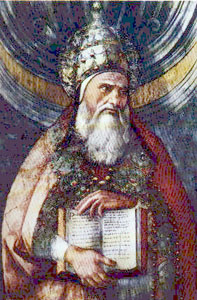
Pius I
pope

Telesphorus
Bishop of Rome from c. 126 to c. 137

Hyginus
Pope and Bishop of Rome from c.138 to c.142

Victor I
Pope and Bishop of Rome from 189 to 199

Anicetus
bishop of Rome from c. 157 to 168

Soter
twelfth pope of the Catholic Church

Zephyrinus
Pope and Bishop of Rome from 199 to 217

Macrinus
Marcus Opellius Macrinus (; – June 218) was a Roman emperor who reigned from April 217 to June 218, jointly with his young son Diadumenianus. Born in Caesarea (now called Cherchell, in modern Algeria), in the Roman province of Mauretania Caesariensis to an equestrian family of Berber origins, he became the first emperor who did not hail from the senatorial class and also the first emperor who never visited Rome during his reign. Before becoming emperor, Macrinus served under Emperor Caracalla as a praetorian prefect and dealt with Rome's civil affairs. He later conspired against Caracalla and
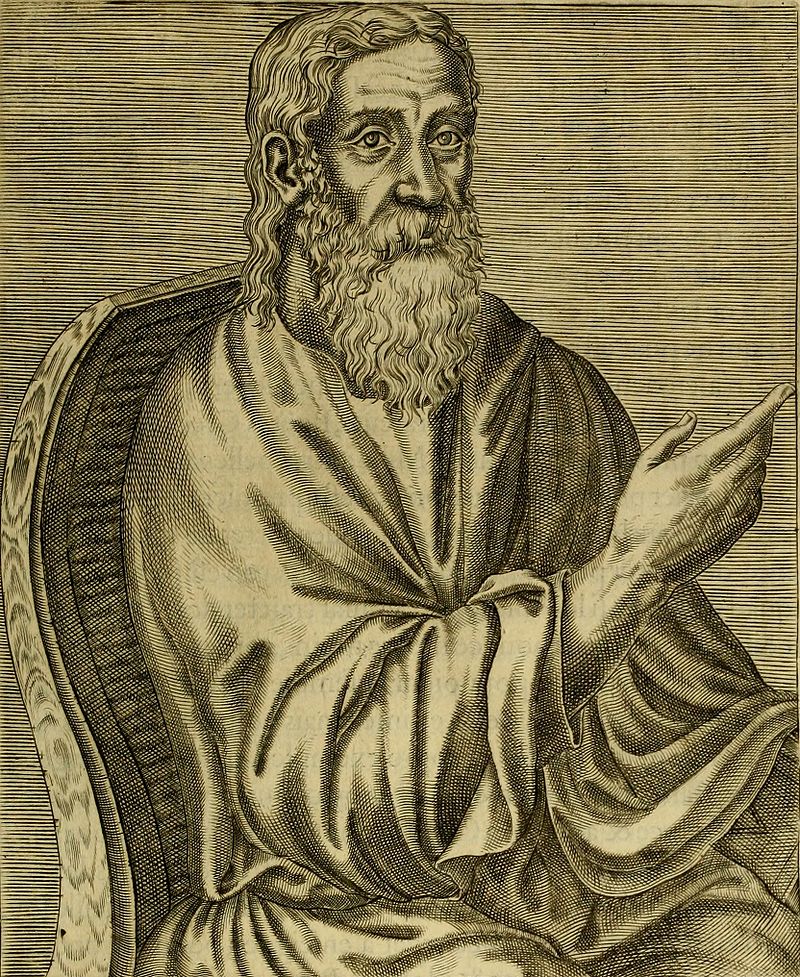
Clement of Alexandria
Christian theologian (c.150 – c.215)

Cassius Dio
Greco-Roman statesman and historian (c. 155–c. 235)

Irenaeus
Irenaeus ( or ; ; ) was a Greek bishop noted for his role in guiding and expanding Christian communities in the southern regions of present-day France and, more widely, for the development of Christian theology by opposing Gnostic interpretations of Christian Scripture and defending orthodoxy. Originating from Smyrna, he had seen and heard the preaching of Polycarp, who in turn was said to have heard John the Evangelist.
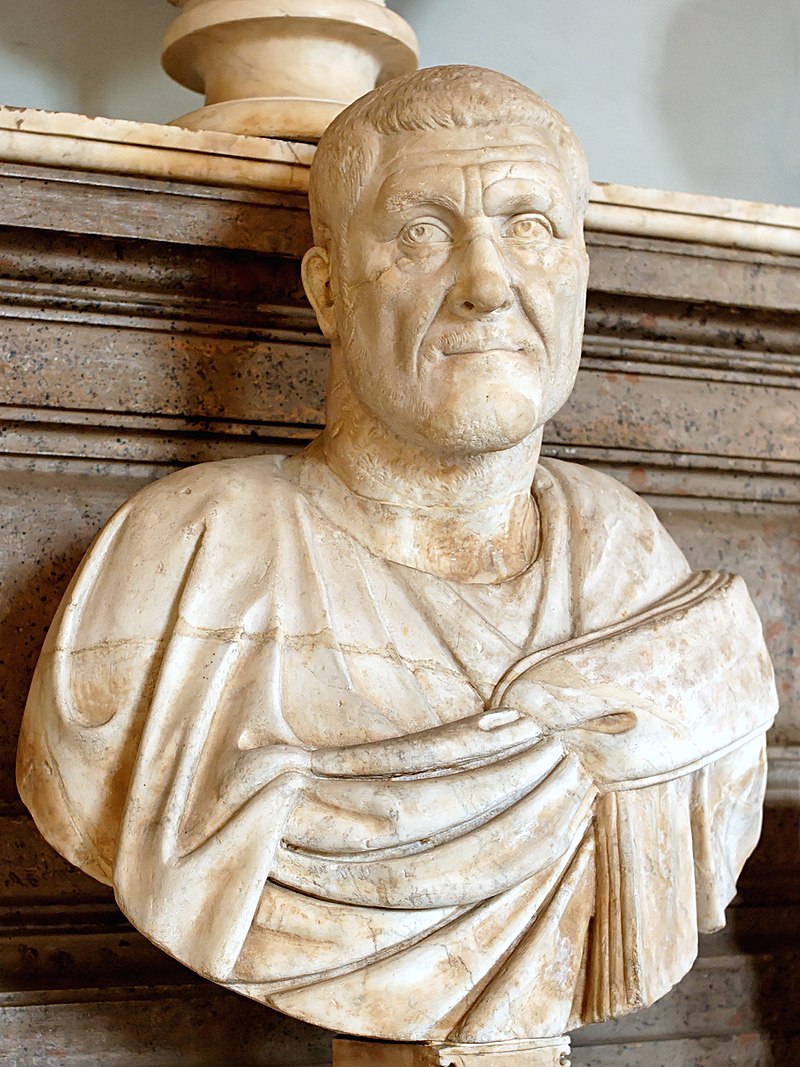
Maximinus Thrax
Roman Emperor (173-238)

Justin Martyr
2nd century CE Christian apologist and martyr

Appian
Appian of Alexandria (; ; ; ) was a Greek historian with Roman citizenship who prospered during the reigns of the Roman Emperors Trajan, Hadrian, and Antoninus Pius.
Arrian
Arrian of Nicomedia (; Greek: Arrianós; ; )

Hippolytus
Christian theologian and saint (c. 170 – c. 235)

Ulpian
Ulpian (; ; 223 or 228) was a Roman jurist born in Tyre in Roman Syria (modern Lebanon). He moved to Rome and rose to become considered one of the great legal authorities of his time. He was one of the five jurists upon whom decisions were to be based according to the Law of Citations of Valentinian III, and supplied the Justinian Digest about a third of its contents.

Aulus Gellius
2nd century Roman author and grammarian

Marcion of Sinope
Anatolian Christian theologian (c.85–c.160)

Justin
Roman historian, 2nd century

Tatian
Tatian of Adiabene, or Tatian the Syrian or Tatian the Assyrian, (; ; ; ; – ) was an Assyrian Christian writer and theologian of the 2nd century.

Aelian
Roman author and teacher (c.175–c.235)
Ammonius Saccas
Hellenistic Platonist philosopher (175-242)

Apollodorus of Damascus
2nd century Syrian Roman architect and engineer
.jpg)
Antinous
Antinous, also called Antinoös, (; ; – ) was a Greek youth from Bithynia, a favourite and lover of the Roman emperor Hadrian. Following his premature death before his 20th birthday, Antinous was deified on Hadrian's orders, being worshipped in both the Greek East and Latin West, sometimes as a god () and sometimes merely as a hero ().

Gaius
Roman jurist (2nd century AD)

Frontinus
Sextus Julius Frontinus (c. 40 – 103 AD) was a Roman civil engineer, author, soldier and senator of the late 1st century AD. He was a successful general under Domitian, commanding forces in Roman Britain, and on the Rhine and Danube frontiers. A novus homo, he was consul three times. Frontinus ably discharged several important administrative duties for Nerva and Trajan. However, he is best known to the post-Classical world as an author of technical treatises, especially De aquaeductu, dealing with the aqueducts of Rome.

Herodian
Herodian or Herodianus (), sometimes referred to as Herodian of Antioch (c. 170 – c. 240), was a minor Roman civil servant who wrote a colourful history in Greek titled History of the Empire from Marcus onwards (τῆς μετὰ Μάρκον βασιλείας ἱστορία) in eight books covering the years 180 to 238. His work is not considered entirely reliable, although his less biased account of Elagabalus may be more useful than that of Cassius Dio. The origin of Herodian is contested in scholarship, popular hypotheses being Syria, Alexandria in Egypt and Asia Minor. However, he appears to have lived for a considera

Dio Chrysostom
Greek orator, writer, philosopher and historian (c. 40 – c. 115)

Marcus Cornelius Fronto
2nd century Roman rhetorician and advocate

Papinian
Aemilius Papinianus (; ; 142 CE–212 CE), simply rendered as Papinian () in English, was a celebrated Roman jurist, magister libellorum, attorney general (advocatus fisci) and, after the death of Gaius Fulvius Plautianus in 205 CE, praetorian prefect.
.jpg)
Lucius Annaeus Florus
thumb|

Marcus Minucius Felix
Latin-language writer

Sextus Julius Africanus
Greco-Roman Christian traveller and historian (c.160–c.240)
%2C_inv._2210%2C_Roman_-_Braccio_Nuovo%2C_Museo_Chiaramonti_-_Vatican_Museums_-_DSC00897.jpg)
Philostratus
Philostratus or Lucius Flavius Philostratus (; ; 170s – 240s AD), called "the Athenian", was a Greek sophist of the Roman imperial period. His father was a minor sophist of the same name. He flourished during the reign of Septimius Severus (193–211) and died during that of Philip the Arab (244–249), probably in Tyre.

Julius Paulus
late 2nd/early 3rd century Roman jurist and possibly father of empress Julia Cornelia Paula
Valentinus
Egyptian gnostic theologian (c.100–c. 160)

Aelius Aristides
2nd century Greek rhetorician and author

Lucius Aelius Caesar
heir of the Roman Empire as the adopted son of Emperor Hadrian, and father of emperor Lucius Verus
Numenius of Apamea
2nd century Greco-Roman philosopher
Hegesippus
2nd century Christian saint and chronicler
Philo of Byblos
Greek author (c. 64 – 141)
Maximus of Tyre
2nd century Greek rhetorician and philosopher
Marinus of Tyre
Greek cartographer and mathematician (c.70–130)
Sextus Pompeius Festus
2nd century AD Roman grammarian
Vitalis of Milan
early Christian martyr and saint