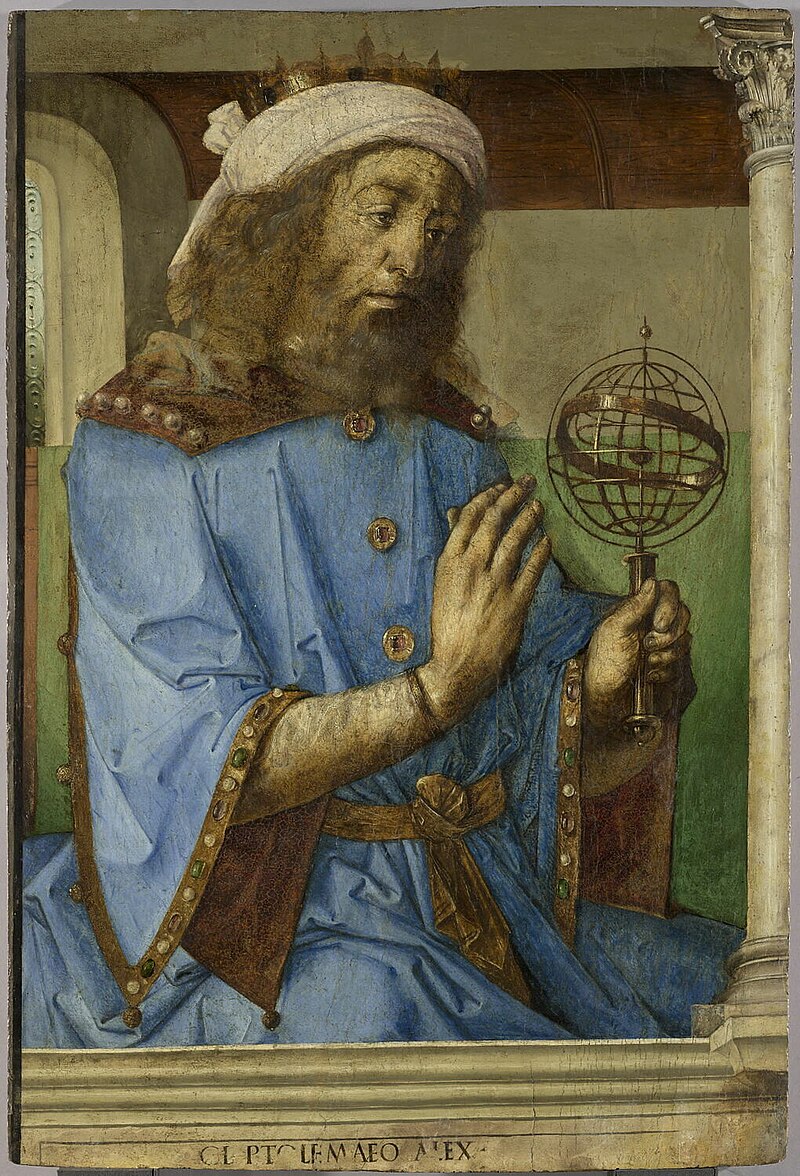
File:Ptolemy_1476_with_armillary_sphere_model.jpg · Wikimedia Commons · See Wikimedia Commons
Ptolemy
Sign in to saveAlso known as Claudius Ptolemaeus, Claudius Ptolemeus, Claudius Ptolemy, Klaudios Ptolemaios
Claudius Ptolemy (; , ; ; – 160s/170s AD), better known mononymously as Ptolemy, was a Greco-Roman mathematician, astronomer, astrologer, geographer, and music theorist who wrote about a dozen scientific treatises, three of which were important to later Byzantine, Islamic, and Western European science. The first was his astronomical treatise now known as the Almagest, originally entitled '''' (, 'Mathematical Treatise'). The second is the Geography, which is a thorough discussion on maps and the geographic knowledge of the Greco-Roman world. The third is the astrological treatise in which he a
OverviewAI-generated
Ptolemy, born Κλαύδιος Πτολεμαῖος in Ptolemais Hermiou during the 2nd century, was a male mathematician, geographer, astronomer, and astrologer of Ancient Rome. He wrote in Ancient Greek and was influenced by Aristotle. Ptolemy resided in Alexandria and worked at the Library of Alexandria. He died in Alexandria or Canopus around 178.
His notable works include the Almagest, Geography, Ptolemy's table of chords, and Ptolemy's inequality. Other writings listed are Cosmographia, Liber Quadripartiti Ptholomei, Opus geographię noviter castigatū & emaculatū additiōbus raris et invisis, Geōgraphikē hyphēgēsis, and Ptolemy's Tetrabiblos, or Quadripartite. His work appears in The Divine Comedy. Collections holding his works include the National Library of Wales and Het Scheepvaartmuseum.
Synthesized by Vinony from 30 facts across 5 sources: Wikidata, Open Library, MusicBrainz, Last.fm, Europeana Sparql. Generated from structured data (not the Wikipedia text) and checked against those facts — may still contain errors.
Person · Open Library
- Born
- 2nd cent.
- Died
- ca.178
- Works
- 131
Top works
- Cosmographia
- Liber Quadripartiti Ptholomei ...
- Opus geographię noviter castigatū & emaculatū additiōbus raris et invisis
- Geōgraphikē hyphēgēsis / Klaudios Ptolemaios = Geographia / Claudius Ptolemaeus
- Ptolemy's Tetrabiblos, or Quadripartite
via Open Library + Wikidata
Listeners · Last.fm
- Listeners
- 173
- Total plays
- 788
Tags
Similar artists
<a href="https://www.last.fm/music/Ptolemy">Read more on Last.fm</a>
Key facts
- Scientist.name
- Ptolemy
- Scientist.native_name
- Κλαύδιος Πτολεμαῖος
- Scientist.image
- Ptolemy 1476 with armillary sphere model.jpg
- Scientist.caption
- Portrait of Ptolemy by Justus van Gent or Pedro Berruguete (1476)
- Scientist.birth_date
- AD 100
- Scientist.birth_place
- Unknown
- Scientist.death_date
- 160s/170s
- Scientist.death_place
- Alexandria, Egypt, Roman Empire
- Scientist.citizenship
- possibly Roman
via Wikipedia infobox
Wikidata facts
- Instance of
- human
- Gender
- male
- Citizenship
- Ancient Rome
- Place of birth
- Ptolemais Hermiou
- Place of death
- Canopus
- Occupation
- writer
- Employer
- Library of Alexandria
- Languages spoken
- Ancient Greek
- Field of work
- music theory
- Image
- Claudio Ptolomeo.png
- Residence
- Alexandria
Show 19 more facts
- topic's main category
- Category:Ptolemy
- Commons gallery
- Κλαύδιος Πτολεμαῖος
- date of birth
- 0085-00-00
- date of death
- 0165-00-00
- Commons Creator page
- Ptolemy
- described by source
- Pauly–Wissowa
- influenced by
- Aristotle
- time period
- Roman Empire
- name in native language
- Κλαύδιος Πτολεμαῖος
- gens
- Claudia gens
- writing language
- Ancient Greek
- present in work
- The Divine Comedy
- has works in the collection
- Het Scheepvaartmuseum
- maintained by WikiProject
- WikiProject Mathematics
- birth name
- Κλαύδιος Πτολεμαῖος
- P12749
- Hanna Maron
- P13311
- Derval
- Commons category
- Ptolemy
Sources (6)
via Wikidata · CC0
Works in European collections
36 objects attributed to Ptolemy, held across European museums, libraries & archives · via Europeana

Ptolemaei magna

Ptolemaei Geographia

Claudius Ptolemaeus de sympragmatice ad Syrum

Ptolemaei De suppositionibus secundum errantes stellas

Ptolemaei

Ptolemaei

Theonis Expositio magnae Exis Ptolemaei

Claudii Ptolemaei Mathematica constructio

Ptolemaei tabulae

Claudii Ptolemaei Geographica

Ptolemaei Apotelesmata

Ptolemaei Geographia

Geographiae Ptolemaei lib. XI

Ptolemaei Geographica narratio
Guilielmi Blaeu Institutio Astronomica De usu Globorum & Sphaerarum Caelestium ac Terrestrium : Duabus partibus adornata, Una, secundum hypothesin Ptolemaei per terram quiescentem. Altera, juxta mentem N. Copernici per terram mobile... [Texto impreso]
Geografia Cioè Descrittione Uniuersale della Terra : Partita in due volumi, nel primo de’quali si contengono gli Otto Libri della Geografia
Procli Sphaera. Ptolemaei de Hypothesibus Planetarum liber singularis, nunc primum in lucem editus. Cuis accessit ejusdem Ptolemaei Canon Regnorum. Utrumque librum ex codicum M.S. collatione summa diligentia restituit, Latine reddidit, et Figuris illustravit Ioh. Bainbridge Med. Doctor, et Astronomiae in celeberrima Oxoniensi Academia Professor [Texto impreso]
Untitled
Untitled
Untitled
Untitled
Untitled

Untitled

Untitled

Untitled

Untitled

Untitled
Untitled
Untitled
Untitled
Untitled
Untitled
Untitled
Untitled
Untitled
Untitled
~32 min read
Encyclopedic overview
24 sectionsContents
- Biography
- Naming and nationality
- Astronomical writings
- ''Mathēmatikē Syntaxis''
- Modern reassessment
- ''Handy Tables''
- ''Planetary Hypotheses''
- Other astronomical works
- Other writings
- ''Geography''
- ''Tetrabiblos''
- ''Harmonics''
- Optics
- Philosophy
- Named after Ptolemy
- See also
- Notes
- Footnotes
- Citations
- Bibliography
- Works of Ptolemy
- References
- Further reading
- External links
Claudius Ptolemy (; , ; ; – 160s/170s AD), better known mononymously as Ptolemy, was a Greco-Roman mathematician, astronomer, astrologer, geographer, and music theorist who wrote about a dozen scientific treatises, three of which were important to later Byzantine, Islamic, and Western European science. The first was his astronomical treatise now known as the Almagest, originally entitled '''' (, 'Mathematical Treatise'). The second is the Geography, which is a thorough discussion on maps and the geographic knowledge of the Greco-Roman world. The third is the astrological treatise in which he attempted to adapt horoscopic astrology to the Aristotelian natural philosophy of his day. This is sometimes known as the '''' (, 'On the Effects') but more commonly known as the '''' (from the Koine Greek meaning 'four books'; ).
The Catholic Church promoted his work, which included the only mathematically sound geocentric model of the Solar System, and unlike most Greek mathematicians, Ptolemy's writings (foremost the Almagest) never ceased to be copied or commented upon, both in late antiquity and in the Middle Ages. However, it is likely that only a few truly mastered the mathematics necessary to understand his works, as evidenced particularly by the many abridged and watered-down introductions to Ptolemy's astronomy that were popular among the Arabs and Byzantines. His work on epicycles is now seen as a very complex theoretical model built in order to explain a false tenet based on faith.
Excerpted from Wikipedia’s “Ptolemy” article, available under the CC BY-SA 4.0 licence.
Gallery (22)
Available in 121 languages
- Español
- Français
- Deutsch
- 中文
- 日本語
- Русский
- Português
- Italiano
- العربية
- हिन्दी
- Afrikaans
- Albanian
- Albanian
- Amharic
- Aragonese
- Armenian
- Asturian
- Azerbaijani
Show 102 more
- Bahasa Indonesia
- Bangla
- Bashkir
- Basque
- be_x_old
- Belarusian
- Bikol
- Bosnian
- Breton
- Bulgarian
- Burmese
- Catalan
- cbk_zam
- Central Kurdish
- Croatian
- Czech
- Danish
- Egyptian Arabic
- Esperanto
- Estonian
- Extremaduran
- Filipino
- Finnish
- fiu_vro
- Galician
- Georgian
- Greek
- Haitian Creole
- Hebrew
- Hungarian
- Iban
- Icelandic
- Ido
- Interlingua
- Irish
- Javanese
- Kannada
- Kazakh
- kbp
- Kurdish
- Kyrgyz
- Latin
- Latvian
- Lingua Franca Nova
- Lithuanian
- Luxembourgish
- Macedonian
- Malagasy
- Malay
- Malayalam
- Marathi
- Mingrelian
- Moksha
- Mongolian
- Moroccan Arabic
- nds_nl
- Nederlands
- Northern Frisian
- Norwegian
- Norwegian Nynorsk
- Occitan
- Odia
- Pampanga
- Pashto
- Piedmontese
- Polski
- Punjabi
- rki
- roa_rup
- Romanian
- Rusyn
- Scots
- Scottish Gaelic
- Serbian
- Serbian (Latin)
- Sicilian
- simple
- Sindhi
- Slovak
- Slovenian
- Svenska
- Swahili
- Tajik
- Tamil
- Tatar
- Telugu
- Tiếng Việt
- Türkçe
- Ukrainian
- Urdu
- Uzbek
- Waray
- Welsh
- Western Frisian
- Western Panjabi
- Wu Chinese
- Yakut
- Zaza
- zh_yue
- فارسی
- ไทย
- 한국어
via Wikidata sitelinks · CC0