Category
page 16th-century BC Greek poets

Sappho
thumb|right|Kalpis painting of Sappho by the [[Sappho Painter ( 510BC)|alt=Vase painting of a woman holding a lyre.]]

Solon
Solon (; ; BC) was an archaic Athenian statesman, lawmaker, political philosopher, and poet. He was one of the Seven Sages of Greece and is credited with laying the foundations for Athenian democracy. Solon's efforts to legislate against political, economic and moral decline resulted in his constitutional reform overturning most of Draco's laws.

Xenophanes
Xenophanes of Colophon ( ; ; – c. 478 BC) was a Greek philosopher, theologian, poet, and critic of Homer. He was born in Ionia and travelled throughout the Greek-speaking world in early classical antiquity.

Anacreon
Anacreon ( BC) was an Ancient Greek lyric poet, notable for his drinking songs and erotic poems. Later Greeks included him in the canonical list of Nine Lyric Poets. Anacreon wrote all of his poetry in the ancient Ionic dialect. Like all early lyric poetry, it was composed to be sung or recited to the accompaniment of music, usually the lyre. Anacreon's poetry touched on universal themes of love, infatuation, disappointment, revelry, parties, festivals, and the observations of everyday people and life.

Alcaeus of Mytilene
thumb|Alcaeus and Sappho, Attic red-figure calathus, c. 470 BC, [[Staatliche Antikensammlungen (Inv. 2416)]]
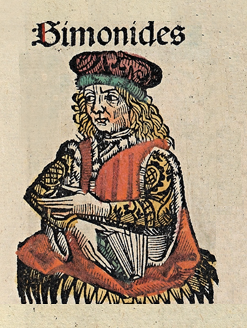
Simonides of Ceos
Greek lyric poet (c. 556–468 BC)

Theognis of Megara
Greek lyric poet active in approximately the sixth century BC

Cleobulus of Lindos
right|thumb|Cleobulus of Lindos
Cleobulus (; , Kleoboulos ho Lindios; fl. 6th century BC) was a Greek poet and a native of Lindos. He is one of the Seven Sages of Greece.

Stesichorus
upright=1.25|thumb|A scene from the Tabula Iliaca, bearing the inscription "Sack of Troy according to Stesichorus"
Stesichorus (; , Stēsichoros; c. 630 – 555 BC) was a Greek lyric poet native of Metauros (Gioia Tauro today). He is best known for telling epic stories in lyric metres, and for some ancient traditions about his life, such as his opposition to the tyrant Phalaris, and the blindness he is said to have incurred and cured by composing verses first insulting and then flattering to Helen of Troy.

Ibycus
Ibycus (; ; ) was an Ancient Greek lyric poet, a citizen of Rhegium in Magna Graecia, probably active at Samos during the reign of the tyrant Polycrates and numbered by the scholars of Hellenistic Alexandria in the canonical list of nine lyric poets. He was mainly remembered in antiquity for pederastic verses, but he also composed lyrical narratives on mythological themes in the manner of Stesichorus. His work survives today only as quotations by ancient scholars or recorded on fragments of papyrus recovered from archaeological sites in Egypt, yet his extant verses include what are considered

Arion
thumb|A musician riding a dolphin, on a Red-figure stamnos (360–340 BC) from Etruria. In this case the musician is an aulete rather than a kitharode, as he is playing the flute (aulos) rather than a kithara.thumb|Arion riding a Dolphin, by Albrecht Dürer (c. 1514)thumb|Arion on a Sea Horse, by William-Adolphe Bouguereau (1855)Arion (; ) was a kitharode in ancient Greece, a Dionysiac poet credited with inventing the dithyramb. The islanders of Lesbos claimed him as their native son, but Arion found a patron in Periander, tyrant of Corinth. Although notable for his musical inventions, Arion is c

Hipponax
thumb|200px|Hipponax from Guillaume Rouillé's Promptuarii Iconum Insigniorum (1553)
Hipponax (; ; gen. Ἱππώνακτος; ), of Ephesus and later Clazomenae, was an Ancient Greek iambic poet who composed verses depicting the vulgar side of life in Ionian society. He was celebrated by ancient authors for his malicious wit, especially for his attacks on some contemporary sculptors, Bupalus and Athenis. Hipponax was reputed to be physically deformed, which might have been inspired by the nature of his poetry.

Epimenides of Crete
thumb|200px|Epimenides of Knossos
Epimenides of Knossos (or Epimenides of Crete) (; ) was a semi-mythical 7th- or 6th-century BC Greek seer and philosopher-poet, from Knossos or Phaistos.
Phocylides
Phocylides (), Greek gnomic poet of Miletus, contemporary of Theognis of Megara, was born about 560 BC.
Phrynichus
late 6th/early 5th century BC Athenian playwright
Myrtis of Anthedon
ancient Greek poet
Onomacritus
Onomacritus (; c. 530 – c. 480 BC), also spelled Onomacritos and Onomakritos, was a Greek chresmologue, or compiler of oracles, who lived at the court of the tyrant Pisistratus in Athens and prepared an edition of the Homeric poems. He was a collector and forger of oracles and poems.
Cleobulina
Cleobulina (, 6th century BC) or Eumetis (Εὔμητις) was an ancient Greek poet. She was known for writing riddles, and three riddles attributed to her survive.
Lasus of Hermione
6th-century BC Greek lyric poet
Eugammon of Cyrene
ancient Greek poet
Demodocus of Leros
ancient Greek poet
Susarion
Susarion (Greek: Σουσαρίων) was an Archaic Greek comic poet, was a native of Tripodiscus in Megaris (see Megara) and is considered one of the originators of metrical comedy and, by others, he was considered the founder of Attic Comedy. Nothing of his work, however, survives except one iambic fragment (see below) and this is not from a comedy but instead seems to belong within the Iambus tradition.
Choerilus
ancient Athenian writer of tragedies
Cynaethus
Cynaethus or Cinaethus ( or Κίναιθος) of Chios was a rhapsode, a member of the Homeridae, sometimes said to have composed the Homeric Hymn to Apollo.
Ananius
Ananius () was a Greek iambic poet, contemporary with Hipponax (about 540 BCE). The invention of the satyric iambic verse called Scazon is ascribed to him as well as to Hipponax. Some fragments of Ananius are preserved by Athenaeus, and all that is known of him was collected by Friedrich Gottlieb Welcker in the 19th century.
Cyclic Poets
ancient Greek epic poets
Hybrias
Hybrias () (fl. 6th century BC) was a Cretan mercenary and lyric poet. He was the author of a highly esteemed skolion (drinking song) called the "Spear-song", which has been preserved by Athenaeus, Eustathius of Thessalonica, and the Analecta Veterum Poetarum Graecorum.
Kerkops
Cercops () was one of the oldest Orphic poets. He was called a Pythagorean by Clement of Alexandria who also states that Epigenes of Alexandria said that he was the author of an Orphic epic poem entitled the "Descent to Hades" and (English "Holy Discourse"), which seem to have been extant in the Alexandrian period. Others attribute the latter work to Prodicus of Samos, or Herodicus of Perinthus, or Orpheus of Camarina. According to Cicero, the Pythagoreans ascribe the Orphic poem to a certain Cercops.