Category
page 16th-century Byzantine writers

Maurice
Byzantine Emperor (539-602)

Cassiodorus
Magnus Aurelius Cassiodorus Senator (c. 485 – c. 585), commonly known as Cassiodorus (), was a Roman statesman, scholar, and writer who served in the administration of Theodoric the Great, king of the Ostrogoths. Senator was part of his surname, not his rank. In his later years, he devoted himself to Christian learning and founded the Vivarium monastery, where he worked extensively during the final decades of his life.

Agathias
Agathias Scholasticus (; 582/594) was a Byzantine poet and the principal historian of part of the reign of the Byzantine Emperor Justinian I between 552 and 558.

Pseudo-Dionysius the Areopagite
Greek philosopher
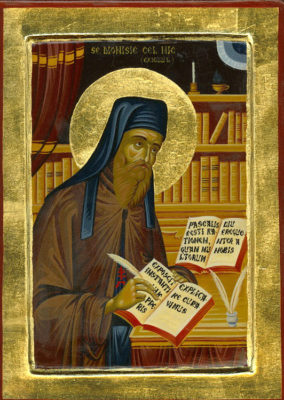
Dionysius Exiguus
Byzantine saint

Anthemius of Tralles
ancient Greek scientist and architect

Cosmas Indicopleustes
6th-century Greek traveller and merchant

Isidore of Miletus
Byzantine Greek architect
.jpg)
Damascius
Damascius (; ; 462 – after 538), known as "the last of the Athenian Neoplatonists", was the last scholarch of the neoplatonic Athenian school. He was one of the neoplatonic philosophers who left Athens after laws confirmed by emperor Justinian I forced the closure of the Athenian school in c. 529 AD. After he left Athens, he may have sought refuge in the court of the Persian King Chrosroes, before being allowed back into the Byzantine Empire. His surviving works consist of three commentaries on the works of Plato, and a metaphysical text entitled Difficulties and Solutions of First Princ

John Philoponus
Byzantine philologist and philosopher (c. 490–c. 570)
Simplicius of Cilicia
6th-century Greek pagan philosopher

Stephanus of Byzantium
6th-century Byzantine grammarian and geographer
Tribonian
Tribonian (Greek: Τριβωνιανός [trivonia'nos], – 542) was a jurist and advisor of the Eastern Roman Empire (Byzantine). During the reign of the Emperor Justinian I, he supervised the revision of the empire's legal code. He has been described as one of the wisest collaborators of Justinian.

Sophronius of Jerusalem
Patriarch of Jerusalem from 634 to 638

Priscian
thumb|270px|right|Priscian, or the Grammar, relief from the bell tower of Florence by [[Luca della Robbia]]
Priscianus Caesariensis (), commonly known as Priscian ( or ), was a Latin grammarian and the author of the Institutes of Grammar, which was the standard textbook for the study of Latin during the Middle Ages. It also provided the raw material for the field of speculative grammar.
Hesychius of Alexandria
5th/6th century Greek philologist and lexicographer
Ammonius Hermiae
5th-century Greek philosopher
Eutocius of Ascalon
Byzantine mathematician
Severus of Antioch
Patriarch of Antioch
Dorotheus of Gaza
ancient Greek monk
Aëtius of Amida
early 6th-century Byzantine physician
Alexander of Tralles
eminent ancient physician
Paul the Silentiary
Byzantine poet
Eutychius of Constantinople
Ecumenical Patriarch of Constantinople
Olympiodorus the Younger
Neoplatonist philosopher (c.495–570)
John of Ephesus
6th-century Byzantine historian

Corippus
thumb|De laudibus Iustini Augusti, published in Antwerp in 1581
Flavius Cresconius Corippus (floruit 565) was a Roman African epic poet who flourished under East Roman emperors Justinian I and Justin II. His major works are the epic poem Iohannis, a panegyric called "Panegyric of Anastasius", and a poem in praise of the Emperor Justin II, In laudem Iustini minoris. Corippus was probably the last important Latin author of Late Antiquity.
John Scholasticus
Patriarch of Constantinople
Maximianus of Ravenna
archbishop of Ravenna
John the Lydian
6th-century Byzantine administrator and antiquarian scholar
Philoxenus of Mabbug
Assyrian writer and theologian (died 523)
Procopius of Gaza
Byzantine sophist and rhetorician
Coluthus
Coluthus or Colluthus of Lycopolis (; ) was a Greek-Egyptian epic poet of the late Roman Empire who flourished during the reign of Anastasius I in the Thebaid.
Aristaenetus
Aristaenetus () was an ancient Greek epistolographer who flourished in the 5th or 6th century. Under his name, two books of love stories, in the form of letters, are extant; the subjects are borrowed from the erotic elegies of such Alexandrian writers as Callimachus, and the language is a patchwork of phrases from Plato, Lucian, Alciphron and others.
Eulogius of Alexandria
Egyptian saint
Hierocles
Byzantine grammarian, author of geographical work Synekdemos (6th century AD)
Dioscorus II of Alexandria
Coptic Orthodox Pope of Alexandria, Egypt
Victor of Tunnuna
priest and chronicler
Andreas of Caesarea
Greek theological writer; bishop of Caesarea
John of Cappadocia
Patriarch of Constantinople
Pope John II (III) of Alexandria
Egyptian saint and archbishop
Christodorus
Christodorus (), a Greek epic poet from Coptos in Egypt, flourished during the reign of Anastasius I (491–518). His father was named Paniskos (Πανίσκος).
Epiphanius of Constantinople
Patriarch of Constantinople
Anastasius I of Antioch
Greek Patriarch of Antioch
Leontios of Byzantium
Byzantine theologian
Ephraim of Antioch
Greek Orthodox Patriarch of Antioch
Secundus of Non
Longobard monk and historian
Sergius of Reshaina
Syriac writer
Fulgentius Ferrandus
6th century African Church theologian
Agapetus
deacon in Constantinople
Rhetorius
Rhetorius of Egypt () was the last major classical astrologer from whom we have any excerpts. He lived in the sixth or early seventh century, in the early Byzantine era. He wrote an extensive compendium in Greek of the techniques of the Hellenistic astrologers who preceded him, and is one of our best sources for the work of Antiochus of Athens. Although no intact original manuscript survives of his work, we do have several late Byzantine versions of it.
Facundus of Hermiane
Roman priest and theologian
Cassianus Bassus
writer on agriculture
Elias
ancient/early Medieval Greek philosopher
Primasius of Hadrumetum
bishop of Hadrumetum (6th century)
Junillus
Junillus Africanus (floruit 541–549) was Quaestor of the Sacred Palace (quaestor sacri palatii) in the court of the Byzantine Emperor Justinian I. He is best known for his work on biblical exegesis, Instituta regularia divinae legis. According to M.L.W. Laistner, Junillus' work was based on the writings of one of the teachers of the School of Nisibis, Paul the Persian, and because Paul had been influenced by the writings of Theodore of Mopsuestia, Junillus' Instituta helped make Western theologians familiar with the Antiochene school of exegesis.
Dorotheus
Byzantine lawyer
Macedonius of Thessalonica
Byzantine writer and poet
Timotheus of Gaza
6th century Greek author of a book on animals
Agapius
neo-Platonist philosopher