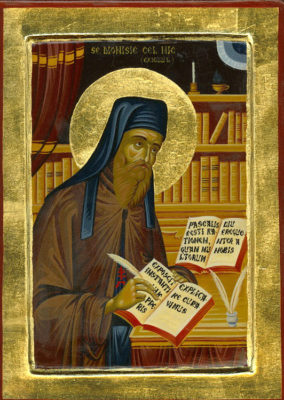
File:Dionysius_Exiguus.jpg · Wikimedia Commons · See Wikimedia Commons
OverviewAI-generated
Dionysius Exiguus was a male human born in 475 in Scythia Minor during the Roman Empire. He worked as a monk, mathematician, translator, and canon law jurist. He wrote in Latin and is recognized as a saint with a feast day on September 1.
His notable works include *D. Gregorii episcopi Nysseni De creatione hominis liber*, *supplementum Hexamer[o]n Basilii Magni fratris*, *Die Canonessammlung des Dionysius Exiguus in der ersten Redaktion*, *The exposition of Dionysius Syrus*, and *A clear and learned explication of the history of our blessed Saviour Jesus Christ*. He died in Rome around 540. He is described in the Brockhaus and Efron Encyclopedic Dictionary, Pauly–Wissowa, and the Encyclopædia Britannica 11th edition.
Synthesized by Vinony from 18 facts across 3 sources: Wikidata, Open Library, Europeana Sparql. Generated from structured data (not the Wikipedia text) and checked against those facts — may still contain errors.
Person · Open Library
- Died
- ca. 540
- Works
- 5
Top works
- D. Gregorii episcopi Nysseni De creatione hominis liber, supplementum Hexamer[o]n Basilii Magni fratris
- Die Canonessammlung des Dionysius Exiguus in der ersten Redaktion
- The exposition of Dionysius Syrus
- A clear and learned explication of the history of our blessed Saviour Jesus Christ
- The exposition of Dionysius Syrus
via Open Library + Wikidata
Key facts
- Born
- c. 470 , Scythia Minor , Eastern Roman Empire
- Died
- c. 544 (aged 73 or 74), Rome, Eastern Roman Empire
- Venerated in
- Eastern Orthodox Church
- Canonized
- 8 July 2008, Bucharest by the Synod of the Romanian Orthodox Church
- Feast
- 1 September (first day of the Byzantine liturgical year )
via Wikipedia infobox
Wikidata facts
- Instance of
- human
- Gender
- male
- Place of birth
- Scythia Minor
- Place of death
- Rome
- Occupation
- writer
- Languages spoken
- Latin
- Image
- Dionysius Exiguus.jpg
Show 9 more facts
- date of birth
- 0475-01-01
- date of death
- 0544-00-00
- canonization status
- saint
- time period
- Roman Empire
- described by source
- Encyclopædia Britannica 11th edition
- name in native language
- Dionysius Exiguus
- feast day
- September 1
- writing language
- Latin
- Commons category
- Dionysius Exiguus
via Wikidata · CC0
Works in European collections
7 objects attributed to Dionysius Exiguus, held across European museums, libraries & archives · via Europeana
Dionysii Exigui, Viventioli, Trojani, Pontiani, S. Caesarii arelatensis episcopi, fulgentii ferrandi et rustici quorum prior carthaginensis, posterior romanae ecclesiae diaconus, necnon Justi, Facundi, Urgellensis et Hermianensis episcoporum, opera omnia. juxta memoratissimas editiones Guillelmi Jani, Gallandii, Margarini de la Bigne, Lucae Holstenii, necnon Edmondi Martene accuratissime expressa, recensita et emendata. accurante J. P. Migne

Dionysius Exiguus: Corpus canonum - BSB Clm 29552(2
![Alkuin, De virtutibus et vitiis [u.a.] - Staatsbibliothek Bamberg Msc.Patr.2](https://api.europeana.eu/thumbnail/v2/url.json?uri=http%3A%2F%2Fdaten.digitale-sammlungen.de%2F~de%2F0014%2Fbsb00140788%2Fimages%2Fbsb00140788_00001.jpg&type=IMAGE)
Alkuin, De virtutibus et vitiis [u.a.] - Staatsbibliothek Bamberg Msc.Patr.2

Collectio canonum Dionysio-Hadriana - BSB Clm 14422

Dionysius Exiguus: Corpus canonum - BSB Clm 29552(1

Canonum collectio Dionysio-Hadriana - Staatsbibliothek Bamberg Msc.Can.3

Dionysii Exigui, Viventioli, Trojani, Pontiani, S. Caesaris Arelatensis episcopi, Fulgentii Ferrandi et Rustici quorum prior Carthaginensis, posterior Romanae ecclesiae diaconus, necnon Justi, Facundi, Urgellensis et Hermianensis episcoporum, opera omnia : juxta memoratissimas editiones Guillelmi Jani, Gallandii, Margarini de la Bigne, Lucae Holstenii, necnon Edmondi Martene accuratissime expressa, recensita et emendata
~22 min read
Encyclopedic overview
Dionysius Exiguus (Latin for "Dionysius the Humble"; Greek: Διονύσιος; c. 470 – c. 544) was a 6th-century Eastern Roman monk born in Scythia Minor and active in Rome. He was a member of a community of Scythian monks concentrated in Tomis (modern Constanța, Romania), the major city of Scythia Minor. Dionysius is best known as the inventor of Anno Domini (AD) dating, which is used to number the years of both the Gregorian calendar and the (Christianised) Julian calendar. Almost all churches adopted his computus for the dates of Easter.
From around the year 500 until his death, Dionysius lived in Rome. He translated 401 Church canons from Greek into Latin, including the Apostolic Canons and the decrees of the First Council of Nicaea, First Council of Constantinople, Council of Chalcedon, and Council of Sardica, and a collection of the decretals of the popes from Siricius to Anastasius II. These Collectiones canonum Dionysianae had great authority in the West, and they continue to guide church administrations. Dionysius also wrote a treatise on elementary mathematics.
Excerpted from Wikipedia’s “Dionysius Exiguus” article, available under the CC BY-SA 4.0 licence.