Category
page 19th-century establishments in Europe

feudalism
thumb|Investiture of a knight (miniature from the statutes of the Order of the Knot, founded in 1352 by [[Louis I of Naples)]]
thumb|Orava Castle in Slovakia. Medieval castles are a traditional symbol of a feudal society.
Feudalism, also known as the feudal system, was a combination of various customs and systems that flourished in medieval Europe from the 9th to 15th centuries. Broadly defined, it was a way of structuring society around relationships derived from the holding of land in exchange for service or labour.

Kievan Rus'
former federation of East Slavic tribes
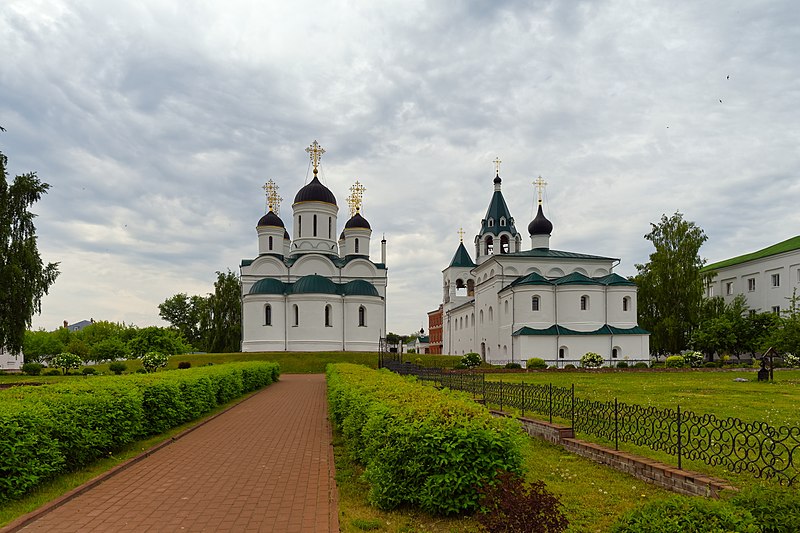
Murom
Murom (, ) is a historical city in Vladimir Oblast, Russia, which sprawls along the west bank of the Oka River. It borders Nizhny Novgorod Oblast and is situated from the administrative center Vladimir. Its population as of the 2021 Census was 107,497.

Kalisz
Kalisz () is a city in central Poland, and the second-largest city in the Greater Poland Voivodeship, with 97,905 residents (December 2021). It is the capital city of the Kalisz Region. Situated on the Prosna river in the southeastern part of Greater Poland, the city forms a conurbation with the nearby towns of Ostrów Wielkopolski and Nowe Skalmierzyce.

Kingdom of Navarre
Basque medieval kingdom that occupied lands on either side of the western Pyrenees, alongside the Atlantic Ocean (1162–1512)

Włocławek
Włocławek is a city in the Kuyavian–Pomeranian Voivodeship in central Poland along the Vistula River, bordered by the Gostynin-Włocławek Landscape Park. As of December 2021, the population of the city is 106,928.

West Francia
former kingdom (843–987)

Great Moravia
9th-century Slavic state

East Francia
country in Western Europe from 843 to 962; predecessor to the Kingdom of Germany

Middle Francia
former country

Bad Frankenhausen
spa town in the German state of Thuringia

Lotharingia
Lotharingia was a historical region and an early medieval polity that existed during the late Carolingian and early Ottonian era, from the middle of the 9th to the middle of the 10th century. It was established in 855 by the Treaty of Prüm as a distinct kingdom within the Carolingian Empire, but abolished already in 869-870 when it was divided by the Treaty of Meerssen. It was territorially reunited in 880 by the Treaty of Ribemont, and reestablished as a kingdom from 895 to 900. Since 903 it was organized as a duchy, which existed up to 959 or 965, when it was divided into two distinct duchie

Serbian Cyrillic alphabet
official script of Serbian language
Kingdom of Italy
(962 – 1801) constituent kingdom of the Holy Roman Empire
Treaty of Meerssen
treaty

Siculo-Arabic
Siculo-Arabic or Sicilian Arabic is a group of Arabic varieties that were spoken in the Emirate of Sicily from the 9th century, persisting under the subsequent Norman rule until the 13th century. However, only one dialect of Siculo-Arabic is still spoken: Maltese. Siculo-Arabic dialects descend from Arabic following the Abbasid conquest of Sicily in the 9th century and gradually marginalized following the Norman conquest in the 11th century.
Early Cyrillic alphabet
Slavic writing system developed in the 9th century in the First Bulgarian Empire

Zachlumia
Zachlumia or Zachumlia (, ), also Hum, was a medieval principality located in the modern-day regions of Herzegovina and southern Dalmatia (today parts of Bosnia and Herzegovina and Croatia, respectively). In some periods it was a fully independent or semi-independent South Slavic principality. It maintained relations with various foreign and neighbouring powers (Byzantine Empire, First Bulgarian Empire, Kingdom of Croatia, Principality of Serbia) and later was subjected (temporarily or for a longer period) to Kingdom of Hungary, Kingdom of Serbia, Kingdom of Bosnia, and at the end to the Ottom
Billung
The House of Billung was a dynasty of Saxon noblemen in the 9th through 12th centuries.