Category
page 1Abstract algebra
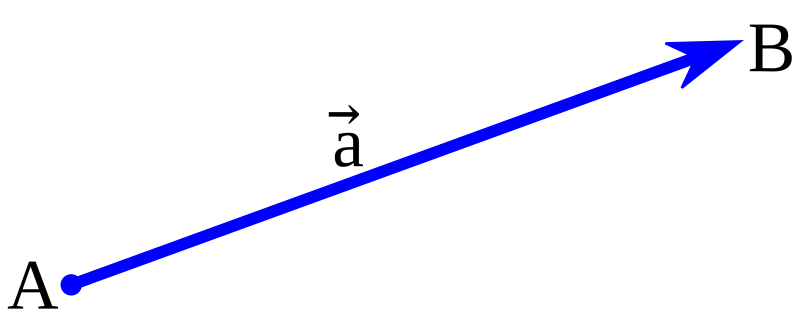
Euclidean vector
geometric object that has magnitude (or length) and direction

dimension
thumb|upright=1.2|From left to right: a square (geometry)|square, a [[cube and a tesseract. The square is two-dimensional (2D) and bounded by one-dimensional line segments; the cube is three-dimensional (3D) and bounded by two-dimensional squares; the tesseract is four-dimensional (4D) and bounded by three-dimensional cubes.
]]
[[File:Dimension levels.svg|thumb|upright=1.2| The first four spatial dimensions, represented in a two-dimensional picture.
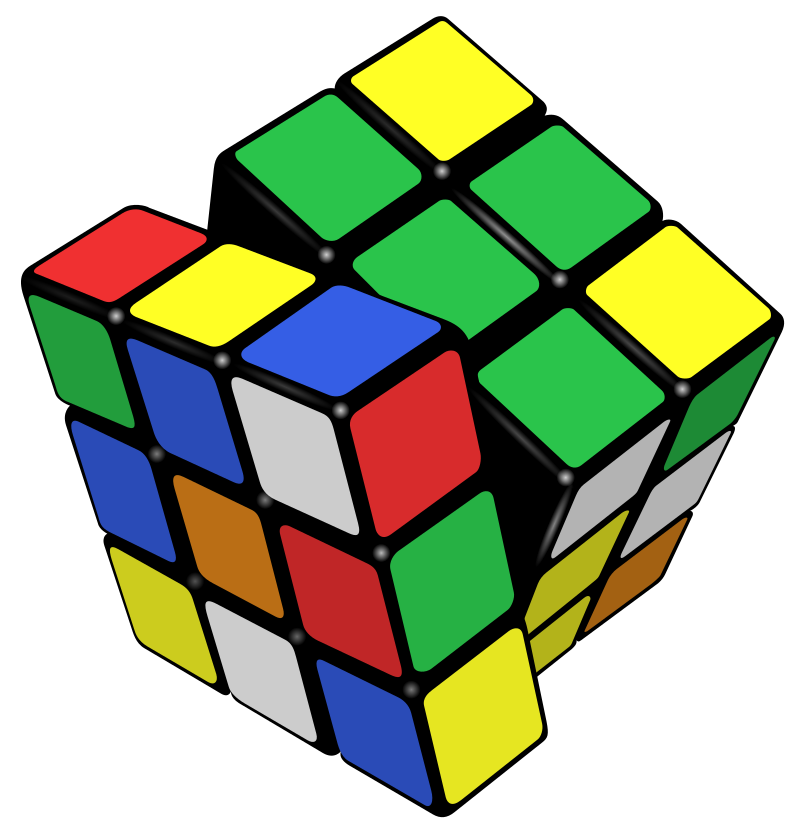
abstract algebra
branch of mathematics studying algebraic structures and their relations

field
commutative ring in which every nonzero element is inversible

multiplicative inverse
of a number x, 1 divided by x

linear map
mapping that preserves the operations of addition and scalar multiplication
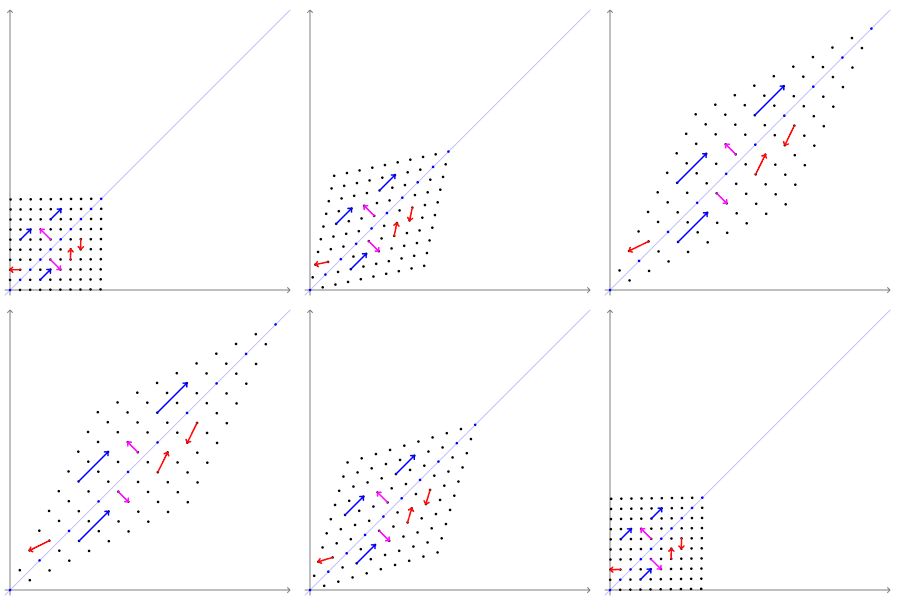
eigenvectors and eigenvalues
vectors that map to their scalar multiples, and the associated scalars
algebraic structure
set equipped with one or more finitary operations defined on it

cauchy sequence
sequence whose elements become arbitrarily close to each other

opposite number
number that, when added to the original number, yields zero

linear independence
property of a set of vectors of a vector space

mathematical expression
formula that represents a mathematical object

transpose matrix
thumb|200px|right|class=skin-invert-image|The transpose AT of a matrix A can be obtained by reflecting the elements along its main diagonal. Repeating the process on the transposed matrix returns the elements to their original position.
inverse element
element with an inverse with respect to a given mathematical operation; element that can 'undo' the effect of another given element
arity
In logic, mathematics, and computer science, arity () is the number of arguments or operands taken by a function, operation or relation. In mathematics, arity may also be called rank, but this word can have many other meanings. In logic and philosophy, arity may also be called adicity and degree. In linguistics, it is usually named valency.
closure
the smallest superset of a given set that is closed under a given operation

automorphism
thumb|right|400px|An w:Automorphism|automorphism of the Klein four-group shown as a mapping between two Cayley graphs, a permutation in cycle notation, and a mapping between two Cayley tables.
linear span
smallest vector subspace containing a given subspace
bilinear form
linear functional on tensor product square of a vector space
zero divisor
ring element such that can be multiplied by a non-zero element to equal 0
congruence relation
equivalence relation in algebra
general linear group
n x n invertible matrices over a ring
embedding
In mathematics, an embedding (or imbedding) is one instance of some mathematical structure contained within another instance, such as a group that is a subgroup.
formal power series
generalization of a polynomial, where the number of terms is allowed to be infinite, defined algebraically without consideration of convergence (so that e.g. evaluation is not always defined)
irreducible polynomial
irreducible element in the ring of polynomials; a non-constant polynomial that is not the product of two non-constant polynomials
commutator
In mathematics, the commutator gives an indication of the extent to which a certain binary operation fails to be commutative. There are different definitions used in group theory and ring theory.
additive identity
an element which, when added to any element x in the set, yields x
skew-Hermitian matrix
complex square matrix such that its its conjugate transpose is equal to its negative
direct product
generalization of the Cartesian product
centralizer
subgroup of a group G that each leaves invariant each element of a given subset of a G-set
center
concept used in algebra
polarization identity
row and column spaces
linear algebra
direct limit
colimit of a "directed family of objects"
inverse limit
construction to "glue together" mathematical objects along a downward-directed set

cokernel
The cokernel of a linear mapping of vector spaces is the quotient space of the codomain of by the image of . The dimension of the cokernel is called the corank of .

absorption law
theorem
multilinear form
filtration
indexed set of subobjects of an algebraic structure
formal derivative
operation on elements of a polynomial ring which mimics the form of the derivative from calculus
direct sum
operation in abstract algebra composing objects into "more complicated" objects
free object
a “generic” algebraic structure over the given set, fulfilling no other equations except those given by the defining axioms
absolutely convex set
convex and balanced set
cycle graph
graph, constructed for a group
absolute value
function which measures the "size" of elements in a field or integral domain
zero-product property
mathematical property shared by many number systems, that a product cannot be zero unless one of its factors is zero
operad
In mathematics, an operad is a structure that consists of abstract operations, each one having a fixed finite number of inputs (arguments) and one output, as well as a specification of how to compose these operations. Given an operad O, one defines an algebra over O to be a set together with concrete operations on this set that behave just like the abstract operations of O. For instance, there is a Lie operad L such that the algebras over L are precisely the Lie algebras; in a sense L abstractly encodes the operations that are common to all Lie algebras. An operad is to its algebras as a group
generator
element of a generating set, a subset of an algebraic structure that allows specifying all elements of the structure
coimage
In algebra, the coimage of a homomorphism
canonical basis
basis of an algebraic structure that is canonical in a sense that depends on the precise context
Light's associativity test
algorithm in mathematics
subquotient
In the mathematical fields of category theory and abstract algebra, a subquotient is a quotient object of a subobject. Subquotients are particularly important in abelian categories, and in group theory, where they are also known as sections, though this conflicts with a different meaning in category theory.