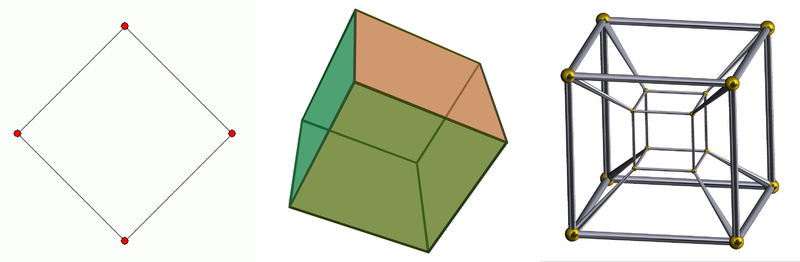
File:Squarecubetesseract.png · Wikimedia Commons · See Wikimedia Commons
dimension
Sign in to saveAlso known as dimensionality, number of dimensions
thumb|upright=1.2|From left to right: a square (geometry)|square, a [[cube and a tesseract. The square is two-dimensional (2D) and bounded by one-dimensional line segments; the cube is three-dimensional (3D) and bounded by two-dimensional squares; the tesseract is four-dimensional (4D) and bounded by three-dimensional cubes. ]] [[File:Dimension levels.svg|thumb|upright=1.2| The first four spatial dimensions, represented in a two-dimensional picture.
A dimension is a measurable direction or axis that describes space—for example, a flat square exists in two dimensions, a cube in three dimensions, and more complex shapes can exist in four or more dimensions. Dimensions matter because they provide a way to understand and describe the structure of objects, from the simple shapes we see around us to more abstract mathematical forms.
AI-generated from the Wikipedia summary — may contain errors.
Wikidata facts
- Instance of
- invariant
- Subclass of
- mathematical property
- Image
- Dimension levels.svg
Show 10 more facts
- described by source
- Encyclopædia Britannica 11th edition
- topic's main category
- Category:Dimension
- Commons gallery
- Dimension
- topic has template
- Template:Dimension topics
- Commons category
- Dimensions
- different from
- dimension of a vector space
- on focus list of Wikimedia project
- Wikipedia:Vital articles/Level/4
- counts
- relative direction
- maintained by WikiProject
- WikiProject Mathematics
- characteristic of
- space
via Wikidata · CC0
~22 min read
Encyclopedic overview
20 sectionsContents
- In mathematics
- Vector spaces
- Manifolds
- Complex dimension
- Varieties
- Krull dimension
- Topological spaces
- Hausdorff dimension
- Hilbert spaces
- In physics
- Spatial dimensions
- Time<!--'Temporal dimension' and 'Temporal dimensions' redirect here-->
- Additional dimensions
- In computer graphics and spatial data
- More dimensions
- List of topics by dimension
- See also
- References
- Further reading
- External links
thumb|upright=1.2|From left to right: a square (geometry)|square, a [[cube and a tesseract. The square is two-dimensional (2D) and bounded by one-dimensional line segments; the cube is three-dimensional (3D) and bounded by two-dimensional squares; the tesseract is four-dimensional (4D) and bounded by three-dimensional cubes. ]] thumb|upright=1.2| The first four spatial dimensions, represented in a two-dimensional picture.
In physics and mathematics, the dimension of a mathematical space (or object) is informally defined as the minimum number of coordinates needed to specify any point within it. Thus, a line has a dimension of one (1D) because only one coordinate is needed to specify a point on itfor example, the point at 5 on a number line. A surface, such as the boundary of a cylinder or sphere, has a dimension of two (2D) because two coordinates are needed to specify a point on itfor example, both a latitude and longitude are required to locate a point on the surface of a sphere. A two-dimensional Euclidean space is a two-dimensional space on the plane. The inside of a cube, a cylinder or a sphere is three-dimensional (3D) because three coordinates are needed to locate a point within these spaces.
Excerpted from Wikipedia’s “dimension” article, available under the CC BY-SA 4.0 licence.
Gallery (36)
Available in 88 languages
- Español
- Français
- Deutsch
- 中文
- 日本語
- Русский
- Português
- Italiano
- العربية
- हिन्दी
- Albanian
- Amharic
- Armenian
- Asturian
- Bahasa Indonesia
- Bangla
- Bashkir
- Basque
Show 69 more
- Belarusian
- Betawi
- Bulgarian
- Catalan
- Central Kurdish
- Chuvash
- Croatian
- Czech
- Danish
- Esperanto
- Estonian
- Filipino
- Finnish
- Galician
- Gan Chinese
- Georgian
- Greek
- Hebrew
- Hungarian
- Icelandic
- Ido
- Jamaican Creole English
- Kabyle
- Kannada
- Kazakh
- Latvian
- Lithuanian
- Luxembourgish
- Macedonian
- Malay
- Malayalam
- Marathi
- Minangkabau
- Nederlands
- Norwegian
- Norwegian Nynorsk
- Oromo
- Polski
- Punjabi
- Romanian
- Serbian
- Serbian (Latin)
- Shona
- Sicilian
- simple
- Sindhi
- Sinhala
- Slovenian
- Sundanese
- Svenska
- Swahili
- Tajik
- Tatar
- Tiếng Việt
- Türkçe
- Ukrainian
- Urdu
- Welsh
- Western Panjabi
- Wu Chinese
- Xhosa
- Yiddish
- zh_classical
- zh_min_nan
- zh_yue
- Zulu
- فارسی
- ไทย
- 한국어
via Wikidata sitelinks · CC0